in Story & News
FKI News

Korea-France Business Roundtable Held
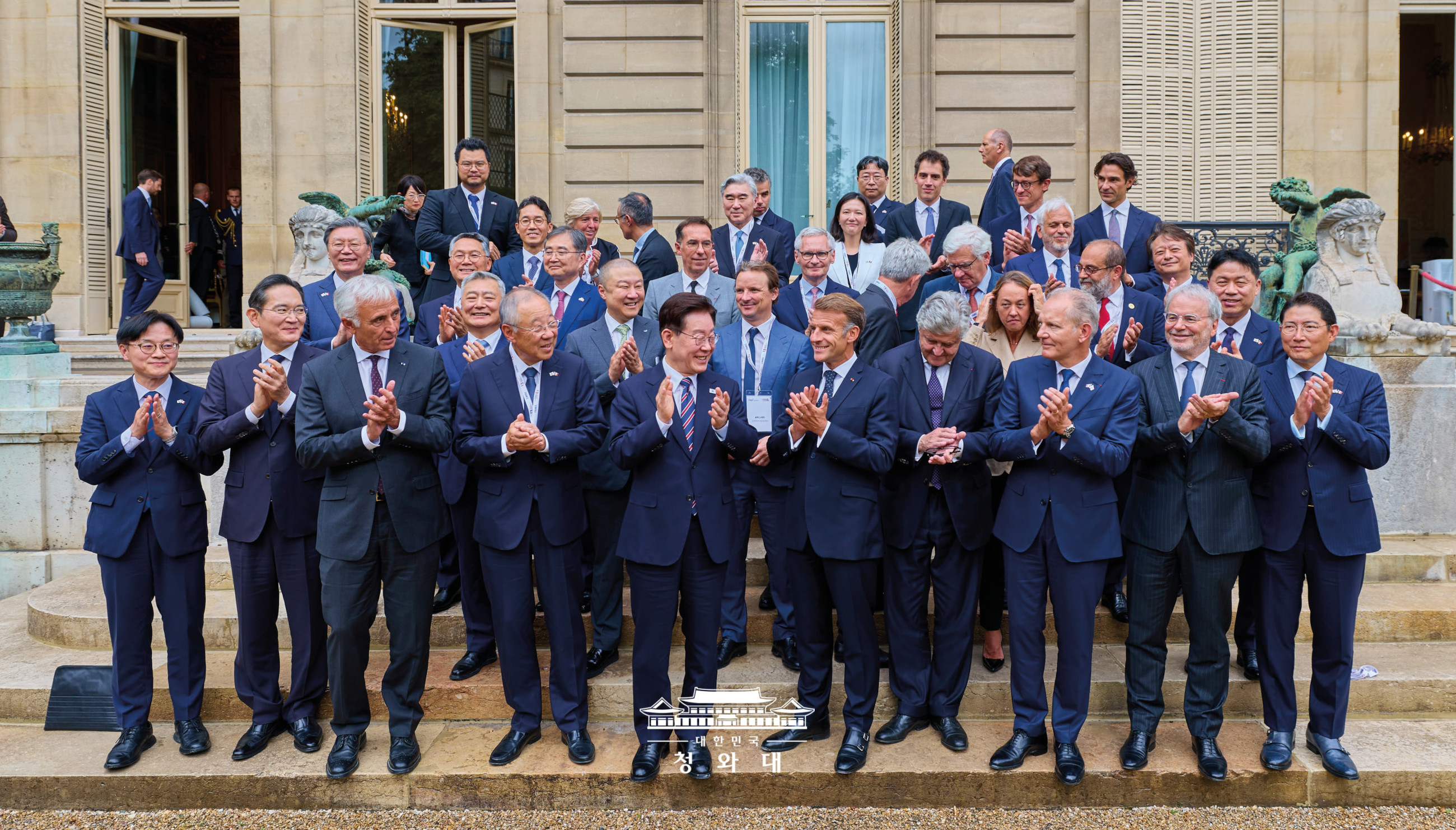
FKI co-hosted the Korea-France Business Roundtable with the Mouvement des Entreprises de France (MEDEF) at the Hôtel de Marigny in Paris on September 8 (local time). Held on the occasion of President Lee Jae Myung’s state visit to France, the event brought together 33 senior government officials and business leaders from both countries, including representatives from Samsung Electronics, LS, Hyosung, Air Liquide, and BNP Paribas.
Participants discussed ways to expand cooperation in advanced technologies such as AI and quantum technology, as well as energy and sustainable chemicals, decarbonized mobility, infrastructure and finance, and health and beauty. FKI Chairman Jin Roy Ryu said, “We look forward to broadening the horizons of economic cooperation by combining France’s scientific and technological capabilities and creativity with Korea’s advanced manufacturing and innovation capabilities.” The visit also led to agreements between Samsung Electronics and Mistral AI, COSMAX and L’Oréal, and Korea Hydro & Nuclear Power and Orano.
New K-Industry Forum Launched
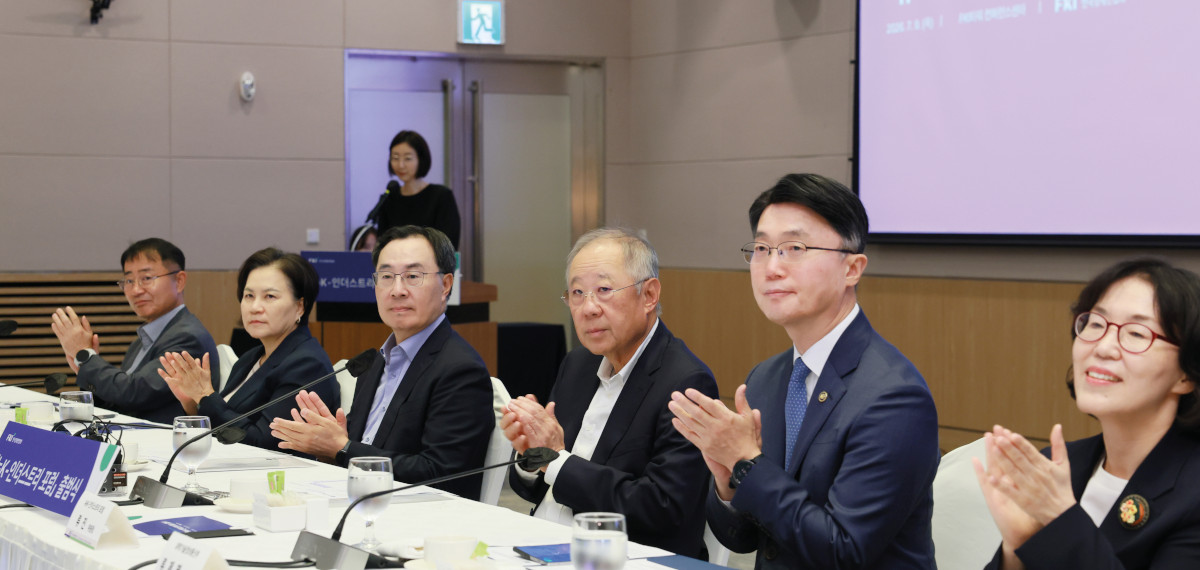
FKI held the launch ceremony for the New K-Industry Forum at the FKI Tower Conference Center on July 9 to explore strategies for Korea’s future industries. FKI Chairman Jin Roy Ryu, and former Minister of Trade, Industry and Energy Sung Wook Moon serve as co-chairs, with experts from government, industry, and academia participating as advisers.
New K-Industry is a future-oriented industrial strategy for redesigning Korea’s industrial structure and growth model based on a “3+1” innovation transformation framework that combines AI Transformation (AX), Green Transformation (GX), and Service Transformation (SX) with Infrastructure Transformation (IX). The forum plans to identify key challenges for industrial transformation, including energy, talent, regulation, and infrastructure, and develop a mid- to long-term roadmap that connects private-sector execution with government policy.
Korea-Italy Business Roundtable Held
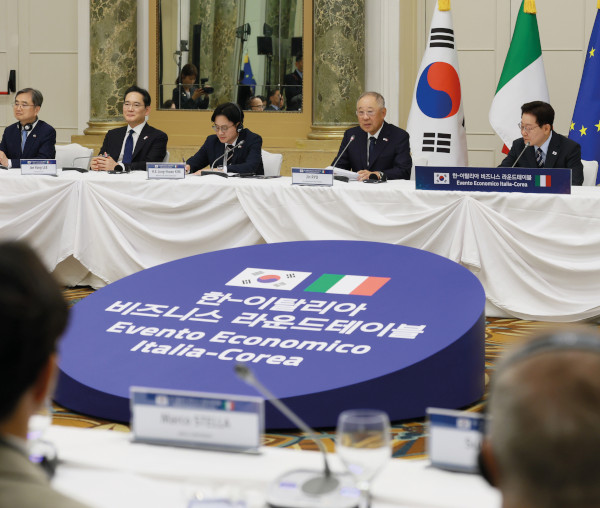
FKI co-hosted the Korea-Italy Business Roundtable with Confindustria in Rome, Italy, on June 12 (local time). Held on the occasion of President Lee Jae Myung’s state visit to Italy, the event brought together 42 senior government officials and business leaders from both countries, including representatives from Samsung Electronics, LS, Hyosung, Hyundai Motor, Ferrari, and Thales Alenia Space.
Participants agreed to expand partnerships across three key areas: strategic and advanced industries, energy and infrastructure, and bio and lifestyle. Proposed partnerships ranged from the establishment of production bases to technology transfer and joint development. Korea Aerospace Industries (KAI) shared plans for jointly entering global markets by combining the two countries’ satellite technologies, while LS presented its plans for cooperation in Europe’s energy transition based on its R&D center in Italy. In the bio and beauty sectors, participants discussed opportunities for cooperation, including Cureverse’s technology licensing and COSMAX’s establishment of local production facilities.
Korea-Brazil Business Roundtable Held
FKI co-hosted the Korea-Brazil Business Roundtable with ApexBrasil, Brazil’s trade and investment promotion agency, in São Paulo on July 28 (local time). Senior government officials and business leaders from companies including Hyundai Motor, POSCO, and Hanjin discussed ways to expand cooperation in manufacturing and infrastructure, advanced industries, and consumer goods and retail.
Participants explored opportunities to build supply chains for critical minerals such as rare earths, cooperate in AI, biotech, and aerospace, and expand the presence of K-beauty in the Latin American market. Immediately following the event, six MOUs were signed covering the food, aerospace, and biohealth sectors.
Seminar on “AI and the Future of Work” Held
FKI held a seminar titled “AI and the Future of Work: Structural Changes in the Labor Market and Strategic Responses” at the FKI Tower Conference Center on July 7. Participants noted that while AI is increasing productivity while reshaping job markets and the range of skills workers require, responses are needed to achieve both employment stability and higher productivity.
Stijn Broecke, senior economist at the OECD, said AI has the potential to increase annual labor productivity growth by up to 0.9%p over the next decade and emphasized the need to expand AI education and training. Experts identified restoring the “skills ladder” for young people, supporting AI technology development in areas facing labor shortages, and redesigning jobs alongside reskilling and upskilling as key priorities. They also emphasized using AI as a complementary technology that enhances worker productivity rather than simply as a means of replacing labor.
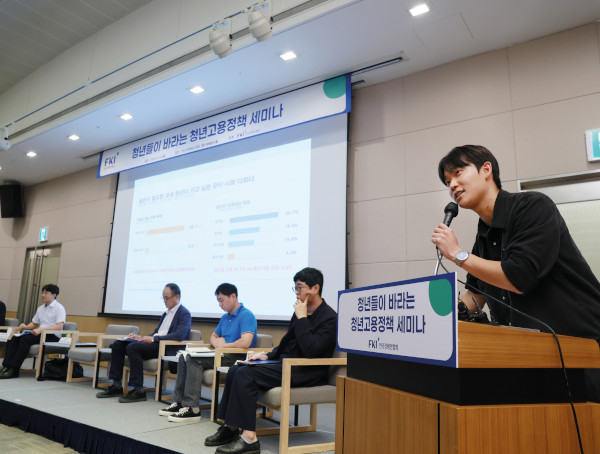
Seminar on “Youth Employment Policies Young People Want” Held
FKI held a seminar titled “Youth Employment Policies Young People Want” at the FKI Tower Conference Center on August 24. The event was the first in the “Youth With Jobs” series, which seeks solutions to youth employment challenges such as declining youth employment rates and delays in entering the workforce.
Participants emphasized that youth employment policies should focus not simply on increasing the number of jobs, but on creating a “growth ladder” that allows young people to build skills while working and move on to better opportunities. They also proposed reforming seniority-based pay systems, addressing the dual structure of the labor market, and creating a foundation for young people to participate as stakeholders in social dialogue. To expand youth employment opportunities in the AI era, participants also called for deregulation in new industries, greater labor market flexibility, and reforms to education and training systems based on industry needs.
Survey on Investment Plans of the Top 500 Companies for the Second Half of 2026
According to FKI’s survey of the top 500 companies by revenue regarding their investment plans for the second half of 2026, 79.2% of respondents plan to maintain investment at a level similar to that of the first half. Companies planning to increase investment accounted for 15.1%, higher than the 5.7% planning to reduce investment. Securing future growth engines, including AI and advanced industries, was cited as a major reason for increasing investment.
In terms of AI investment, spending aimed at improving productivity was prominent, including expanding the automation of business operations and production processes (43.7%) and strengthening R&D using AI (20.8%). In addition, 27.4% of companies are considering increasing investment outside the Seoul metropolitan area over the next three years, with fiscal support such as tax incentives and subsidies identified as the most needed measure to promote regional investment. Companies cited the easing of investment regulations, as well as greater interest rate stability and more favorable financing conditions as priorities for improving the domestic investment environment.
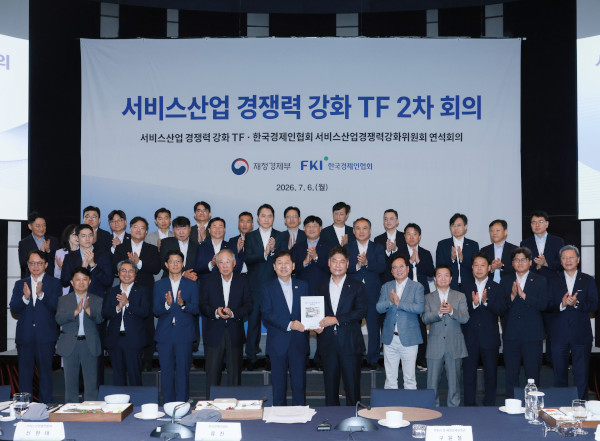
Second Meeting of the Service Industry Competitiveness Enhancement Task Force Held
FKI held a joint meeting of the government’s Service Industry Competitiveness Enhancement Task Force and FKI’s Service Industry Competitiveness Enhancement Committee at The Westin Josun Seoul on July 6. FKI Chairman Jin Roy Ryu emphasized the need to make the service industry a central pillar of Korea’s national growth strategy alongside manufacturing and called for the enactment of the Framework Act on the Development of the Service Industry.
FKI’s Service Industry Competitiveness Enhancement Committee proposed 20 policy measures, including enacting the Framework Act on the Development of the Service Industry, expanding financial support for K-content, expanding tax credits for post-production in the film and video industry, and improving standard terms and conditions governing contactless parcel delivery.
286th NAEK Forum Co-Hosted
FKI and the National Academy of Engineering of Korea (NAEK) jointly hosted the 286th NAEK Forum at the FKI Tower Conference Center on July 20 under the theme “New Growth Engines for Korea: New K-Industry.” Government, business, and academic experts discussed strategies for Korea’s future industries in response to the restructuring of the global industrial order and the growing competitiveness of Chinese manufacturing.
Chul Chung, FKI Chief Research Officer and President of the Korea Economic Research Institute, said that the AI era requires “Industrial Policy 3.0,” which transforms existing industrial systems, and explained the “3+1” innovation transformation framework combining AX, GX, and SX with IX. Participants emphasized the need to gain an early foothold in new industries and markets by building on innovation in institutions, talent, finance, and physical infrastructure.
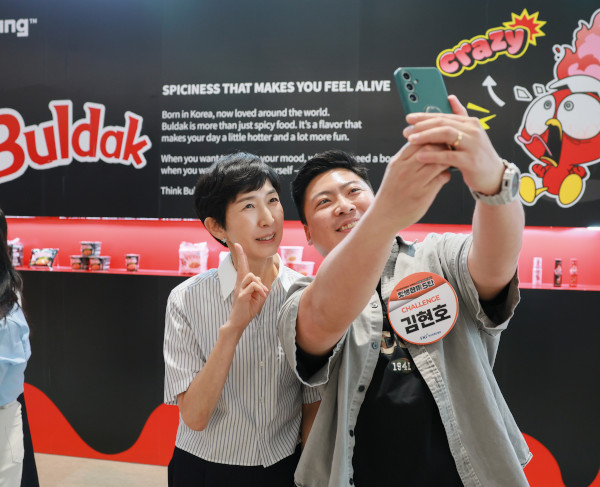
“Godsaeng Meal” with Samyang Foods Chairman Jung-soo Kim
FKI held the fifth “Godsaeng Meal” event with Samyang Foods Chairman Jung-soo Kim and 15 young people, including young entrepreneurs and startup founders, at the Samyang Roundsquare Building on June 24. “Godsaeng Meal” is FKI’s youth engagement program, in which young people communicate directly with business leaders and exchange experiences and insights.
Under the theme “Creating Change Through Challenge,” Chairman Kim shared the story of Buldak’s global growth and emphasized the importance of having the courage to act first rather than waiting for the perfect set of circumstances, as well as the importance of continually taking on challenges. She then shared a meal of ramen with the young participants and held an informal conversation about careers and growth, entrepreneurship, and entering global markets.
“The Plus Entrepreneurship” National Startup Project Launched
To mark its 65th anniversary, FKI is launching “The Plus Entrepreneurship,” a national entrepreneurship project aimed at revitalizing the private-sector startup ecosystem. The program expands FKI’s existing youth initiatives, which have focused on fostering entrepreneurship, to include identifying and nurturing prospective and early-stage entrepreneurs and helping them secure investment.
A total of 100 teams comprising prospective entrepreneurs and early-stage startups will be selected to receive 12 weeks of one-on-one consulting from former executives of major corporations, proof-of-concept (PoC) and open innovation opportunities, and business partnerships and investment connections with large and mid-sized companies. Companies in new industries such as AI, semiconductors, biotech, robotics, and advanced manufacturing that have been in operation for up to 10 years will also be eligible. FKI plans to leverage the business community’s experience and networks to expand collaboration between startups and large corporations and build a private-sector-led entrepreneurship ecosystem.
Seminar on “Shifts in the Global Order and Korea’s Challenges” Held
The Korea Economic Research Institute co-hosted a seminar titled “Shifts in the Global Order and Korea’s Challenges” with the Institute for Democracy and the Korean Association of Social Sciences at the FKI Tower Conference Center on June 18. Participants discussed economic, social, and diplomatic and security policy challenges in response to complex changes including the restructuring of the international order, slow growth, and widening inequality.
Participants called for a shift in the growth strategy from “Made in Korea” to “Innovated in Korea,” centered on innovative advanced products, along with regulatory reforms in the labor market as well as the service and investment industries. They also proposed the development of concrete policy instruments and delivery systems to realize “welfare for all.” In terms of diplomacy and security, participants suggested strengthening security cooperation with the United States and Japan while maintaining channels for strategic dialogue with China and Russia.
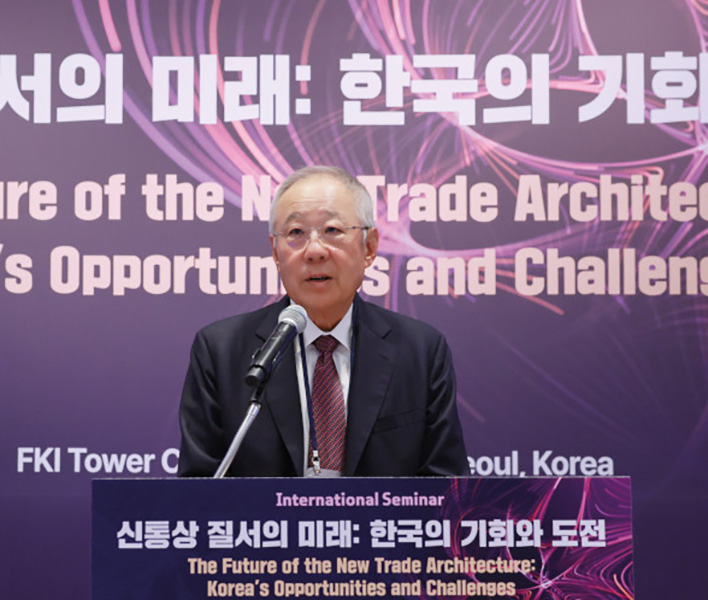
International Seminar on “The Future of the New Trade Architecture” Held
FKI jointly hosted the international seminar “The Future of the New Trade Architecture: Korea's Opportunities and Challenges” with the Korea Institute for International Economic Policy at the FKI Tower Conference Center on August 31. Participants suggested that Korea should pursue “selective partnerships” with like-minded countries in response to the weakening of the multilateral trading system, supply chain restructuring, and the spread of protectionism.
Deborah Elms, Head of Trade Policy at the Hinrich Foundation, emphasized that open plurilateral cooperation using existing frameworks such as the CPTPP could be a practical alternative. Jeffrey Schott, Senior Fellow at the Peterson Institute for International Economics, noted that trade between Korea and CPTPP members accounts for approximately 25% of Korea’s total merchandise trade and said an institutional framework is needed to comprehensively govern these existing trade relationships.
2026 Visionpreneur Camp Held
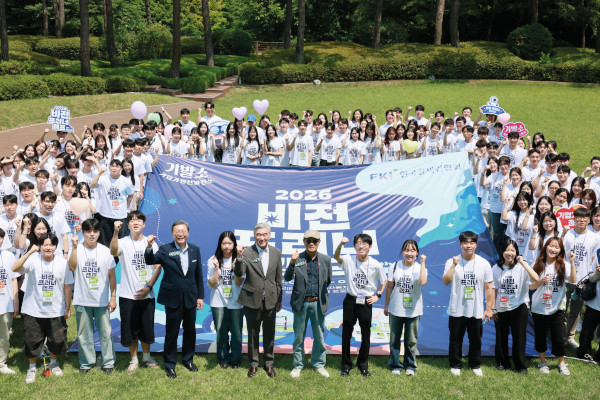
Between June 29 and July 1, FKI and Hyundai Motor jointly held “2026 Visionpreneur Camp: Hyundai Motorpreneur,” an entrepreneurship program for university students in Hwaseong, Gyeonggi Province. Now in its third year, the camp was designed to help students develop an entrepreneurial mindset by learning from examples of corporate challenge and innovation and undertaking projects connected to real-world industry.
Participants explored the entrepreneurial spirit of Hyundai Motor founder Chung Ju-yung and the history of the Hyundai Pony car, then developed their own business models based on Hyundai Motor’s future strategies, including software-defined mobility, electric vehicles, and purpose-built vehicles. The program also featured special lectures by Hyundai Motor executives, industry site visits, and networking opportunities among university students.