in Issue & Trend
Charting a New Power Course in the AI Era
HD Hyundai Heavy Industries’ HiMSEN Engine
As data centers rapidly proliferate with the growth of AI and cloud computing, securing a stable power supply is becoming increasingly important. Twenty-five years ago, HD Hyundai Heavy Industries took on the challenge of developing its own engines—the heart of a ship. Today, these engines, named HiMSEN, are expanding beyond marine applications into the power infrastructure of the AI era.
By Na-yeon Kim
Photo Credit HD Hyundai Heavy Industries
A Challenge for a Shipbuilding Powerhouse: Achieving Engine Technology Independence
The engine is a core component of a ship, responsible for both propulsion and onboard power supply. Achieving world-class competitiveness in shipbuilding requires expertise not only in building ships but also in design and manufacturing technologies for the key equipment and engines installed on them.
However, though Korea’s shipbuilding industry grew, engine manufacturing remained heavily dependent on foreign technology. HD Hyundai Heavy Industries began producing engines in 1979 through a technology partnership with a foreign company, but these engines were manufactured based on the designs and technologies of overseas engine makers. Even as the company designed and built its own ships and became more competitive globally, the engines installed on those ships continued to rely on foreign technology.
Dependence on foreign engine technology created various constraints across the business. The company had to pay royalties to overseas partners to manufacture engines, and its ability to make independent design changes to improve performance or reduce costs was limited. There were also limits to modifying engines to meet customers’ specific requirements. Producing engines using technology developed elsewhere was fundamentally different from mastering the principles of engine design and using that knowledge to improve its own products.
As the shipbuilding industry expanded in global markets and the types of vessels ordered and customer requirements became more diverse, the need for proprietary engine design technology grew. HD Hyundai Heavy Industries chose to develop its own engines rather than continue relying on foreign technology. In 1991, the company began full-scale development of a proprietary medium-speed engine, and after about a decade of research and development, it completed the Hyundai HiMSEN, a medium-speed engine developed using proprietary Korean technology, in August 2000. The following year, in 2001, it produced its first HiMSEN engine, taking its first step into an era of independently developed engines.
“Producing engines using technology developed elsewhere is fundamentally different from mastering the principles of engine design and using that knowledge to improve the company’s own products.”
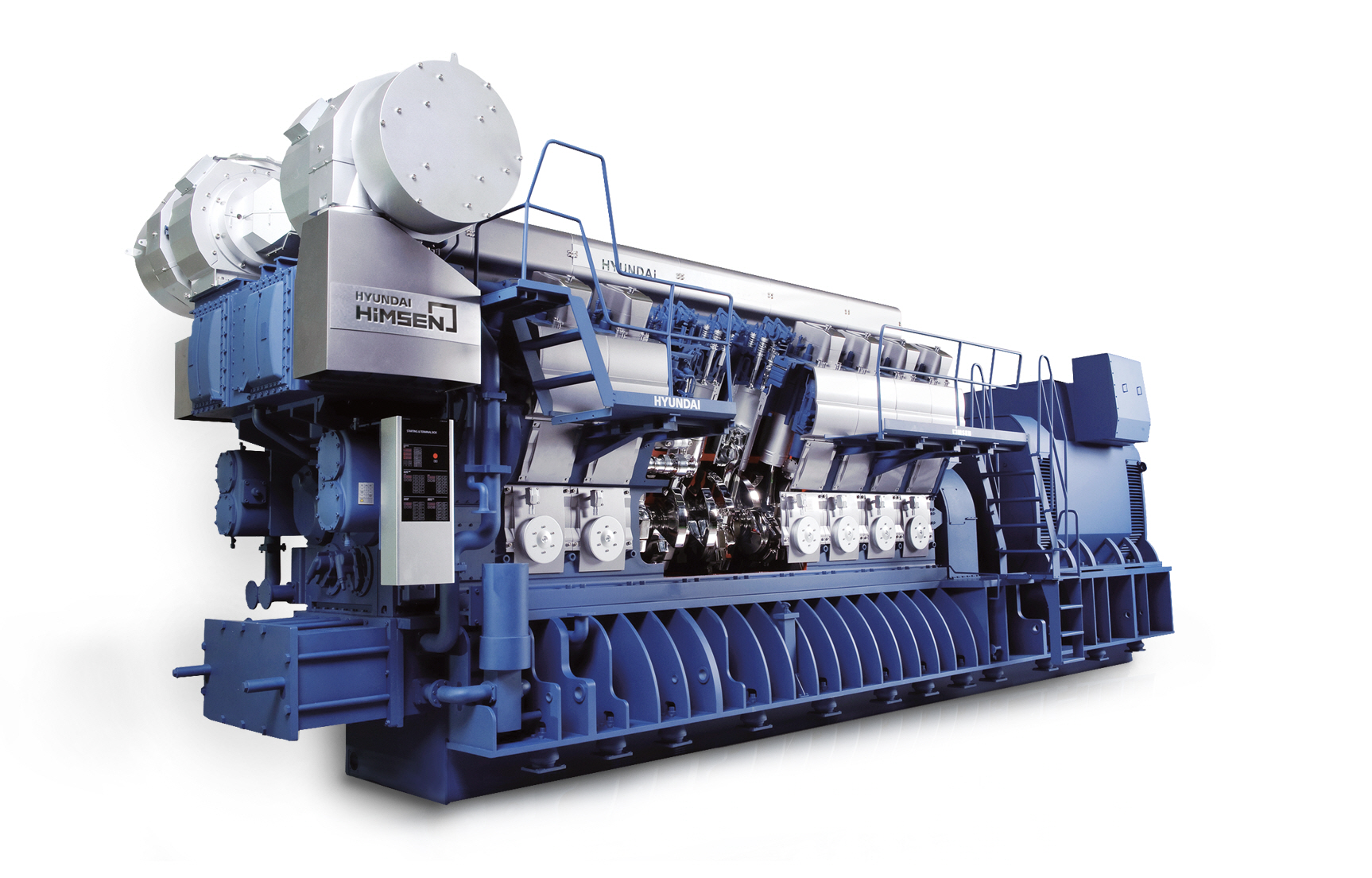 HD Hyundai Heavy Industries HiMSEN gas engine for stationary power generation
HiMSEN’s Competitive Edge: Designed With People in Mind
The name “HiMSEN” embodies the identity of the engine itself. It takes its name from the initials of “Hi-touch Marine & Stationary Engine,” meaning to an engine designed for both marine and stationary applications, while also referencing himsen, a Korean word meaning “strong” or “powerful.” By moving beyond engines manufactured using foreign technology and giving its independently developed product its own name, the company created a new brand.
In developing its own engine, HD Hyundai Heavy Industries set HiMSEN apart through a design that emphasized ease of handling and maintenance. The company incorporated the “Hi-touch” concept into the design, taking into account the convenience of both manufacturers and users. Pipes surrounding the exterior of the engine were eliminated, while key consumable components were positioned on the outside to make repairs, replacement, and cleaning easier. Cylinder heads were modularized, and the fuel injection and supply systems were simplified and modularized. The crankcase1 opening was also designed to be as wide as possible to facilitate maintenance work. The result was a simple, rational structure that improved not only manufacturing and assembly efficiency but also ease of after-sales service.
Environmental performance and power output were also taken into consideration. The engine was designed to produce emissions below the limits set by the International Maritime Organization (IMO) while delivering 200 kW per cylinder, enabling it to be used for both ship propulsion and power generation. HiMSEN’s distinguishing feature was that it incorporated not only proprietary technology but also input from actual production and operating environments into the product design.
The company’s proprietary technology also expanded beyond a single product into a broad lineup. HiMSEN engines range from 500 kW to a maximum output of 22,400 kW, encompassing engines powered by diesel and heavy fuel oil as well as gas and multi-fuel engines using LNG, methanol, and ammonia. Building on this product competitiveness, HiMSEN became the global leader in medium-speed engines, with 25% market share.
Production also grew rapidly. After beginning with four HiMSEN engines in 2001, cumulative production surpassed 5,000 units in 2011 and 10,000 units in 2016. An engine that began with the goal of securing proprietary technology grew into a global engine brand representing HD Hyundai Heavy Industries, supported by a diverse product lineup, strong market share, and an excellent track record of production.
- 1.Crankcase : The space inside an engine where the crankshaft rotates, providing access for inspection and maintenance.
HiMSEN Opens an Unexpected New Route
HiMSEN engines are primarily used in marine applications and for stationary power generation. At sea, they serve as propulsion systems for small and medium-sized vessels or as power generation engines for large vessels. Following the production of the first engine, HD Hyundai Heavy Industries expanded the use of HiMSEN engines in the generator sets of ships it built, further establishing their usage.
HiMSEN also made its mark early in the stationary power generation market. HD Hyundai Heavy Industries packaged HiMSEN engines for land-based power generation and incorporated them into Packaged Power Stations (PPS) and Diesel Power Plants, exporting them to Latin America, Southeast Asia, and other markets. The Cuban government, which used PPS installations to address chronic energy shortages, even featured a PPS on the back of its 10-peso banknote issued in 2007.
A new source of demand is now emerging rapidly in the stationary power generation sector. As generative AI and cloud services expand, large-scale data center investments are underway around the world. AI computing requires large numbers of servers and substantial computing infrastructure, which in turn require equally substantial amounts of electricity. For data centers where countless servers operate around the clock, power generation infrastructure capable of supplying large amounts of electricity reliably is essential.
HiMSEN’s applications are expanding into new markets as industry needs evolve. After expanding from marine engines into stationary power generation, HiMSEN is now finding applications in power generation systems intended to serve energy-intensive data centers. When HiMSEN was first developed around 2000, it would have been impossible to anticipate today’s AI data center market. More than two decades later, however, the proprietary engine technology developed back then is meeting the power demands of a new industry.
AI-Driven Power Demand Expands into U.S. Data Centers
The power demand created by the growth of AI data centers has already translated into large-scale contracts. In April 2026, HD Hyundai Heavy Industries signed a contract with U.S. energy infrastructure developer Aperion Energy Group (AEG) to supply power generation facilities with a total capacity of 684 MW based on 20 MW-class HiMSEN engines. The contract marked a significant step in bringing HiMSEN-based power generation facilities into the U.S. data center power market.
A second, larger contract followed just four months later. In August 2026, HD Hyundai Heavy Industries signed a contract with U.S. company Corban Energy Group to supply power generation facilities with a total capacity of 1,000 MW based on 9.6 MW-class HiMSEN engines. The power generation facilities will be used to supply electricity to data centers operated by major U.S. technology companies.
The successive large-scale contracts secured in the U.S. data center market within a short period show how HiMSEN’s range of applications is changing. Notably, the two contracts use HiMSEN engines in the 20 MW and 9.6 MW classes, respectively. The fact that the two contracts involve large-scale power generation facilities configured around engines with different output capacities also highlights HiMSEN’s potential to support a range of power generation configurations tailored to the size and power requirements of data centers.
More striking is the change in what the market demands of HiMSEN. While the development of the proprietary engine in the 1990s was driven by the pursuit of independence from foreign technology, HiMSEN is now responding to new power demand created by the rapid growth of the AI industry.
To respond to this changing market, HD Hyundai Heavy Industries plans to invest KRW 833.6 billion to build a new HiMSEN engine production facility in Onsan-eup, Ulju-gun, Ulsan, with an annual production capacity equivalent to 3 GW of engine output, while also upgrading its existing engine plant in Yeongam. These investments will bring the company's total annual production capacity for stationary power generation engines to 4 GW, with full-scale operations scheduled to begin in 2028. The investment is aimed at proactively responding to rapidly growing demand for power generation engines driven by AI data centers and accelerating the company’s expansion in the stationary power generation market. From ships to stationary power generation and now AI data centers, HiMSEN is expanding its production base in response to new sources of demand and preparing for another leap forward as a global engine brand.