
in Issue & Trend
The Trade War Will Not End
Even After Trump Leaves Office
Chad Bown, Senior Fellow, Peterson Institute for International Economics
Although Trump's tariff policies are shaking up the global trading system, Chad Bown argues that attention should be directed toward problems that will outlast the Trump administration. In an era when the concentration of production in a single country and dependence on its supply chains can be used as instruments of economic pressure, what should Korean companies be preparing for? Chad Bown, author of How to Win a Trade War, discusses the nature of the new trade war and the choices facing Korean companies.
By Na-yeon Kim
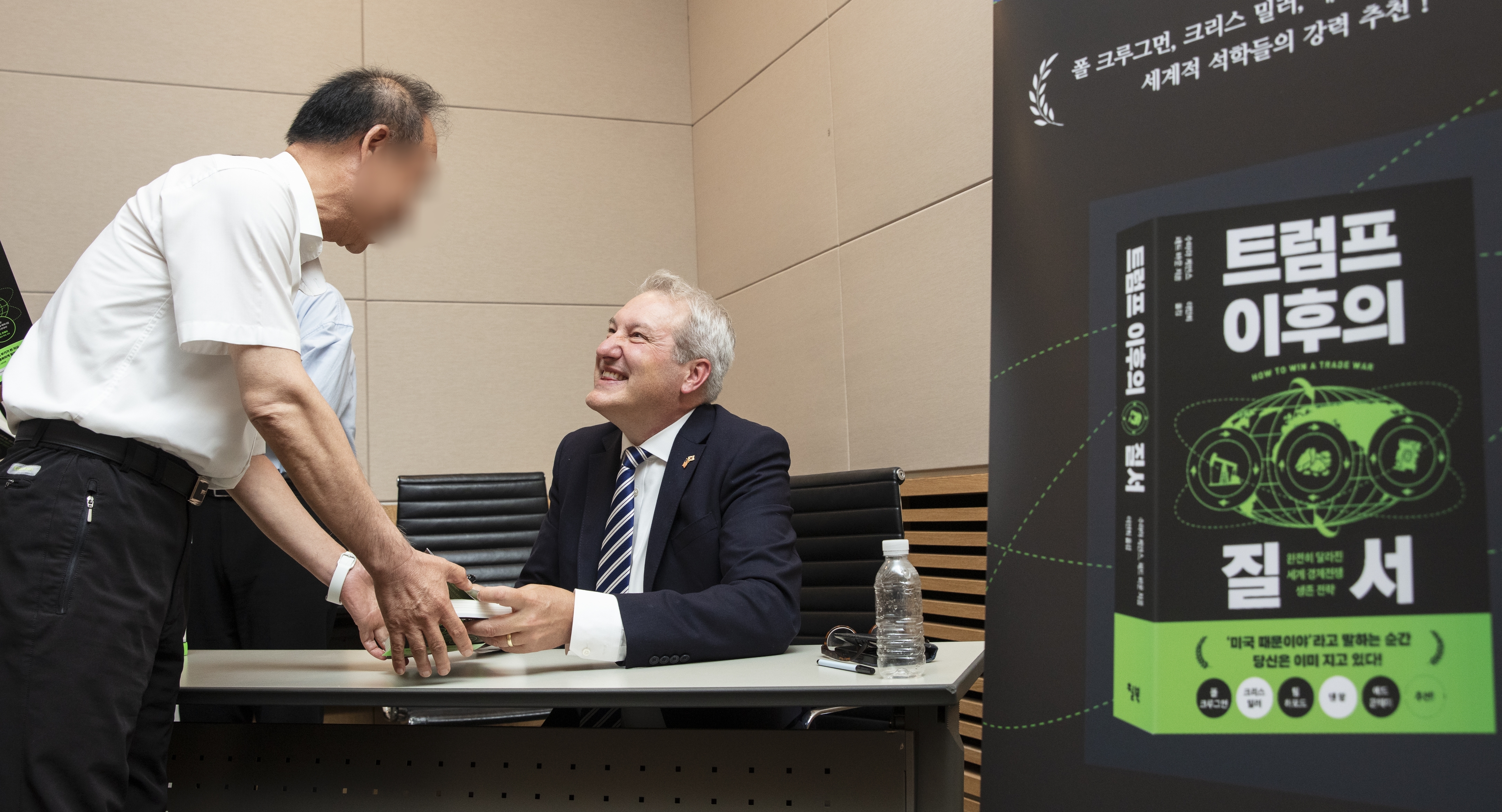
Photo Credit Gyu-chul Shin

Q. You recently published ‘How to Win a Trade War’. In the book, you emphasize that viewing current changes in the trading system solely in terms of Donald Trump risks missing a deeper fundamental issue. What is that issue?
A.
I would like to begin by explaining why I wrote this book. In a sense, it is intended to sound an alarm. At present, all attention is focused on President Donald Trump, but what I emphasize in the book is that the fundamental issue does not revolve around him. In fact, focusing too heavily on him can distract us from the issues that truly deserve our attention.
The deeper issue is China's relationship with the global economy. In the past, concerns centered mainly on problems such as China's non-market economic system and excess production capacity. Now, however, we need to pay closer attention to one-sided dependencies in supply chains.
China is building a system of supply chains that is not dependent on the rest of the world, but rather, the other way around. Other countries are dependent on China's supply chains. Such dependence can be weaponized. China accounts for a very large share of global production not only in steel, aluminum, and shipbuilding, but also in products that had previously received less attention, such as rare-earth permanent magnets. When China restricted permanent magnet exports in 2025, we saw that the entire global automotive industry could be significantly affected.
If one country has enormous market power in certain essential goods and can use that power as a means of economic pressure, it becomes difficult to maintain a properly functioning trading system. This is the essence of the trade war that we need to address now, and an issue that will persist even after President Trump leaves office. Even if the next U.S. administration reverses all the Trump administration's policies, China's growing market dominance in certain industries and its willingness and ability to weaponize that dominance would still remain.
Q. You have visited Korea several times and said that “few countries understand trade wars better than Korea.” At the same time, you have pointed out that even Korea did not actively bring WTO cases when China used subsidies to encroach on Korea's shipbuilding and battery industries. Why do you believe that a strategy of waiting for the rules-based system to be restored is no longer effective?
A.
I have studied the rules-based trading system for a long time and also worked at the WTO, and I understand not only the strengths of this system but also its limitations. The existence of rules alone is not enough. For a rules-based trading system to function in practice, members must comply with those rules and be willing to enforce them when violations occur.
Even when it became clear that China was not complying with rules concerning subsidies, industrial policy, and forced technology transfer, efforts to correct the situation were insufficient. The United States brought some WTO disputes, but that was not enough, and other countries did very little in practice. Korea was no exception. China rapidly strengthened its shipbuilding industry competitiveness through massive subsidies and actively utilized subsidies and local-content requirements in the battery industry. However, there was insufficient use of the WTO's dispute settlement procedures in response.
In light of this, simply waiting for a restoration of the rules-based trading system is unlikely to be a realistic solution. We need to recognize that the existing system has already failed to respond adequately to problems posed by China.
That does not mean that rules are unnecessary. To respond to new challenges such as China's industrial policies and supply chain concentration, we need to consider not only how to enforce existing rules but also what new approaches can be used to address problems that are difficult to manage under those rules.
Q. You have said that the first step toward winning a trade war is to “identify vulnerabilities and stockpile.” You also noted that Korean companies that had built up inventories in advance coped relatively well with last year's permanent magnet crisis. What should companies keep in mind when building up stockpiles to secure economic security?
A.
The first thing to do is accurately identify where the vulnerabilities lie. Companies need to determine which supply chains they depend on and whether those dependencies could be weaponized against them.
The next step is to build up defensive capacity. One of the most basic measures is stockpiling. When China restricted permanent magnet exports last year, not all companies were affected equally. It appears that Korean companies did a relatively good job of anticipating that this could become a problem. Some had built up inventories in advance and were therefore able to withstand the shock relatively well.
Of course, building up inventories and maintaining stockpiles entails costs, but these should now be considered necessary costs for safeguarding economic security. Through stockpiling, companies can buy time and withstand supply chain disruptions. Beyond that, companies will need to decide which products to stockpile, in what quantities, and how to rotate those inventories in line with actual industrial demand.
Q. You have said that, as countries seek alternative sources of supply to reduce their dependence on China, Korea could itself become an “alternative supplier.” What significance do Korea's strengths in areas such as HBM, shipbuilding, and batteries have in the emerging trading system?
A.
Creating alternative sources of supply is not as simple as it may seem. When one country has overwhelming dominance in a particular product or industry, efforts by other countries to develop new sources of supply may prompt the dominant country to flood the global market. Such a move can sharply lower prices and undermine profitability, ultimately eliminating incentives for long-term investment. In such circumstances, it is difficult to build a stable alternative supply chain by relying on the market alone.
That is why the government's role is important. For strategically important industries, governments need to consider supporting prices at a certain level so that companies can withstand periods of falling prices. In some cases, states may even choose to take direct equity stakes in certain companies.
Korea, however, has an important strength in this regard. When countries seeking to reduce their dependence on China look for new sources of supply, Korea is often seen as an alternative.
For example, two of the world's three major producers of high-bandwidth memory, or HBM, which is essential for AI, are Korean companies. In shipbuilding, Korea is one of the few countries outside China capable of supplying ships competitively. Korean companies also occupy an important position in global battery supply chains.
Countries are diversifying their supply chains out of concern that China could weaponize their dependence on Chinese supplies. For Korea, this shift ultimately presents opportunities as well as risks. Korea could gain access to new markets and investment opportunities by becoming the alternative supplier that other countries need.
Q. Cooperation among middle powers, such as through the CPTPP, has been discussed as a potential new solution. Do you think cooperation among middle powers alone can address the weaponization of supply chains? You have also said that there are lessons to be learned from China in designing new industrial and trade policies. Could you elaborate?
A.
I strongly agree with the general direction of cooperation among middle powers. Agreements such as the CPTPP can help middle powers reduce trade barriers among members, secure new export markets, and expand alternative markets when access to the U.S. market becomes more difficult. If member countries could also coordinate their tariff and subsidy policies toward countries of concern, such cooperation could play a much greater role.
However, it is difficult to say that cooperation among middle powers alone could solve the issue of supply chain weaponization. It is important to build actual alternative sources of supply, which may require the use of instruments such as tariffs and industrial policy.
When designing new industrial and trade policies, countries should study China's experience. China has made extensive use of policy instruments such as stockpiling, subsidies, and export and import restrictions. In China, protectionist policies and subsidies exist alongside intense competition among companies. Chinese companies face strong pressure to compete and innovate, while subsidies can help them withstand periods of deteriorating profitability. This structure has, in some cases, produced technologically advanced products capable of competing in global markets.
Of course, that does not mean we should simply follow China's system. The point is that we need to understand how China has become a technological leader in a number of industries.
Chinese state-owned enterprises are not necessarily focused solely on profit maximization. They may pursue other objectives, such as maintaining employment, safeguarding national security, and expanding market share. This kind of system is difficult to address adequately using only traditional trade remedies such as antidumping measures, safeguards, and countervailing duties. We therefore need to reconsider what problems we are actually facing and think about suitable new policy instruments.
Q. Finally, what is the most important message you would like to convey to readers through ‘How to Win a Trade War?’ How would you like this discussion to develop?
A.
One clear message I wish to convey through the book is that economists and trade experts need to approach the issue from a somewhat different perspective than before.
When advising government policymakers, I have felt that there is still insufficient economic analysis being undertaken when making decisions on emerging policy questions, including on stockpiling, subsidies, and export and import restrictions. This is why I would like to see economists and trade experts engage more actively with practical policy challenges. We need more analysis on how these instruments work, what effects they have, and what unintended consequences they may produce.
We have discussed some rather serious issues today, but the book has plenty of lighthearted moments. I hope you won't think of it as being too heavy. (Laughs)