
in Focus
「Survey on AI Transformation (AX) Among PartnerCompanies: Progress and Barriers to Wider Adoption」
Supply Chain AX at the Threshold
of Widespread Adoption
AI transformation (AX)1 in manufacturing is expanding in scope beyond individual companies to encompass entire supply chains. According to FKI's Survey on the Status and Challenges of AI Transformation (AX) Among Partner Companies targeting Korea’s top 800 manufacturing companies by sales, 91.5% of respondents said AX across the entire supply chain, including partner companies, is important for ensuring manufacturing competitiveness. Limited digital and AI capabilities among partner companies, initial adoption costs, and data integration and security issues were identified as major challenges to wider adoption. The article examines the roles businesses and the government need to play in promoting wider AX adoption across supply chains.
By Na-yeon Kim
Data provided by FKI
- 1.In this survey, AI transformation (AX) means using AI in business operations, including production, quality control, equipment, logistics, and supply chain management, to enhance prediction, decision-making, optimization, and automation. It does not refer to individual use of AI for routine office tasks such as document drafting, searching for information, or summarizing meeting minutes.
• Survey population: Korea’s top 800 manufacturing companies by sales
• Survey period: June 9–22, 2026
• Survey agency: Mono Research
• Respondents: 200 companies
• Margin of error: ± 6.0%p at the 95% confidence level
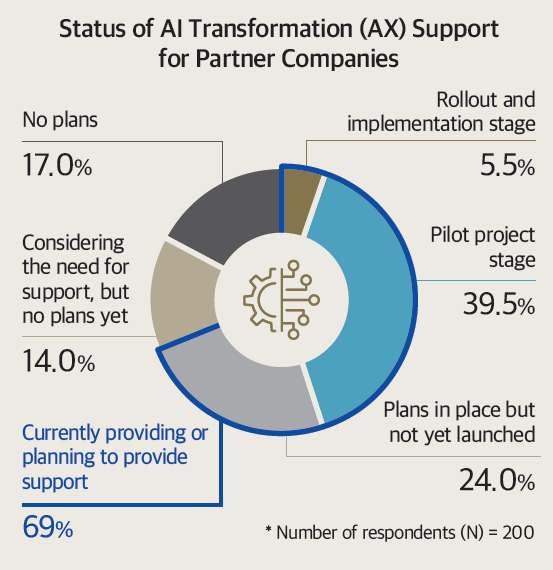
AX support for partner companies is still at an early stage, but activity is already beginning across the manufacturing sector. Among the respondents, 45.0% said they are currently supporting AX among partner companies. Of all respondents, 39.5% were conducting pilot projects targeting selected partner companies, while 5.5% had reached the stage of broader adoption and established use. Another 24% had plans to provide support but had not yet begun. Taken together, 69% of respondents are either already supporting AX among partner companies or have plans to do so in the future.
- While a considerable number of companies intend to support AX adoption among partner companies, actual implementation remains largely at the pilot stage, with companies working with a limited number of partner companies to assess feasibility and effectiveness. This suggests that widespread adoption has yet to take off.
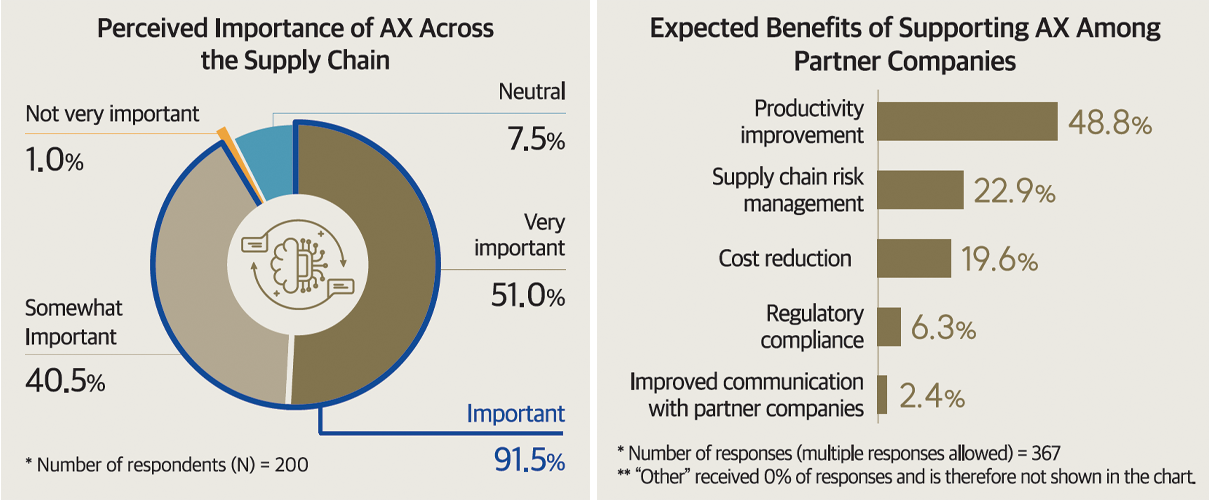
More companies recognize the need for AX among partner companies than are currently providing support. Among all respondents, 51.0% said that AX across the entire supply chain, including partner companies, is “very important,” while 40.5% considered it “somewhat important.” Notably, even among the 62 firms with no specific plans to support AX among partner companies, 82.3% considered AX across the supply chain important.
- This indicates that even among companies that have not yet begun providing support, there is already broad recognition of the need for AX among partner companies.
The benefit companies expect most from AX is improved productivity. The strongest expectations are for tangible improvements on the manufacturing floor, such as more consistent quality and shorter delivery times. Respondents also expected improved supply chain risk management2, cost reduction, regulatory compliance3, and improved communication with partner companies.
- This shows that companies view AX among partner companies not simply as an initiative for mutual growth, but as a means of improving productivity and supply chain competitiveness.
- 2.Supply chain risk management : Early identification of and response to potential disruptions in the supply of raw materials and components and delays in delivery.
- 3.Regulatory compliance : Systematic management of partner company information, such as carbon emissions and country of origin, to respond to disclosure and data submission requirements.
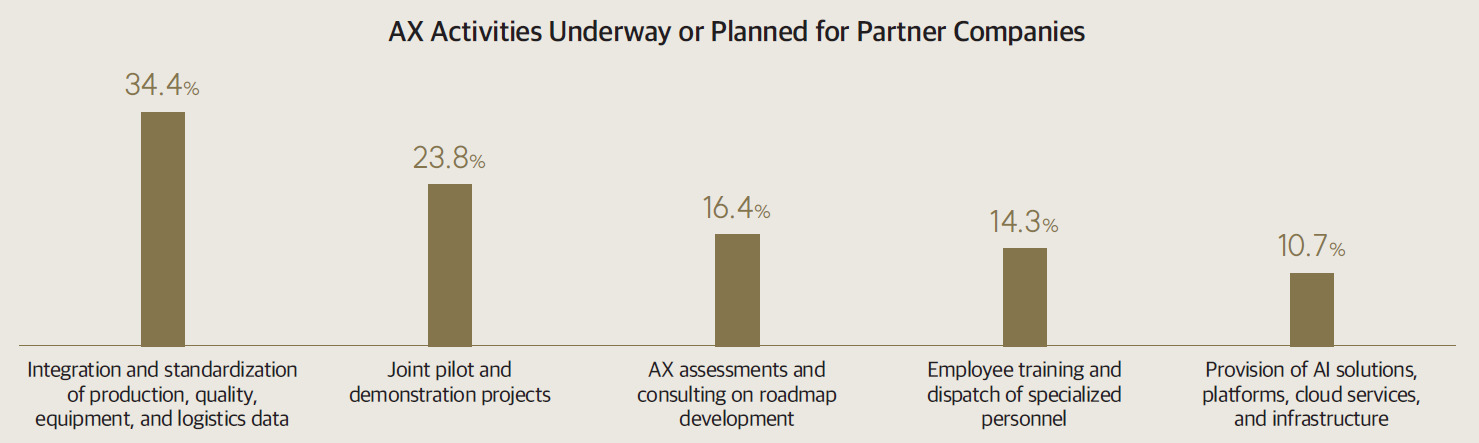
Looking at the types of AX support that companies are currently providing or planning to provide to their partners, data integration and standardization accounted for the largest share at 34.4%, followed by joint pilot and demonstration projects at 23.8%. These were followed by AX assessments and consulting on roadmap development (16.4%), employee training and the dispatch of specialized personnel (14.3%), and the provision of AI solutions, platforms, cloud services, and other programs or infrastructure (10.7%).
- Support activities that link data with partner companies or standardize data for use with AI account for a relatively larger share than the provision of AI programs or equipment.
- These findings suggest that a foundation for using data and conditions for testing the effectiveness of AX in actual production processes are both important for wider adoption among partner companies.
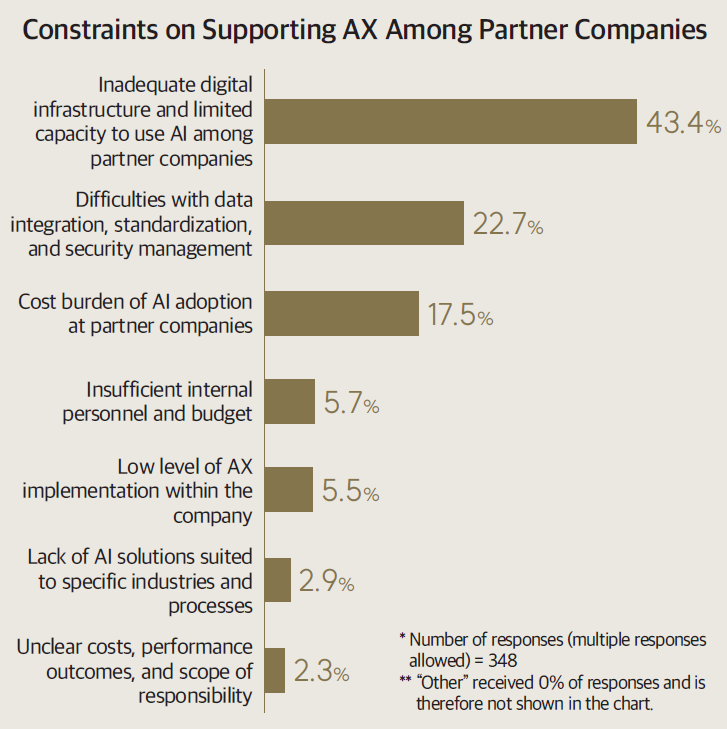
The most commonly cited challenge to expanding AX among partner companies was a lack of digital infrastructure and AI capabilities at partner companies (43.4%). This was followed by difficulties with data integration, standardization, and security management (22.7%), and the cost burden of adopting AI (17.5%).
- The lack of digital and AI capabilities among partner companies stood out clearly above the other factors, indicating that building partners’ basic capacity to use AI is a priority before addressing the costs or technologies involved in adoption.
- Taken together, the findings suggest that expanding AX among partner companies will require a foundation that strengthens their capacity to use digital technologies and AI while easing difficulties with data integration and security and reducing the burden of initial adoption costs.
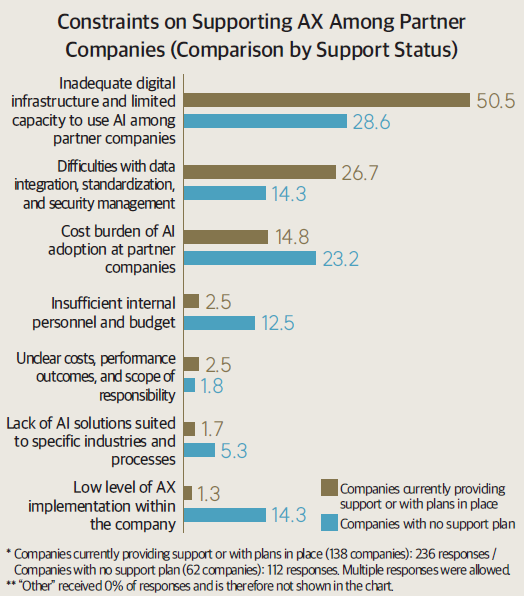
The challenges companies faced also varied depending on how far they had progressed in supporting AX among partner companies. Among companies already providing support or with plans in place, the most commonly cited constraints were partners’ inadequate digital infrastructure and limited capacity to use AI (50.5%) and difficulties with data integration, standardization, and security management (26.7%). Partners’ inadequate digital infrastructure and limited capacity to use AI also topped the list among companies with no support plans (28.6%). However, the cost burden of AI adoption for partner companies (23.2%), a low level of internal AX implementation (14.3%), and insufficient internal personnel and budget (12.5%) accounted for relatively larger shares than among companies providing support or with plans in place.
- Among companies without specific support plans, concerns about costs and their own internal capabilities were relatively more prominent. Among companies already providing support or with plans in place, partners’ AI capabilities and data integration and security issues stood out more clearly.
- These findings suggest that rather than providing the same type of support to all companies, supply chain AX may require a tailored approach that reflects the readiness of both companies and their partners and the stage of implementation.
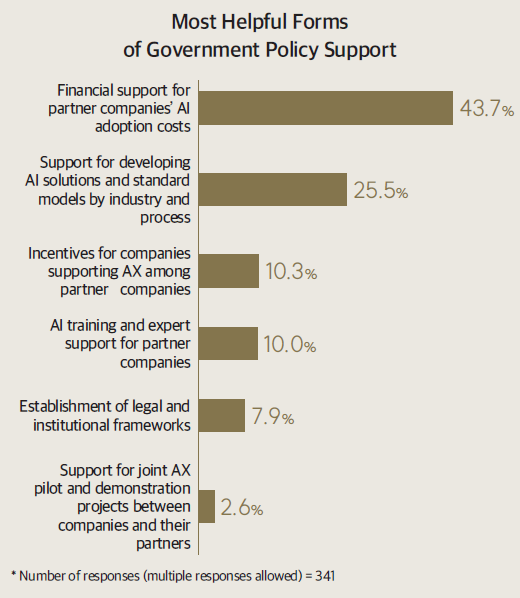
Among respondents, 86.5% said government support would help expand AX activities among partner companies. The policy support most needed was financial assistance with partner companies’ initial AI adoption costs (43.7%), followed by support for developing AI solutions and standard models tailored to specific industries and processes (25.5%). Next came incentives for companies supporting AX among their partners (10.3%), AI training and the dispatch of experts to partner companies (10.0%), and legal and institutional frameworks covering data, security, and the scope of responsibility (7.9%).
As for the roles companies could play in expanding AX across supply chains, data integration and standardization were cited most often (40.1%), followed by joint pilot and demonstration projects (25.4%).
- The findings suggest that the government needs to ease the burden of initial adoption and establish foundations for practical use.
- Companies, in turn, need to make efforts to link data with that of their partners, and build experience through practical AI applications.
This survey shows that AX in manufacturing can no longer be confined to changes within individual companies. More than nine in ten respondents recognize the importance of AX across the entire supply chain, including partner companies, and many are already running pilot projects or have concrete support plans in place.
In practice, however, companies face several barriers at once. The difficulties they face also vary by the stage of support. Assistance therefore needs to be tailored to conditions on the ground. If the government helps cover initial costs and supports the development of AI solutions and standard models tailored to specific industries and processes, while companies expand practical applications through data integration and joint demonstration projects, AX across supply chains could gain further momentum.