in Focus
Toward Innovation Excellence:
Korea in the AI-Driven Era
2026 FKI Jeju Summer Forum for Business Leaders
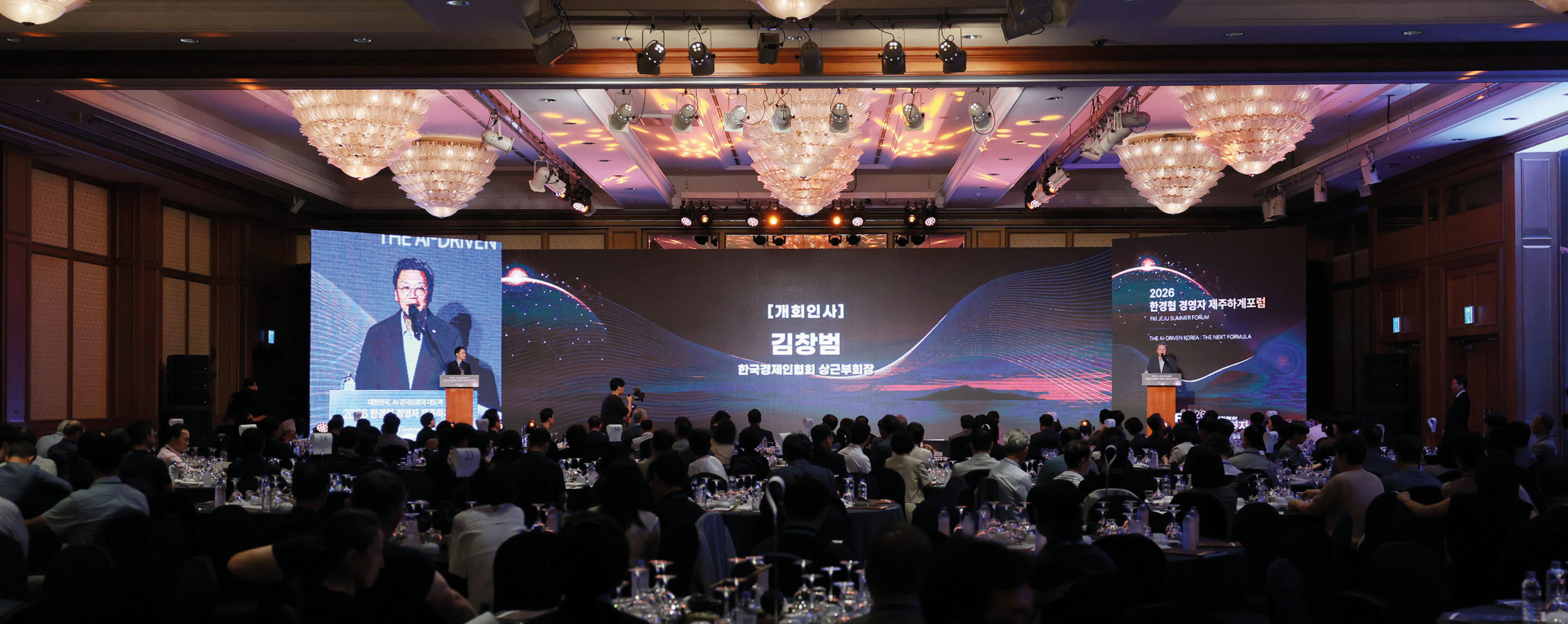
The 39th FKI Jeju Summer Forum for Business Leaders was held under the theme “The AI-Driven Korea.” As AI transforms industries and corporate management across the board, business leaders explored changes underway and discussed new growth strategies. Drawing on insights from experts across various fields, this report examines what businesses need to prepare for in the AI era.
Photo Credit FKI
 July 15 – 18, 2026 (3 nights, 4 days)
 Lotte Hotel Jeju
| DAY 1 July 15 (Wed) | |
|---|---|
|
[Opening Lecture] How Can Businesses Survive and Lead in the Era of AI Transformation? Jae-sik Choi, Endowed Chair Professor, KAIST |
[Welcome Dinner & Performance] A Summer Harmony in Jeju Jeju Chamber Orchestra |
| DAY 2 July 16 (Thu) | |
|
[Practical Strategy] Living With AI: What to Protect or Change Se-dol Lee, Collaborating Professor, UNIST [Strategic Insights] The Battle for Supremacy in AI Infrastructure: The Era of Data Centers Has Already Begun June Paik, Founder & CEO of FuriosaAI |
[Growth Algorithm] Growth Is No Accident: Success by Design Seok-hoon Kang, Founder & CEO of ABLY Corporation [Dinner & Cultural Performance] A Midsummer Night Live Concert Singer Lyn |
| DAY 3 July 17 (Fri) | |
|
[Between Success and Failure] AI Technology Adoption: Convenient, but Not Followed Up by Business Transformation Min-jun Park, CEO, AX CIC, Wrtn Technologies |
[The Essence of Decision-Making] In an Age of AI Answers, Human Choices Matter More Gwedo, Science Communicator |
| DAY 4 July 18 (Sat) | |
|
[Future Management] The Future Operating Model for Your Company Gil-young Song, Author & Data Analyst |
[Closing Lecture] New Roles for the State and Businesses in the AI Era Jung-woo Ha, Former Senior Presidential Secretary for AI Future Planning |
The FKI Jeju Summer Forum for Business Leaders, now in its 39th year, brings business leaders together to exchange knowledge, examine rapidly changing business conditions, and seek new directions for growth. Held in Jeju from July 15 to 18, this year’s forum brought together around 400 business leaders to explore the future of industry and corporate management in an era of AI-led transformation, under the theme “The AI-Driven Korea.” AI is shaping into more than an individual technology or a tool—it is transforming the way people work, and how organizations and industries are structured. The forum addressed these challenges by examining how businesses should respond to these transformations and develop new competitive strengths, rather than concentrating on specific technologies.
Cultural programs, including an orchestral performance and a live concert, gave participants a break from their busy daily routines and a chance to recharge. Bringing together knowledge, culture, and networking, the forum helped business leaders share new perspectives and prepare for the next leap forward amid the sweeping changes brought by AI.
“We have a solid manufacturing and digital base, as well as competitiveness in semiconductors and manufacturing-related AI. What matters now is execution. We need to equip ourselves with strategies and infrastructure fit to lead a major industrial transformation and make the leap from being an excellent manufacturer, as signified by the slogan, ‘Made in Korea,’ to becoming a country known for its strong innovation capability in the AI-driven era, encapsulated in the slogan, ‘Innovated in Korea.’”
- Jin Roy Ryu, Chairman of FKI, Welcoming Remarks
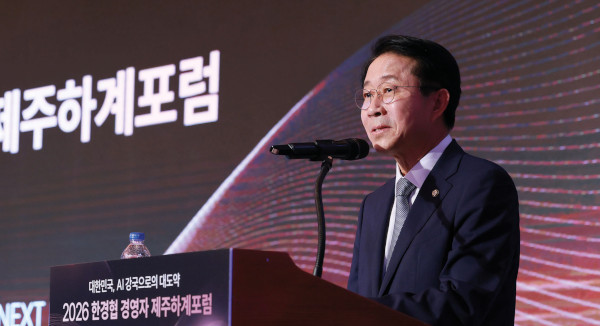
“Building on our competitiveness in semiconductors, our manufacturing capabilities, and our outstanding talent, we must move beyond being followers and become first movers—creating new markets and paradigms. The National Assembly will be a strong partner in this effort, moving swiftly on legislation and institutional improvements to enable business innovation and confident investment. We will listen closely to voices from the field, and creating a predictable environment.”
- Jeong-sik Cho, Speaker of the National Assembly, Congratulatory Remarks
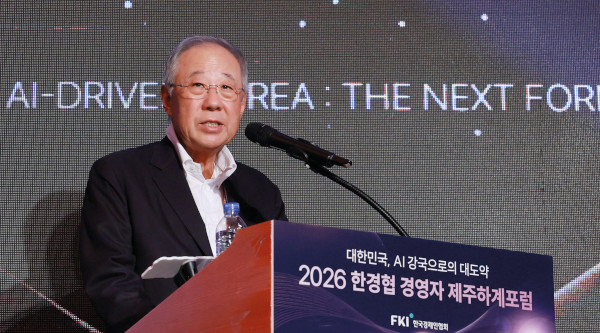
 Top_Jin Roy Ryu, Chairman of FKI, Welcoming Remarks
Bottom_Jeong-sik Cho, Speaker of the National Assembly, Congratulatory Remarks
Moving From AI Adoption to AI-Integrated Business Operations
Jae-sik Choi Endowed Chair Professor, KAIST
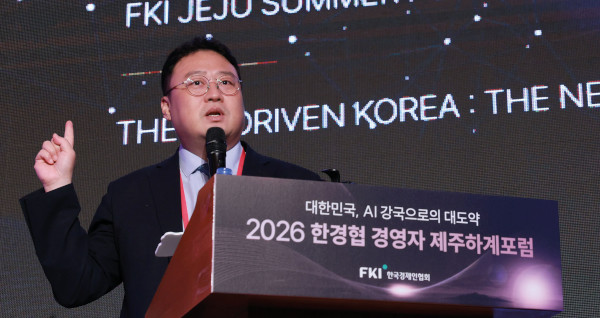
Agentic AI Expands the Scope of Work Automation
AI is now moving beyond experimental use in select projects and is becoming basic infrastructure for actual business operations. At the center of this change is “agentic AI.” AI is increasingly playing a direct role in business processes through legal chatbots, the drafting of administrative documents, and the compiling and summarizing of HR reports. Non-developers can also create necessary work tools through vibe coding. I believe that going forward, it will become widespread practice for employees in administration, finance, marketing, and other business functions to create tailored AI tools for work without relying on development teams.
However, AI adoption does not immediately lead to full automation. AI use should be viewed as a multi-stage progression: from monitoring, prediction and diagnosis, decision support, and conditional automated execution to eventual full autonomy. Companies need to assess their current level of AI use in both manufacturing and administrative work and develop a concrete plan for reaching their target stage. Moreover, higher individual productivity does not automatically translate into higher productivity across the organization. For AI adoption to produce tangible results across the organization, there must also be changes in performance management, goals, and organizational culture.
Manufacturing Competitiveness Creates New Opportunities in the Physical AI Era
The scope of AI applications is expanding rapidly, and going beyond digital work into actual industrial settings. “Physical AI” in this context is becoming increasingly important. Physical AI replaces or supports human roles in the physical world through, for example, autonomous vehicles and industrial equipment. At manufacturing sites, AI can be applied to various processes, including production planning, process control, quality management, equipment maintenance, energy management, logistics, and shipping. Moreover, AI can be trained to run processes that previously relied on workers’ experience and tacit knowledge so that eventually, equipment control could be enhanced by AI, to achieve gains in utilization and productivity.
I believe Korea’s manufacturing strengths, digital foundations, and capabilities in semiconductors and manufacturing-related AI will be valuable assets in the era of physical AI. Looking ahead, we must go beyond introducing AI services from overseas and work with domestic data centers, services, and manufacturing sites to develop AI technologies that meet their needs. As AI applications expand from agentic AI to physical AI, companies will also need to assess what level of AI capability is required for their work and industrial settings—and gradually advance their capabilities.
In the AI Era, Preserve Your Convictions but Let Go of Preconceptions
Se-dol Lee Collaborating Professor, UNIST

Lessons for the AI Era From a Defeat That Caught Me Unprepared
My match against AlphaGo in 2016 was my first real encounter with the AI era. It was a decisive moment for me, because although I thought that AI would eventually surpass humans at Go, I did not expect that day to arrive so quickly. I was insufficiently prepared, which made losing Games 1 through 3 all the more painful. It felt unfamiliar to play without being able to sense my opponent’s energy and rhythm, and I relied on intuition to counter AI’s data-driven play. If I had prepared well enough, I might have approached that aspect of the match differently. In Game 4, however, I crafted a strategy to make the middle game decisive and won by making decisions that I had never made before. Faced with something completely new, I prepared myself to make unprecedented decisions based on my view of the new playing field, rather than relying on previous experiences.
The Go community was introduced to the AI era ahead of many other fields. As AI-powered Go programs became widespread, professional players gained new insights not only by playing against AI, but also by studying AI analysis. This led to players gradually learning and accepting moves that were previously difficult to understand. Meanwhile, the skill difference between human players persisted, even though AI-powered Go programs were readily accessible. This was because top players learned to use and understand AI more effectively, and pulled even further ahead. The question is no longer whether to use AI. I think that gaining a competitive edge will hinge on how well we understand AI and how effectively we can apply AI to our respective fields.
Preserve Personal Convictions and Philosophy, but Let Go of Preconceptions
Then what role remains for humans in an era when AI makes judgments far superior to those of humans? I believe the answer lies in 'expressing our convictions and philosophy through narrative.' Human play, as preserved in Go records, may be inferior to AI’s in purely technical terms, but each game of Go contains a player’s life experiences, relationship with the opponent, personal convictions, and philosophy. Sophisticated works of art and music may also be produced by AI, but ultimately, it will be people who confer them with a narrative or significance. With AI use becoming more prevalent, uniquely human elements will become even more important.
However, while we should try to preserve our convictions, we ought to be willing to let go of our preconceptions. For example, AI-powered Go programs would, without hesitation, play moves that no professional player would consider. Professionals shied away from such moves simply because they were not ‘textbook’. This shows how easily people can become trapped in familiar frameworks. AI can serve as a tool that presents possibilities beyond preconceptions, and we need to recognize this potential and harness it to enhance our judgment. Moreover, we need to combine and integrate diverse sets of knowledge, communicate, and cooperate—even with competitors. Just as a game of Go is not truly complete until it has been reviewed after the result is decided, we need to reflect on our successes and failures and share our thoughts with one another before we move up to the next stage.
AI Semiconductor Competitiveness Ultimately Comes Down to Design and Efficiency
June Paik Founder & CEO of FuriosaAI
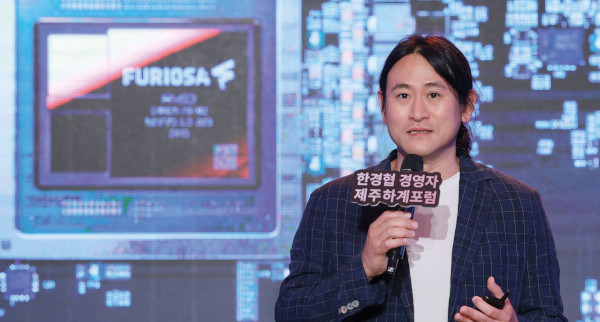
Aiming for the World’s Best Without Setting Limits
AI semiconductors are devices that perform computations required by AI algorithms quickly and efficiently. Ultimately, I believe the competitiveness of semiconductor companies rests on their design capabilities. Around 2014–2015, deep neural network-based AI began to demonstrate possibilities that set itself apart from those of existing technologies. We saw the potential for AI to become foundational to other technologies. This is why I left Samsung Electronics in 2016 and joined my colleagues in developing AI semiconductors. At the time, there was a perception that Korean companies were weak in design, but I believed Korea had real potential. Rather than taking limitations as a given, however, it was important to see new possibilities and set our sights on being globally competitive.
From the outset, FuriosaAI's aim has been to develop “the world’s best chip.” I believe that setting this ambitious goal enabled us to attract talented people with experience at global companies. It is important to note that AI semiconductor design requires more than hardware design. Hardware, software—including compilers—and algorithms must be designed together, requiring expertise across diverse fields. I see startups as places where we can move beyond existing conventions and experiment with new ways of organizing. Ultimately, technological competitiveness is determined by an organizational culture that allows designers to focus on their core work and solve new problems, as well as by the capabilities of the people themselves.
Energy Efficiency Is Key in the Era of AI Inference
As AI use rapidly increases, the role of data centers is also changing. In the past, the focus was on “training” AI models, but going forward, I expect “inference”—using models to power AI services—to account for a much larger share of data center activity. As AI usage and token volumes rise, demand for inference semiconductors is also growing. From the outset, we have developed chips for data centers that run the most powerful AI models, and we believe this market will become a core part of the semiconductor industry.
The most important source of competitiveness in this process is energy efficiency. Since electricity supply is one of the biggest constraints when building AI data centers, the key technological capability of AI semiconductors will be their ability to perform the same computations using less energy. Thus, we have focused on designs that minimize data movement while maximizing computational performance. However, the performance of the chip itself is not enough for a new AI semiconductor to establish itself in the market. The software and infrastructure for utilization must also grow alongside it. The key task ahead of us will be to bring companies and talent together to create a new AI ecosystem.
The Key to AI Transformation: First, Reshape Your Data and Organization
Min-jun Park CEO, AX CIC, Wrtn Technologies
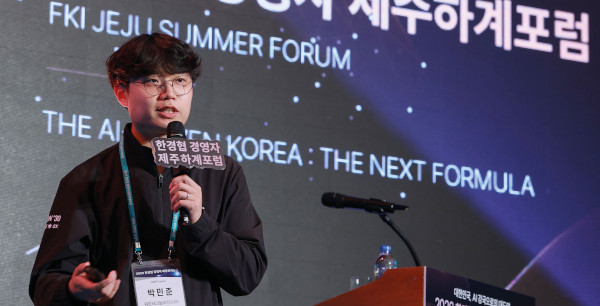
First, Lay the “Tracks” for AI to Work
For Wrtn, AI transformation was not a choice but a matter of survival. To compete with the global companies behind ChatGPT, Gemini, Claude, etc., we needed to achieve high productivity with fewer people and less capital. As we pursued AI transformation internally, we realized something important. Even if we can hand off 80% of a workload—made up of simple, repetitive tasks—it will not allow people to devote five times as much attention on the remaining important 20%, as there is a limit to human concentration. So, rather than focusing solely on reducing repetitive tasks, we chose to transform our decision-making and core work processes—things that affect real revenue and costs—using AI.
We began by experimenting with AI to transform the work of senior management. When we assigned multiple tasks to a single AI, there were contextual mix-ups which resulted in declining quality. Also, there was a limit to what human review of AI-generated results could achieve. So, we assigned separate AI agents to individual functions such as development, product, and communications. The multi-agent system functions by having individual agents provide their views and a person making the final decision. When AI advances enough to operate computers and perform most office work seamlessly, I expect the multi-agent structure will become increasingly common. Just as a smart entry-level employee would still need sufficient training and the help of an onboarding system to perform at their full potential, AI also needs sufficient context and work systems in place before it can function effectively within an organization.
Data AI Can Read and Assess Is a Competitive Advantage
Our first task in building the multi-agent system was to build a data foundation for AI use. Companies possess vast amounts of information that humans can recognize immediately, but which can be hard for AI to decipher. These include files in PDF and HWP file formats, Excel files containing images, and data using different codes and standards. We parsed documents to extract data, defined the meaning of each data element, and then built an ontology that links data elements and specifies the relationships and rules between them. Ultimately, AI transformation requires not just the collection of large amounts of data, but also the ability of AI to understand the meaning and context of that data and use it in actual work.
Also, AI transformation is not complete just because an organization has the relevant technology. Adoption could grind to a halt if AI is perceived as something that will make jobs redundant or create an additional work burden. That is why we shared AI usage figures and ran programs such as hackathons, which enable non-developers, too, to gain first-hand experience of the potential benefits of AI. Above all, the goal of AI transformation must be to achieve tangible benefits. Being able to say that “AI has been adopted” is not enough. We need to assess the benefits of AI in areas where it can actually reduce costs or increase revenue. To usher in an era of multi-agent systems that can perform tasks in various areas of an organization, companies need to first prepare the data, systems, and organizational culture that will allow multi-agents to work effectively.
In the AI Era, “Choosing What to Solve” Matters More Than Finding Answers
Gwedo Science Communicator
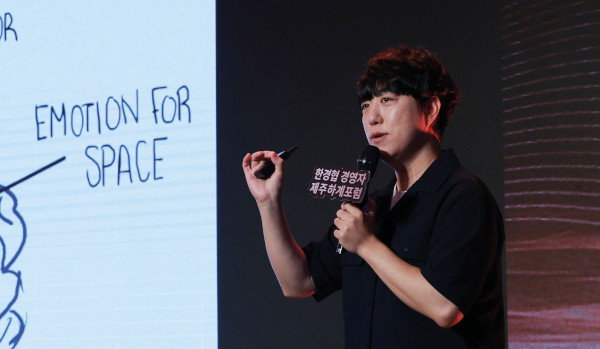
How Are Rational Choices Made?
A central issue in the AI era is “choice.” Though we may consider ourselves rational, our brains are not designed to make perfectly rational judgments. That said, eliminating emotions does not necessarily lead to better decisions. There are reports of cases where patients with damage to brain regions involved in emotion were unable to make trivial decisions, even though their intellectual abilities remained intact. Emotions are not obstacles to judgment; they help make it possible. The same applies to corporate decision-making. Taking emotion out of decision-making is not the answer. Rather, we need to create a system to help us make better decisions.
Also, spending more time deliberating in meetings does not necessarily lead to better results. We need to consider the possibility of failure in advance, weigh opposing views, and have clear visibility on who the final decision maker is and that they will take that responsibility. Better decisions can also result from giving frontline staff the necessary authority to make certain decisions, and by providing them with appropriate advice while refraining from unnecessary interference. Pooling knowledge and building a shared sense of identity also contribute to sound judgment. The same applies to AI-generated results. To handle “workslop”1 plausible-looking but unusable AI output - people need time and systems for proper verification and assessment, rather than the capacity to produce even more information.
- 1.Workslop : A phenomenon in which inaccurate or context-deficient AI-generated output, instead of making work more efficient, creates additional tasks such as reviewing and revising AI-generated results.
When AI Finds Answers, People Must Identify What Is Fundamental
The emergence of AI does not diminish the value of human judgment. In Go, for example, professional players’ judgment actually improved after AI began suggesting moves that humans had never considered. In mathematics, there are cases where people without specialized training in higher mathematics identified promising ideas among AI-proposed answers and then used those ideas to develop novel solutions to long-unsolved problems. Instead of just accepting AI generated answers, it is important to verify their significance and then use them to inform new judgments.
That is why I believe we should look beyond what AI can and cannot do. The more important question is what remains unchanged at the core of our work, even in the AI era. When AI entered the Go community, human players still wrestled with every move and the essential nature of competition remained unchanged. Likewise, companies will be able to integrate AI effectively when they understand the essence of their areas of expertise. AI will take less and less time to solve problems. Our task as human beings, then, is to decide which problems need solving and why, rather than spend more time searching for answers. In the AI era, business competitiveness will stem from clearly defining what is fundamental to a company and then building a new future on that foundation.
In the AI Era, Make Organizations Smaller, Faster, and Lighter
Gil-young Song Author & Data Analyst
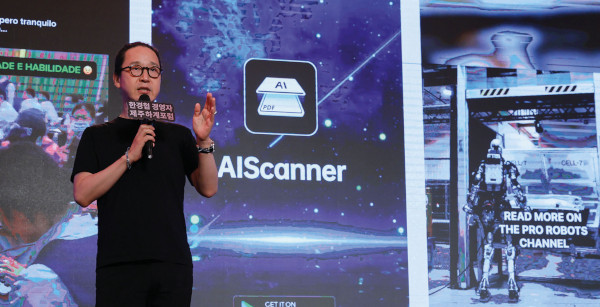
AI Is Not a Choice but a Condition for Survival
AI has the potential to go far beyond making things better. In fact, I think that companies that do not use AI may become uncompetitive altogether. The potential for widespread use is what makes a technology formidable. Once self-service ordering kiosks became part of everyday life, adopting them became a necessity across entire industries. AI will likewise spread across all industries. As AI and robots begin to take over repetitive tasks, management, and supervision, the existing roles of people and organizations will also change. In the past, working diligently was important. Over time, working smarter became a source of competitiveness. Going forward, the shift will be toward boldly letting go of tasks that no longer need to be performed by people.
Decision-making methods also need to change. The old approach was to plan and review at length before taking action. With falling technology costs, however, it makes more sense to test ideas quickly and discard what does not work, until successful.
For AI to work effectively, companies also need to provide it with knowledge and context. Thus, going forward, “ontology,” an accumulated structure of experience and wisdom drawn from individuals, will become important. Ultimately, learning a new technology requires active engagement with it. Organizations need to learn through practical use and experimentation with AI, then apply what they learn to the way they work.
From Bloated to Lean Organizations
The greater change AI will bring is that organizations themselves will become leaner. To enable numerous people to work together, companies have developed hierarchical structures in which instructions are given, tasks are allocated, results are compiled, and decisions are approved. When one person using AI can handle work that previously required several people, however, intermediate processes can slow things down. What will matter more than the size of an organization is how quickly it can move. I believe that competitive organizations will be leaner, able to grow revenue without significantly increasing their workforce, and capable of securing outside partners when necessary.
Individuals will also be able to accomplish more on their own than ever. With AI assistance, individuals can now take on work once handled by whole companies and compete with large, hierarchical organizations. Companies therefore need to be able to take on larger tasks that individuals cannot accomplish alone. This requires more than simply providing employees with AI tools. Companies need to streamline their reporting and approval processes, as well as their operational methods. In particular, executives at the forefront of change need to learn about AI and start using it themselves. “Lean transformation” aims to remove organizational bloat and increase the speed of execution. In the AI era, companies need to become leaner—and better able to respond quickly to change—rather than focus on preserving bloated organizational structures.