New K-Industry: New Engines of Growth for the Korean Economy
Industrial Policy 3.0:
From Picking Winners
to Enabling Transformation
By Chul Chung, CRO of FKI and President of the Korea Economic Research Institute (KERI)
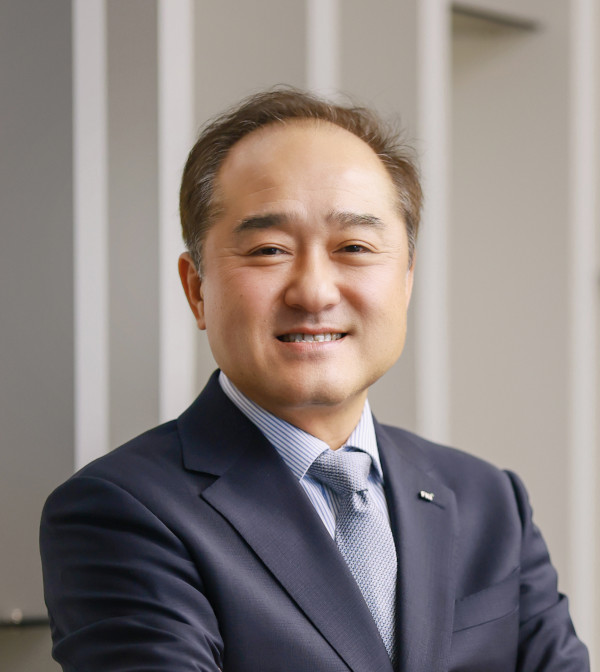
• Chief Research Officer (CRO), Federation of Korean Industries (FKI)
• President, Korea Economic Research Institute (KERI)
• Co-Chair, Korea National Committee for Pacific Economic Cooperation (KOPEC)
• President, Korean Association of Trade and Industry Studies (KATIS)
What Will Drive Korea’s Growth in the Years Ahead?
What will drive Korea’s growth over the next 30 years? With exports and industrial activity recovering recently, led by semiconductors, new opportunities for growth are emerging in the Korean economy. According to the Bank of Korea’s August 2026 outlook, real GDP growth is projected to rebound from 1.1% in 2025 to 3.3% in 2026, driven by strength in the semiconductor sector. However, a short-term economic recovery does not guarantee the next 30 years of growth. Structural constraints remain, including a declining working-age population and a falling potential growth rate, while the vitality of manufacturing outside semiconductors and the competitiveness of service exports are still insufficient. What Korea needs now is to look beyond this year’s growth rate and establish a framework that can keep generating new engines of growth.
At times like this, it is common to say that we need to find “the next semiconductor-scale growth engine.” Of course, we need to act early to secure breakthrough technologies and strategic industries that will drive future growth. However, the next engine of growth does not necessarily have to come from a completely new industry. Korean manufacturing’s competitiveness rests on years of accumulated process expertise and skills, established supply chains, and lessons learned through trial and error. If these accumulated capabilities are combined with AI, clean energy, and new services to create globally competitive solutions, new growth engines can emerge from existing industries. What matters is not selecting and supporting a few promising industries, but rather changing the value-creation structure of industry as a whole so that new technologies and companies can continue to grow. This is where New K-Industry begins.
Industrial Policy Must Change as the Unit of Competition Changes
The global stage for industrial competition is already changing rapidly. McKinsey projects that the revenues of 18 future high-growth industries will grow from approximately $7.2 trillion in 2022 to between $29 trillion and $48 trillion by 2040. What is important here is not that manufacturing is disappearing. Rather, the way value is created in industry itself is changing as AI, clean energy, and services are combined with the competitiveness of existing manufacturing industries. Semiconductors are becoming connected with AI, automobiles are expanding into software and mobility services, and energy is becoming a key determinant of industrial competitiveness, linking power grids, AI data centers, and advanced manufacturing facilities. Competition is now moving beyond “product versus product” toward “ecosystem versus ecosystem,” in which technology, energy, services, and infrastructure are interconnected.
The evolution of Korea’s industrial policy can be broadly explained in terms of three successive policy paradigms. Industrial Policy 1.0 (1960s-1970s) laid the foundation for Korea’s industrialization through export-led manufacturing development. Industrial Policy 2.0 (1990s) expanded ICT industries and digital infrastructure as new foundations for growth. In the era of AI, Industrial Policy 3.0 should focus on the “transformation” of existing industries as a whole. An approach based solely on the government selecting specific industries and allocating resources to them is insufficient to respond to ecosystem-level competition in which technology, energy, services, and infrastructure are integrated. The core of Industrial Policy 3.0 is to create an environment in which corporate creativity and investment can give rise to new industries, rather than to have the government pick industrial winners.
Three Transformations Reshaping Production, Markets, and Value Creation
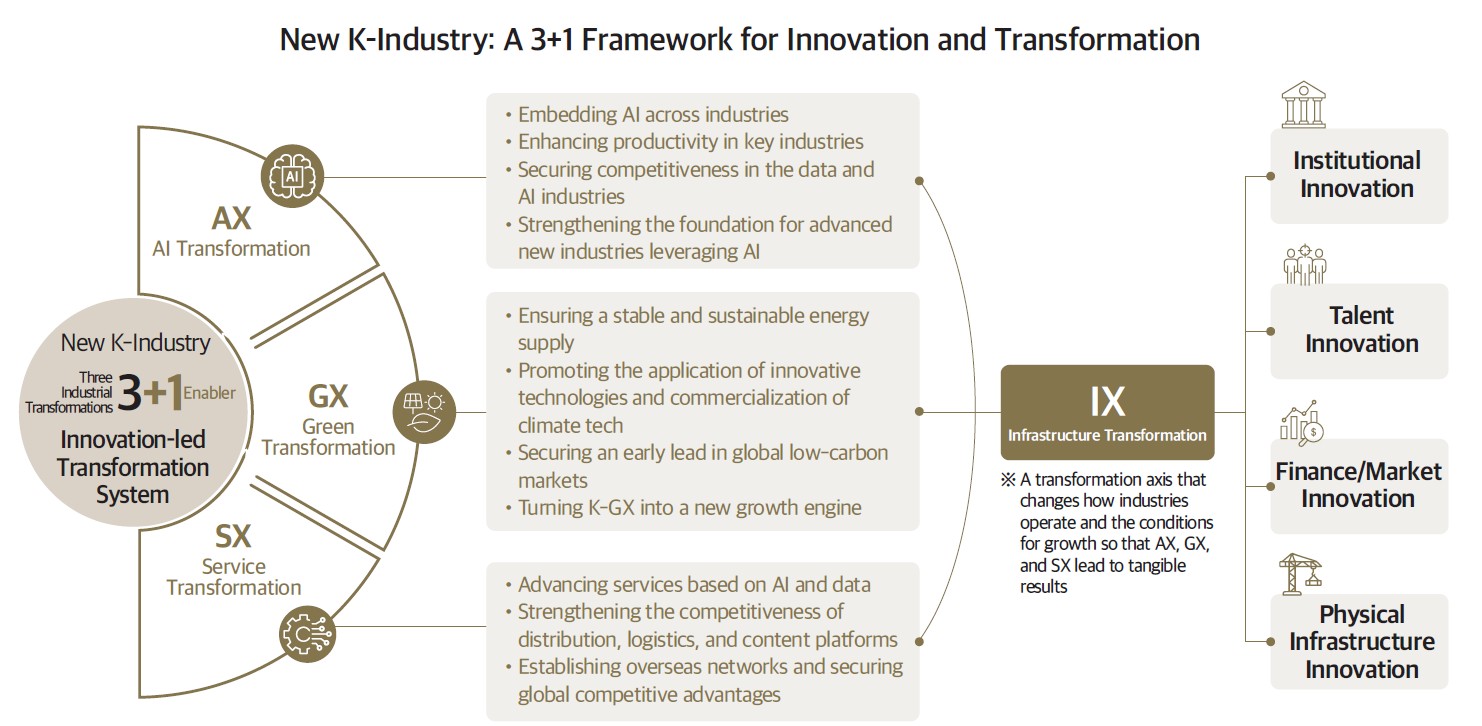
New K-Industry can be understood through a “3+1” framework: three transformations—AX, GX, and SX—supported by IX. To advance this 3+1 strategy, the Federation of Korean Industries (FKI) launched the New K-Industry Forum in July 2026 as a public-private platform to develop a long-term roadmap for Korea's industrial transformation.
First, AX (AI Transformation) means changing how industries produce. Competitiveness now depends at least as much on effective AI use in industry as on how well AI is developed. We need to embed AI across industries, including manufacturing, finance, distribution, and logistics, to make them more intelligent and thereby increase productivity and create new added value. In particular, combining physical AI with the process data, tacit knowledge of engineers, and precision manufacturing capabilities accumulated by Korean manufacturers can translate AI competition in the digital realm into competitiveness on the factory floor. Success in physical AI will depend not only on the performance of general-purpose models, but also on how accurately and safely robots and equipment operate in the field and how much they improve productivity. In this regard, Korea’s broad manufacturing base gives it a clear opportunity.
GX (Green Transformation) must go beyond carbon reduction. It must integrate energy supply, industrial competitiveness, and new market development. Without reliable electricity at competitive prices, it will be difficult for AI data centers, the semiconductor industry, and advanced manufacturing facilities to grow. At the same time, clean hydrogen, sustainable aviation fuel, CCUS (Carbon Capture, Utilization and Storage), next-generation nuclear power, renewable energy, and the circular economy can become new export industries. The core of Korea’s GX is an “industrial and energy transformation” that simultaneously pursues energy security, carbon neutrality, and competitiveness in new industries.
SX (Service Transformation) means changing how value is created and exported. The auto industry is expanding beyond vehicle sales into over-the-air (OTA) updates, autonomous driving, financial and insurance services, and subscription services, while the home appliance industry is expanding beyond products—into apps, smart homes, and service platforms. K-Content, too, can create greater industrial impact when it goes beyond production and commercial success to connect with platforms, performances, tourism, food, beauty, and other areas. “K-Everything,” which breaks down the boundaries between manufacturing and services and extends the power of K-Culture into exports of consumer goods and services, represents another growth model that Korea can create in global markets.
IX Will Determine the Success or Failure of New K-Industry
If AX, GX, and SX represent the direction of industrial transformation, IX (Infrastructure Transformation) provides the foundation for turning that direction into actual investment and business activity. Here, infrastructure does not refer only to physical facilities such as roads, ports, and telecommunications networks. It encompasses various conditions that enable innovation, including institutions, talent, finance and markets, and physical infrastructure. The pace of industrial transformation may be determined not by the most advanced technology, but by the foundations that are slowest to adapt. In this sense, IX is not a supplementary support measure for New K-Industry, but a core pillar that will determine the success or failure of AX, GX, and SX.
Talent is the most fundamental of these foundations. AX requires professionals with interdisciplinary expertise spanning AI technology, manufacturing processes, and industrial operations, while GX requires engineering talent capable of connecting electricity, nuclear power, hydrogen, and carbon technologies. However, the declining school-age population and shortage of science and engineering talent are already emerging as constraints on industrial transformation. Simply training more people is not enough. Education and research must be connected to actual corporate projects. The labor market and conditions for immigration and settlement must also be transformed so that outstanding talent from Korea and abroad can take on challenges in Korea.
The reason becomes clear when we consider AI data centers. For instance, even with the necessary technology and willingness to invest, companies may miss the investment window as they seek permits and approvals from one government ministry after another. If companies select a site first and only then try to secure electricity and water, the project may be delayed. Training only software specialists would make it difficult to secure enough professionals with the interdisciplinary expertise needed to operate data centers and apply AI across industries. A single bottleneck can delay innovation as a whole. Institutions must be able to accommodate new initiatives, while talent, finance, markets, and physical infrastructure must also be coordinated around actual corporate investment and innovation. Transforming these foundations to keep pace with changes in technology and markets is the essence of IX.
Industrial transformation is not simply a matter of technology and investment. Even when a new data center or energy facility is considered necessary at the national level, it is difficult to sustain a project without the consent of the local communities that bear the burden of electricity and water use. When AI adoption changes the value of jobs and skills, retraining and transition support for workers who bear the burden of those changes must also be put in place. This is why a “just transition” is needed, one that broadly shares the benefits of industrial transformation rather than concentrating its costs on particular regions and groups. Social acceptance is not an obstacle that slows innovation, but essential infrastructure that makes innovation sustainable.
In particular, institutional innovation is the starting point for opening the way for new technologies and businesses to reach the market. If existing rules that permit only explicitly authorized activities cannot keep pace with changes in technology and consumer demand, legal uncertainty may increase and the emergence of innovative technologies may be hindered. In new industries, the shift toward a regulatory approach that permits activities in principle and restricts them only by exception should be expedited. At the same time, so-called “stair-step regulation”—size-based regulatory thresholds that discourage firms from growing—needs to be rationalized. The regulatory framework itself must be transformed so that institutions can keep pace with the speed of change in technology and markets.
Build a System for Growth Instead of Picking Future Industries
Global competition in industrial policy is not determined solely by the size of subsidies. As major countries redesign their entire industrial systems, Korea can distinguish itself by how quickly and precisely it connects and transforms the strengths it already possesses. Korea already has world-class manufacturing capabilities, digital infrastructure, and global influence created by K-Culture. What matters is connecting these assets with AI, energy, and services rather than keeping them separate, and transforming them into new sources of competitiveness.
The roles of the government and businesses are also important in making this transformation a reality. Rather than choosing the winners of future industries on behalf of businesses, the government should remove bottlenecks to industrial transformation, including those involving institutions, talent, finance, electricity, water, and sites. Rather than waiting for support, businesses should combine AI, energy, and services with their existing businesses to create new business models and spread innovation across supply chains and regional ecosystems.
The role of the New K-Industry Forum should not stop at producing yet another industrial policy report. The forum should pair the investment and innovation tasks that businesses need to undertake in AX, GX, and SX with the IX tasks that the government needs to address, and develop an industrial transformation roadmap distinguishing short-term priorities from long-term tasks spanning 10 years or more. When the forum’s proposals lead to actual corporate investment and government policies, and their outcomes are continuously reviewed, New K-Industry can become a growth strategy rather than a slogan.
No one can accurately predict which technologies and industries will lead the world 30 years from now. What is clear is that future growth cannot be guaranteed by today’s key industries and successful approaches alone. Our generation’s responsibility is not to choose future winners for the next generation. It is to pass on an environment in which they can try, fail, get up again, and continue on to create new companies and industries.
We need to combine accumulated manufacturing capabilities with AI, energy, and services and transform them into growth engines. This is the direction of New K-Industry and Industrial Policy 3.0: building on Korea's manufacturing strengths to become an innovation powerhouse with AI embedded across its industries.