
U.S. Midterm Elections and Trade Risks: Three Key Variables—Tariffs, Export Controls, and Industrial Policy
2026 U.S. Midterm Elections:
The Balance of Power and the Policy Outlook
How should we read the polls ahead of the U.S. midterm elections? Despite recent forecasting misses, surveys of presidential approval ratings and party preference polls still point to the likelihood that Democrats retake the House. This article looks at the likely balance of power after the elections and what it could mean for the direction of U.S. policy on tariffs, investment in strategic industries, AI, U.S.-China relations, and interest rates.
By Jon Lieber, Head of Research and Managing Director (United States), Eurasia Group
Election forecasting is both an art and a science. The science of sampling public opinion in the U.S. dates back nearly 100 years, when George Gallup started large-scale surveys of the American public using the most advanced sampling techniques available at the time. The science of collecting large samples and inferring the intention of voters from them only improved in the ensuing decades. But the art comes in knowing when to dismiss those results.
The polling industry has come under fire in recent years due to a series of developments beyond its control. The Pew Research Center reported in 2019 that response rates for their telephone surveys declined from 36% in 1997 to 6% in 2018, with further declines documented since then. In some cases, pollsters must call 100 people to get one response. As a result of this decline, and high-profile polling misses in recent major elections, trust in these polls has declined precipitously.
Not all is lost, however. Several signals can be used to interpret public opinion and draw conclusions. And in this midterm cycle, there are two strong signals that the Democratic Party is poised to make significant gains in November.
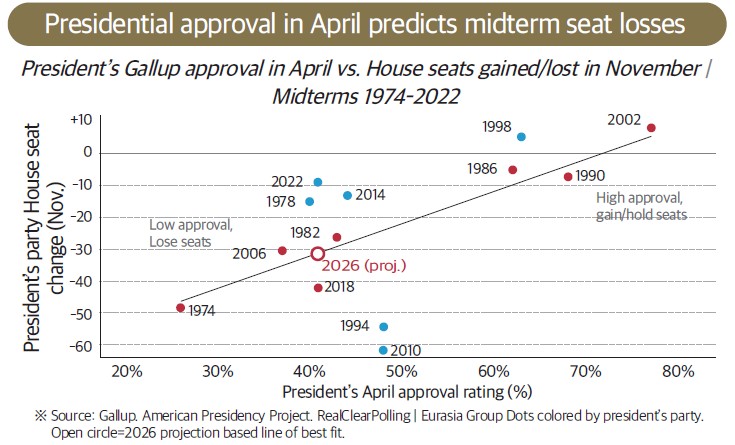
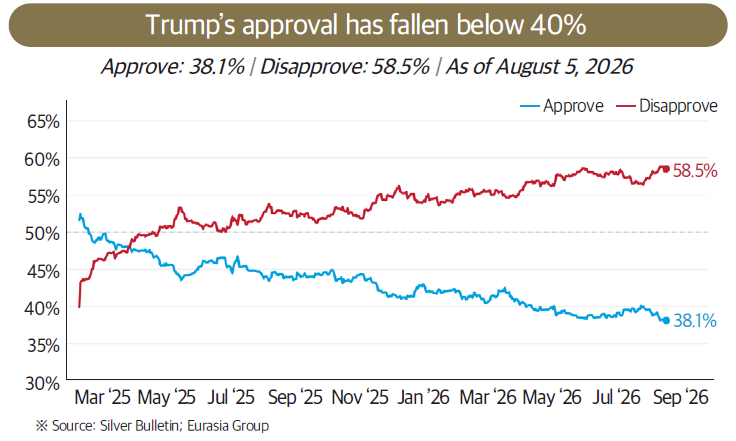
The first is presidential approval. Incumbents get the blame when things go wrong and can take credit when things go right. And when 72% of Americans tell the Gallup Organization in July of this year that they are not satisfied with the way things are going in the United States and 55% say their financial situation is getting worse in a separate April 2026 poll, it is not surprising that incumbent President Donald Trump’s approval ratings are below 40%. According to Eurasia Group’s analysis, this is consistent with a loss of roughly 30 seats for that president’s party.
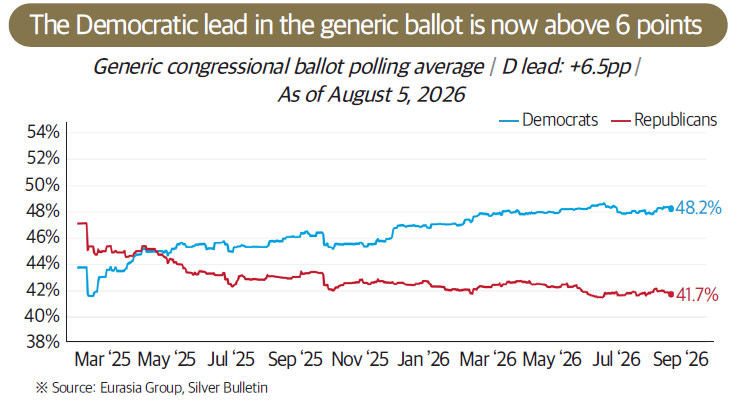
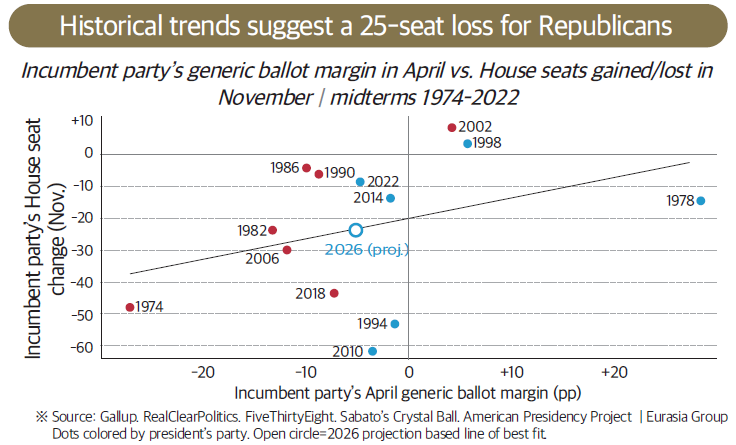
The second is the generic congressional ballot. This asks voters if the election were held today, who they would vote for among a generic Democrat or a generic Republican. This signal is a flashing red light for Republicans: Democrats currently have a 6.5-point lead, consistent with a wipeout election for the incumbent party, historically consistent with a roughly 25-seat loss for Republicans.
What’s the good news for Republicans? There aren’t that many competitive seats. Primarily due to the way districts are drawn in the United States, many have been designed to protect incumbents. This has led to a re-election rate of over 90%, which means many of the 218 serving Republican members of the House are likely to return in 2027. In a normal cycle with national tailwinds like this, Democrats would be looking at large “wave” elections the way Republicans picked up 63 seats in 2010 and Democrats picked up 41 seats in 2018. However, even minimal seat losses still mean it is overwhelmingly likely Democrats take the House, as the current Republican majority is only 4 seats.
The Senate is another potential bright spot for the otherwise beleaguered Republicans. Senate races are more idiosyncratic, and recent history shows that bad national environments don’t always translate into bad results for the party in power. Republicans gained seats in the Democratic wave election of 2018. Democrats expanded their majority in the Senate despite an overall bad year in 2022.
This means the likeliest outcome next year is divided government; Republicans will continue to control the White House, and Democrats will control at least one and possibly both chambers of Congress. The Senate matters because it has sole authority for confirming the president’s executive branch and judicial appointments, giving senators a veto over parts of President Trump’s agenda.
But even if Democrats don’t take the Senate, gridlock is the most likely outcome next year. Typically, very little gets done in divided government, and as partisanship and polarization have increased, that trend has become more pronounced. Even in divided government in 2007-2008, George W. Bush still signed 460 bills into law. Compare that to divided government in 2023-2024, when President Joe Biden signed nearly half as many – 274 – bills into law.
Gridlock can be good for financial markets. Investors and companies sometimes benefit when Washington does not act. Eurasia Group’s analysis has found that ten-year Treasury yields typically go up during divided government and down in unified government, in part because of an increased propensity for borrowing when one party controls Washington.
However, that finding comes from an era where the Executive Branch was more limited in what they could achieve without Congress. The recent trend of increasing concentration of power in the executive branch means that it is unlikely Washington does nothing over the next several years. The Trump administration has been the most aggressive and active in areas where Congress has had little role, increasing the potential for disruption. This is particularly true for trade and industrial policy.
November's results will quickly shift Washington's attention toward the 2028 presidential race. In the meantime, here are five policies to watch in the last two years of Trump’s term.
1. Tariff policy
Trade has been the number one tool for the second Trump administration. The administration has used the threat of tariffs to force equalization of tariffs, secure inbound investment pledges, and threaten domestic industries (like drug manufacturers) to get price discounts for Americans.
The intensity of this will decline as the U.S. pivots towards a new equilibrium of more managed trade, but with multiple investigations into individual countries and industries, like polysilicon, still ongoing, tariff rates will continue shifting for the remainder of Trump’s term. While this was a major driver for global markets over the past two years, tariff instability will matter far more for specific industries and countries over the next two years of Trump’s term. And while Trump has been able to rebuild his tariff wall after the Supreme Court overturned his initial proclamations, the legality of several tariff powers currently in use is uncertain.
2. Government directed investments
The Trump administration has cleverly used existing laws to channel taxpayer money towards strategic industries. Critical minerals, semiconductors, steel, and nuclear energy firms have all been beneficiaries of investments from American taxpayers. Some of these have already generated an attractive return on investment. And more are likely to come. Trump has already flirted with taxpayer stakes in failing airlines, and critical firms in the defense and energy industries could be candidates for future capital injections. Foreign capital has been influential here as well. The primary aim of Trump’s trade deals is to direct foreign investments towards industries like chip manufacturing, alternative energy, data centers, and shipbuilding. These investments are vital to the administration’s agenda of investing in America, marking a stark departure from how industrial policy has traditionally been managed.
3. AI regulation
The White House cannot stay neutral on AI forever. This is likely to be a major political flashpoint in the 2028 election, and as the capabilities of leading AI models increase every day, the government will be asked to do something, anything, to exert public control over these private capabilities. So far, that has been limited to selective reviews of new models, but this position will be politically untenable for the future Republican presidential nominee. The Commerce Department is likely to be involved, and if it is not, states will take the lead in regulating AI tools and companies. The data centers that feed them will be another policy flashpoint, with almost half of U.S. states either considering or implementing legislation that would restrict data center construction or operation. Voters are broadly suspicious of AI’s effects on both society and the job market—data centers provide a physical manifestation of this threat, and therefore will continue to attract controversy, with candidates from both parties putting forward proposals to stop them.
4. U.S.-China relations
The truce struck between President Trump and Xi Jinping at Busan in October is likely to hold, but individual irritants will still be a major factor. Selective decoupling1 in strategic industries will increasingly cause problems for both governments. Expect both sides to use black lists and export controls to block each other from accessing critical technologies, and expect both sides to continue to ban specific companies. The U.S. is now painfully aware of how vulnerable U.S. supply chains are to China’s control over critical minerals after the October ban on their export. Steep escalation is unlikely. Rather, decoupling will continue in a piecemeal fashion where neither side moves to cripple the other.
- 1.Decoupling: The reduction or separation of cross-border linkages in areas such as trade, investment, technology, and supply chains.
5. Interest rate policy
With government borrowing costs rising globally and a new regime at the Federal Reserve, rising interest rates will be an ongoing challenge for the Trump administration, which has set low 10-year borrowing rates as a key performance indicator. Expect the U.S. Treasury to be increasingly active in using its limited toolkit to manage these rates and assuage markets about the growing pile of U.S. government debt. In recent weeks, Treasury has broken norms to intervene in support of the Japanese Yen and has expanded a bond buyback program, both with a goal of controlling U.S. borrowing costs.
So far, Fed Chair Kevin Warsh has maintained excellent relations with the White House, but markets are pricing in rate hikes before the end of the year, a potential flashpoint for the president who has long pushed the Fed to cut rates. Trump is unlikely to pressure Warsh the way he did former Chair Jay Powell, but he continues to harass Fed Board member Lisa Cook, and maintains his ability to undermine Warsh through public attacks if he does not like the direction of policy.
Preparing for 2028
Election forecasting may be getting harder, but the rules that govern the balance of power in Washington remain largely the same. Elections in November will change that balance of power, but not the direction of policy. The Trump administration will continue to find novel tools to achieve its goals of boosting investment in America, while Democrats will primarily focus on investigations of White House-aligned businesses, countries, and individuals. This will help Democrats make the case that they are the party American voters should support in the 2028 presidential elections, which will come to dominate Washington soon after the races are called. For foreigners looking into the U.S., this means the Washington roller coaster is likely to slow modestly and have fewer, but not no, twists and turns next year. Korean firms sit at the fault line of U.S.-China decoupling. As Washington and Beijing tighten restrictions on semiconductors and critical minerals, the pressure on Korean companies to align with one side will likely grow.