in Issue & Trend
Paving the Way to Decarbonized Steel
POSCO HyREX
As global environmental regulations on climate change become increasingly stringent, steel industry decarbonization has emerged as a critical challenge for building a sustainable future. POSCO is pursuing an answer through HyREX, its proprietary Korean Hydrogen Reduction Ironmaking process that replaces coal with hydrogen.
By Na-yeon Kim
Photo Credit POSCO
From Coal to Hydrogen: Transforming the Steelmaking Process
Steel is a fundamental material that underpins key downstream industries such as automotive, shipbuilding, and construction. At the same time, it is also an industry that emits large amounts of carbon during production. As environmental regulations tighten and the Carbon Border Adjustment Mechanism (CBAM) comes into force, decarbonization is no longer optional for steelmakers—it has become essential for survival. Against this backdrop, POSCO has unveiled its 2050 Decarbonization Roadmap and embarked on developing technologies that fundamentally transform conventional steelmaking.
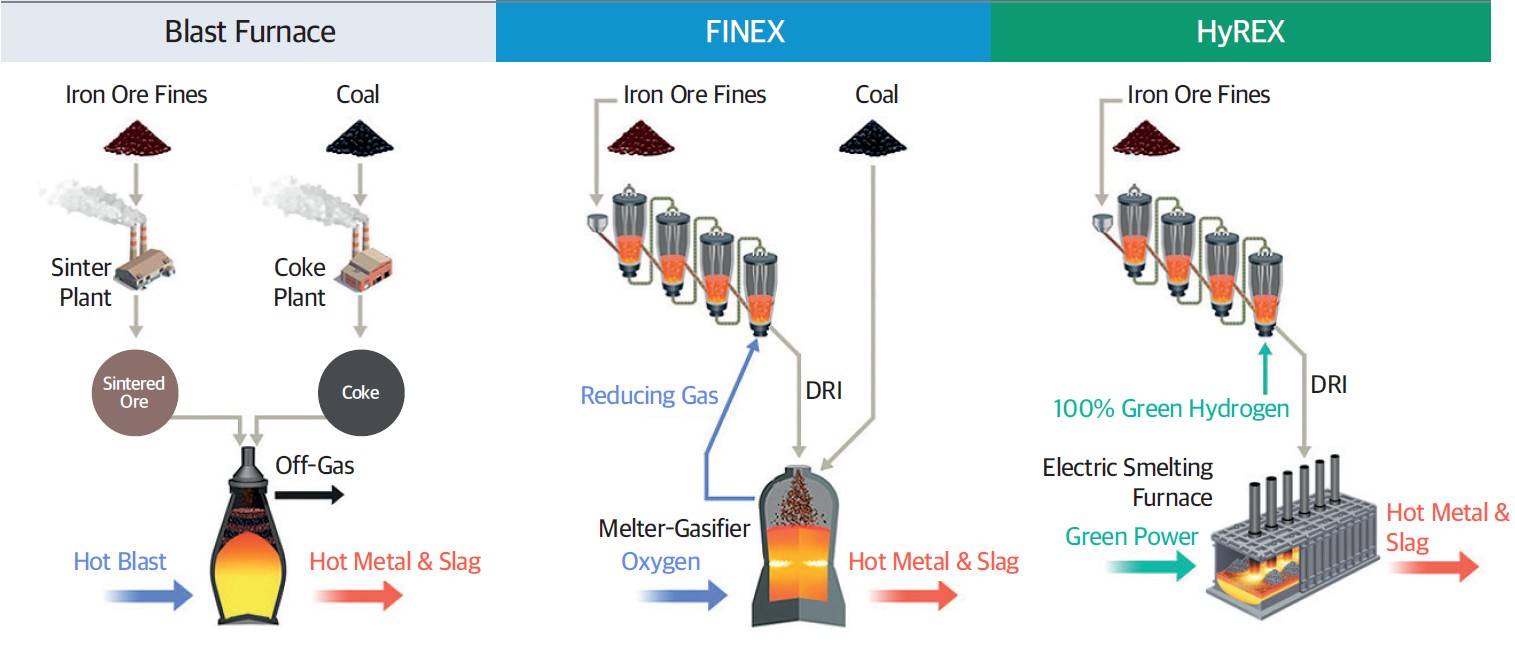
Traditional blast furnace steelmaking relies on coal as the reducing agent to remove oxygen from iron ore. At temperatures exceeding 1,500°C, coal combustion generates carbon monoxide, which strips oxygen from the ore while simultaneously melting the reduced iron to produce molten iron. Both reduction and smelting take place within a single coal-based blast furnace, and so, carbon dioxide emissions have been a structurally unavoidable byproduct.
HyREX takes a fundamentally different approach. Instead of relying on fossil fuels, high-temperature hydrogen is injected to remove oxygen from iron ore. Hydrogen serves as the reducing agent, and so, water—not carbon dioxide—is produced as the byproduct. The reduced solid iron is converted into Direct Reduced Iron (DRI) before being melted in a separate smelting process to produce molten iron. Replacing coal with hydrogen fundamentally changes the emissions structure of steel production.
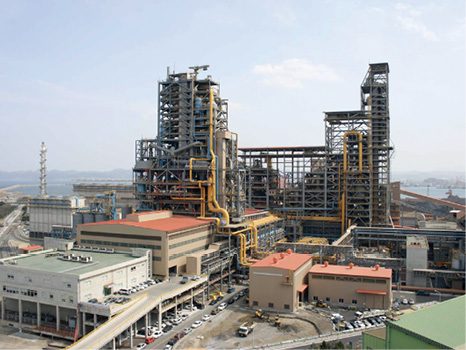
HyREX builds POSCO's commercially proven FINEX1 process, specifically, its fluidized-bed reduction technology. While reduction technologies using 100% hydrogen have yet to reach commercial deployment anywhere in the world, POSCO is leveraging decades of operational experience using hydrogen in the reduction stage of FINEX to develop HyREX, with the goal of raising the hydrogen ratio up to 100%. By integrating a new decarbonization process with an established technology platform, HyREX represents the next evolution of POSCO's proprietary technologies.
- 1.FINEX: Short for Fine Iron Ore Reduction Execution, FINEX is an innovative steelmaking process developed by POSCO and commercialized in 2007. Unlike the conventional blast furnace route, FINEX eliminates the need for coke making and sintering by directly using iron ore fines and non-coking coal to produce molten iron.
“POSCO is leveraging decades of operational experience using hydrogen in the reduction stage of FINEX to develop HyREX, with the goal of raising the hydrogen ratio up to 100%.”
 POSCO FINEX2 Plantcial
A Korean Technology That Uses Iron Ore Fines Directly
The most distinctive competitive advantage of HyREX lies in its raw materials. Most overseas steelmakers developing hydrogen reduction steelmaking technologies use shaft furnaces2, which require high-grade DR-grade pellets—iron ore processed into uniformly sized pellets—as feedstock. By contrast, HyREX's fluidized-bed reduction technology can utilize ordinary iron ore fines directly from the mine without additional processing. The distinctive process has a direct impact from the very beginning.
Such a difference could become a significant competitive advantage as hydrogen-based steelmaking enters commercial deployment. Of the world's approximately 1.7 billion tons of annual iron ore supply, only about 4% is suitable for producing DR-grade pellets, raising concerns about intensifying global competition. HyREX, however, uses abundant and lower-cost iron ore fines, providing both greater supply security and a cost advantage.
Another fundamental differentiating factor is how fluidized-bed reactors interact with iron ore. In a shaft furnace, hot reducing gas flows through stacked pellets, where the reduction reaction takes place. In contrast, reducing gas is evenly injected through a bottom distributor plate into a fluidized-bed reactor, mixing with fine iron ore particles while suspended within the reactor. Similar to when liquids are mixed, hydrogen comes into close contact with suspended ore particles, which then undergo reduction. The reactor's precision temperature control across multiple reaction stages enables the stable processing operations of a wide variety of iron ore fines.
This is precisely why POSCO describes HyREX as a Korean Hydrogen Reduction Ironmaking technology. Korea relies entirely on imported iron ore, and so, it is essential to develop a process that can utilize diverse raw materials rather than depending on scarce, high-grade feedstock. Built on decades of expertise in fluidized-bed reduction technology, HyREX is a proprietary decarbonized iron and steelmaking technology optimized for Korea's raw material supply conditions and industrial environment.
- 2.Shaft Furnaces: A vertical cylindrical reduction reactor widely adopted by European and U.S. steelmakers developing hydrogen-based steelmaking technologies. Iron ore pellets are charged from the top of the furnace, while heated reducing gas—produced from reformed natural gas or hydrogen—is injected from the bottom. The gas passes through the permeable bed of pellets, producing DRI.
Completing the Decarbonization Process with the Electric Smelting Furnace
Hydrogen-based steelmaking does not end with the production of DRI in the reduction reactor. The reduced solid iron must then be melted to produce molten iron, making the smelting stage an equally essential part of the process. This is why POSCO is developing Electric Smelting Furnace (ESF) technology alongside its fluidized-bed reduction reactor.
Conventional electric arc furnaces (EAFs) primarily use steel scrap and DRI as feedstock. However, both materials have inherent limitations. Steel scrap contains residual impurities, making it difficult to produce high-quality flat steel products such as automotive sheet steel. DRI, meanwhile, contains gangue3 minerals that generate large volumes of slag4 during smelting, which reduces efficiency while increasing electricity consumption.
POSCO's ESF is being developed to overcome these limitations. By maintaining a reducing atmosphere inside the furnace, it minimizes the loss of iron contained in the DRI while allowing slag composition to be controlled much like in a conventional blast furnace. Moreover, the slag generated during the process can be recycled as a raw material for cement, contributing to a more circular use of resources.
Ultimately, the competitiveness of HyREX lies not only in reducing iron ore with hydrogen. Its true strength comes from integrating a fluidized-bed reduction reactor capable of processing a wide range of raw materials with an ESF that melts the reduced iron efficiently and reliably. Together, these technologies complete the Korean-style Hydrogen Reduction Ironmaking system.
- 3.Gangue: The non-valuable mineral components contained in ore. In steelmaking, gangue refers to impurities such as silicon (Si) and aluminum (Al) present in iron ore that must be removed during the smelting process.
- 4.Slag: A byproduct formed when gangue (impurities) separated from iron ore reacts with fluxes such as limestone and rises to the surface of the molten metal. Once regarded simply as industrial waste, slag is now recycled almost entirely as a raw material for cement, fertilizer, and other products, making it an important resource in the circular economy.
Ambitious Moves Toward Setting a Global Standard in Steelmaking
POSCO aims to complete the commercial development of HyREX by 2030 before gradually transitioning to commercial-scale plants, contributing to Korea's broader national decarbonization transition. Demonstration projects are already progressing in stages. In April 2024, the company successfully produced its first 15 tons of hot metal using a pilot ESF capable of producing up to one ton of hot metal per hour, establishing a technological foundation for future commercialization. POSCO has also begun constructing a large-scale electric arc furnace in Gwangyang with an annual production capacity of 2.5 million tons, which will serve as a transitional solution for reducing carbon emissions while the next generation of steelmaking technologies is being commercialized.
The decarbonization of the steel industry is no longer a challenge for the distant future. CBAM, ESG disclosure requirements, and increasingly stringent global supply chain regulations are turning steel product production methods into a key measure of competitiveness. In the years ahead, the industry's success will depend not only on steel production capacity and quality, but also how low-carbon its steelmaking process can become. HyREX is POSCO's answer to that challenge. The transition from coal to hydrogen, and from the blast furnace to a combination of fluidized-bed reduction and ESF technologies, represents a major milestone in demonstrating how the steel industry can continue to evolve in the era of decarbonization.