in Issue & Trend
Opening the Way for Space Logistics with
Microsatellite Propulsion Technology
Dong-ha Park, CEO, Cosmo Bee
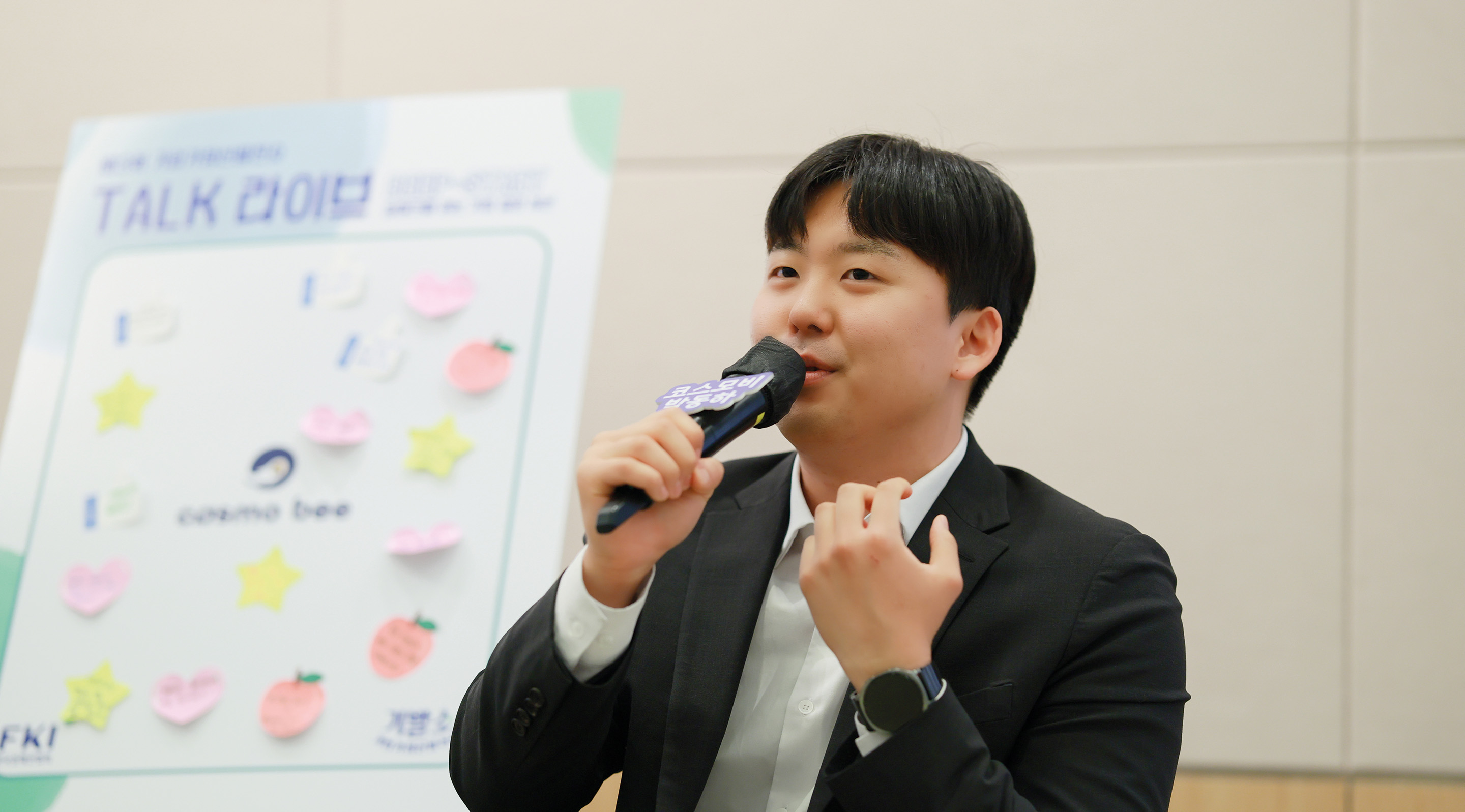
A satellite that strays from its intended orbit may lose its way before it can complete its mission. Dong-ha Park, CEO of Cosmo Bee, develops space propulsion systems that ensure satellites reach precisely where they need to be. By pioneering compact, lightweight propulsion technologies for the New Space era, Park is opening up the New Space market. As a speaker at the FKI Entrepreneurship Power House Live TALK, he shared the story of his entrepreneurial journey and the value of taking on challenges with youth participants joining the event both online and offline.
By Na-yeon Kim
Photo Credit FKI
You chose entrepreneurship over the relatively stable career path of a researcher. What gave you the confidence to start your own company?
During my junior year of college, I took a course on entrepreneurship. I had never thought of starting a business before, but the course inspired me to seriously consider it. With graduation approaching in my senior year, I was thinking about my future and realized that that entrepreneurship course was a major turning point. I had always wanted to become a space researcher, but I did not have a clear vision of my career. I have always been drawn to take on challenges that others may have shied away from and I do value creating meaningful change. Entrepreneurship aligned perfectly with my mindset, and it gave me the confidence to pursue a path less taken.
After launching a lab-based startup, what was the biggest challenge of actually running a business?
Developing the technology itself was less of a challenge than translating that technology into the language of business and building an organization around it. Every step was a new one, from finding co-founders who shared the same vision to establishing the company's legal and institutional foundations, including equity allocation and shareholder agreements. For deep-tech companies focused primarily on B2B and B2G markets, building technological credibility through government-funded R&D projects is often more important than generating immediate revenue. As both an undergraduate student and a founder, I experienced plenty of trial-and-error navigating that process. Today, my role has evolved beyond developing technology. My goal every day is to become a better leader by fostering effective communication between and among investors, customers, and our own team.
As the New Space era reshapes the industry, what is Cosmo Bee's core business model?
Cosmo Bee develops propulsion systems that enable all satellite maneuvers for microsatellites—from orbital insertion, station-keeping, collision avoidance, and controlled deorbiting at the end of its operational life. A simple explanation would be that we build space navigation engines, ensuring that satellites reach the exact intended point. Whereas the traditional space industry has focused on large satellites, we develop low-power, cost-effective propulsion systems optimized for microsatellites that weigh less than 200 kilograms, reflecting the needs of the New Space era. Our long-term goal is to become a key infrastructure partner for satellite system companies. We aim to support the rapidly expanding market for satellite constellations by enabling space logistics infrastructure through our propulsion technologies.
Proving component reliability in the space industry is an extremely demanding process. What was Cosmo Bee's latecomer strategy to secure technological differentiation and market trust?
Success in the space industry depends not on ground-test specifications but proving that components function correctly in extreme space conditions. Cosmo Bee has strategically leveraged opportunities on the 4th, 5th, and 6th launches of the Nuri launch vehicle to validate our technologies one step at a time. Under actual spaceflight conditions, we proved that our technology works, from individual components to complete propulsion systems. Many startups struggle to commercialize their technologies because they cannot overcome the barrier of verifying reliability, but we took a different approach. Building on two decades of research conducted at KAIST, we improved manufacturability while also accumulating real flight data through demonstration missions aboard the Nuri rocket. Data from such missions is Cosmo Bee’s core competitive advantage and the basis for quickly establishing ourselves as a partner to Korea’s satellite system companies.
You have targeted the technically demanding but relatively untapped markets of very low Earth orbit and microsatellites. How do entrepreneurs develop the ability to identify these market opportunities?
Identifying market opportunities requires paying close attention to customer pain points. Cosmo Bee's business model originated from closely observing the demands of the global satellite market and understanding the challenges our customers face in the field. It is also important to study competitors and monitor technological developments, but continuously engaging with customers must be the highest priority. The key to innovation lies in solving customers' pain points.
Deep-tech startups face far greater technical and commercialization challenges than other companies. What qualities are most important to becoming a successful deep-tech leader?
I believe the two most important qualities are strategic thinking and the ability to lead people. Managing relationships among individuals is something every leader must do. For deep-tech founders, however, there is an additional challenge: connecting highly complex technologies with uncertain market realities. More than 75% of my work involves meeting people—helping investors without technical backgrounds understand our technology, bridging the gap between highly specialized engineers and the business front lines and overcoming the barriers posed by legacy industries. This requires the ability to meet high expectations for communication and coordination. Ultimately, deep-tech leadership is about more than technical expertise. It is about bringing together people, strategy, and technology to turn a vision into reality.
As a student and an entrepreneur, what is your ultimate aspiration, beyond a developer of technology?
I believe politicians and entrepreneurs are the two most powerful forces for changing the world. Politicians transform nations and societies, while entrepreneurs change how the world works by creating technologies, products, and services. My ambition is not simply to develop better technology, but to use that technology to improve people's lives through products that make a meaningful difference. To me, the true role of an entrepreneur is to turn this ambitious vision into reality alongside supportive colleagues.