
in Focus
「Business Survey Index (BSI) for July 2026」
An Export-Led Recovery:
A Critical Juncture for Strengthening
Economic Fundamentals
With the recent geopolitical risk driven by events in the Middle East having passed their peak, business sentiment among Korean companies appears to have passed its most difficult phase. However, a full return to normal conditions is likely to take time. According to the Business Survey Index (BSI)1 for July 2026 released by FKI, the BSI outlook for July came in at 98.0, down slightly from 98.6 in the previous month. Although export sentiment, supported by strong semiconductor performance, remained above the baseline of 100 for a second consecutive month, business confidence across the broader manufacturing sector remains subdued due to the cumulative impact of external uncertainties. At this juncture, it is critical to boost business vitality and pursue economic stabilization measures aimed at spreading the current positive export momentum.
- 1.An index that quantifies companies' assessments and outlook for business conditions. A BSI outlook that surpasses 100 signifies positive business sentiment for the overall economy, relative to the prior month, and vice versa.
By Na-yeon Kim
Source FKI
Business Survey Index (BSI) for July 2026
•Survey period: June 11–18, 2026
•Respondents: Korea's 600 largest companies by revenue across industries, excluding the financial sector
•Response rate: 58.8% (353 companies)
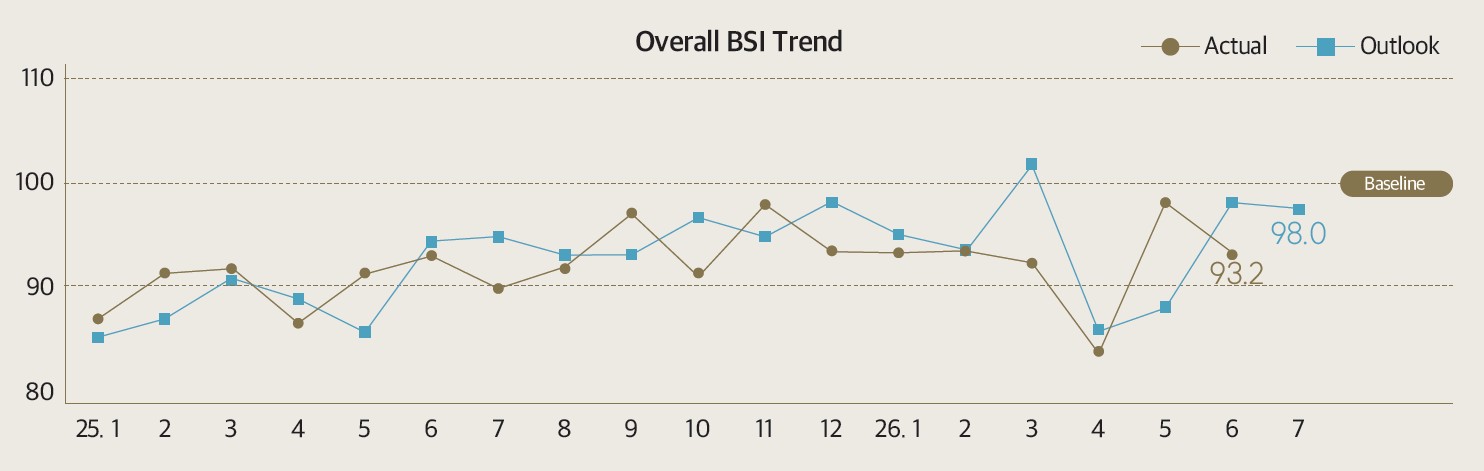
The BSI outlook for July 2026 stood at 98.0. After posting a positive reading of 102.7 in March, the index has remained below the baseline for four consecutive months, recording 85.1 in April, 87.5 in May, 98.6 in June, and 98.0 in July.
Meanwhile, the actual BSI for June came in at 93.2, marking 53 consecutive months below the baseline since February 2022 (91.5).
- The slight decline appears to reflect a combination of a base effect following the sharp rebound in the previous month and persistent challenges facing businesses on the ground, suggesting that overall business sentiment remains cautious.
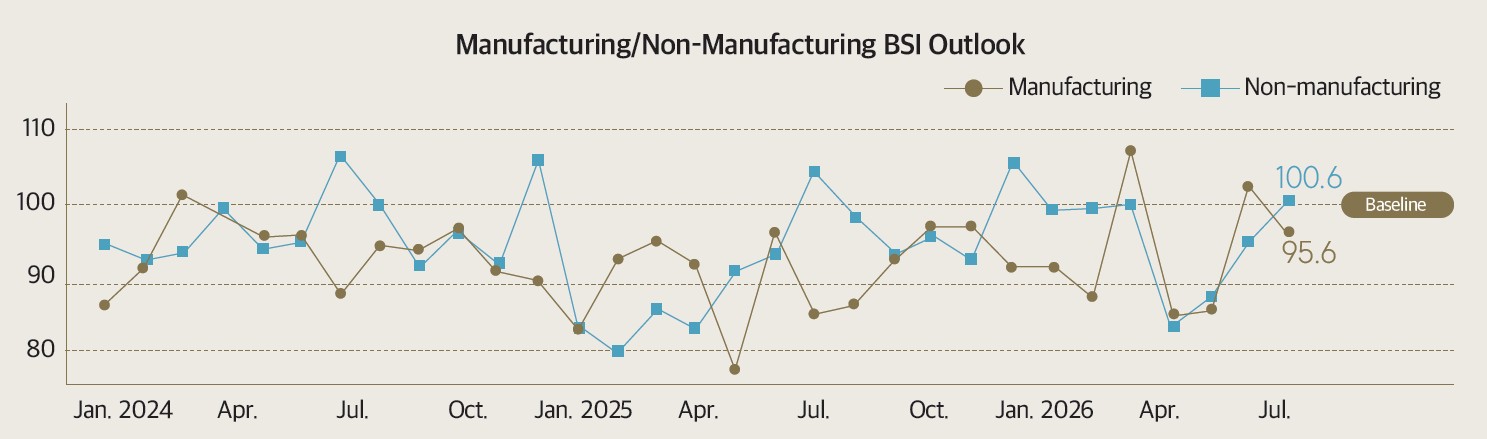
Business sentiment diverged sharply across sectors. The manufacturing BSI outlook fell to 95.6, slipping back into negative territory just one month after temporarily rebounding to 101.7 in June. By contrast, the non-manufacturing BSI outlook rose to 100.6, surpassing the baseline for the first time in seven months since December 2025 (105.2).
- This divergence suggests that the recovery is not yet broad-based across the economy. Instead, business sentiment continues to vary significantly by industry, reflecting sector-specific conditions and temporary tailwinds rather than a uniform improvement in economic activity.
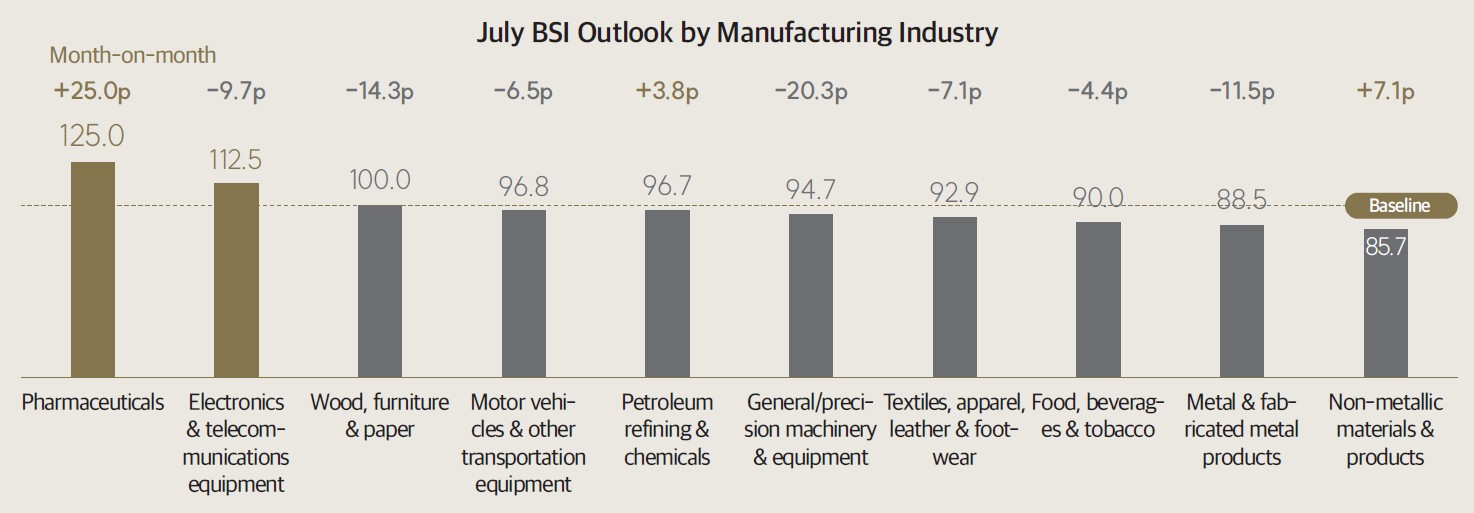
Among the 10 manufacturing industries, only pharmaceuticals (125.0), supported by robust healthcare demand, and electronics & telecommunications equipment (112.5), buoyed by the semiconductor boom, remained well above the baseline, helping to put a floor under the manufacturing index. Apart from wood, furniture, and paper, which narrowly reached the baseline, all other industries posted negative outlooks.
- This indicates that the improvement in manufacturing sentiment continues to depend on demand in a handful of industries, particularly semiconductors and healthcare, rather than reflecting a broad-based recovery across the manufacturing sector.
- With most industries still below the baseline, recovery momentum across manufacturing remains limited.
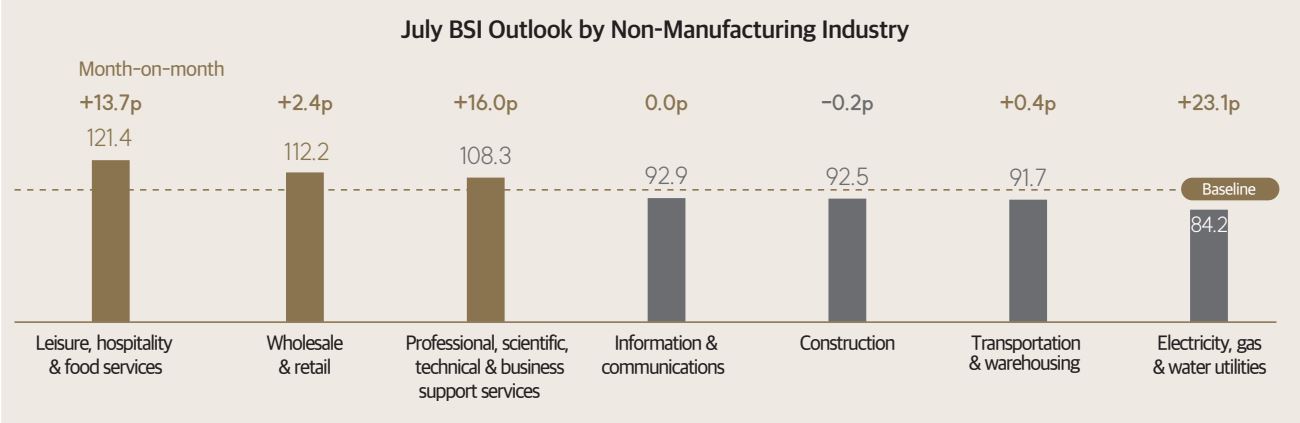
Within the non-manufacturing sector, leisure, hospitality & food services (121.4), wholesale & retail (112.2), and professional, scientific, technical & business support services (108.3) posted positive outlooks. In contrast, infrastructure-related industries continued to lag, with information & communications (92.9), construction (92.5), transportation & warehousing (91.7), and electricity, gas & water supply (84.2) all remaining below the baseline.
- The strength in service industries appears to reflect increased outdoor activity and early demand ahead of the summer vacation season.
- Although the signing of a memorandum of understanding to end the war between the United States and Iran has somewhat eased uncertainty over international oil prices, the recovery in business sentiment in energy- and transportation-related industries remains slow amid accumulated cost burdens and rising inventories.
The Export BSI outlook stood at 100.6, remaining above baseline for a second consecutive month for the first time in four years and nine months. Semiconductor export strength continues to drive overall export sentiment.
- Despite persistent uncertainty in the global economy, the semiconductor sector continues to serve as a pillar of support for the Korean economy.
- The extent to which this solid export momentum spreads into a broader economic recovery will be a key variable for the economy in the second half of the year.
With the exception of exports, all major business indicators remained below the baseline2, including domestic demand (96.9), investment (95.5), employment (94.9), and financing conditions (91.5).
- This suggests that the recovery led by export-oriented industries has yet to spread evenly to domestic demand-driven industries or improve profitability across the corporate sector.
- In particular, continued pressure from raw material procurement costs and financing expenses is weighing on companies' financing conditions and profitability, highlighting the erosion of their underlying financial resilience.
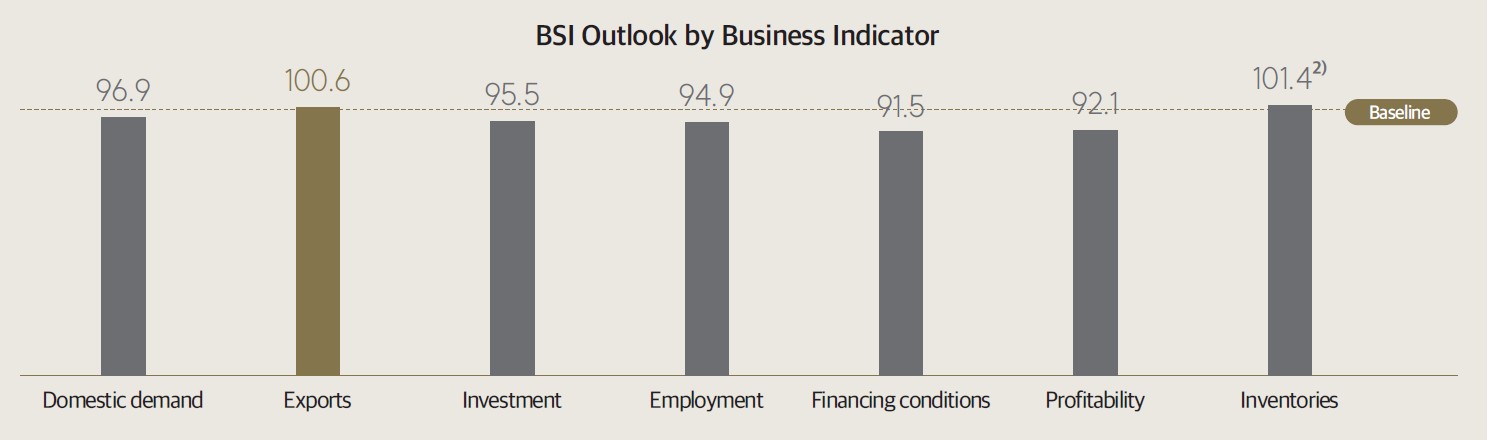
- 2.For inventories, a reading above 100 indicates a negative outlook.
The latest survey underscores the divergence across industries and business indicators beneath the headline signs of economic recovery. While specific manufacturing industries such as semiconductors and pharmaceuticals are leading exports and seasonal demand is supporting service industries, traditional manufacturing industries and domestic demand-driven infrastructure sectors remain constrained by accumulated cost burdens and tightening financing conditions. Becoming overly optimistic about short-term export indicators while overlooking deteriorating corporate profitability and mounting financing pressures would make it difficult to avoid a vicious cycle of weaker long-term investment and declining employment.
To ensure that the recent strong recovery in the Korean economy spreads across all industries, carefully targeted policy measures to ease regulations and address tight funding markets are urgently needed. The priority now is to create a virtuous cycle in which export gains stimulate domestic demand, turning the modest rebound seen in the first half of the year into a firm economic recovery.