
The Reemerging Importance of Energy Security: New Imperatives for Energy, Supply Chains, and Industrial Strategy
Keys to Success in the Global Power Market:
Field Execution and Speed
Kiyeoung Kweon, Senior Vice President, Hyosung Heavy Industries
In the past, power grids were viewed merely as public utilities. Today, they have become core security assets that underpin national industrial survival, as well as strategic assets for companies. As Hyosung Heavy Industries continues to post record-high quarterly earnings amid the global supercycle in ultra-high-voltage power equipment, Senior Vice President Kiyeoung Kweon shares his perspective on the structural transformation reshaping global energy transition, the challenges businesses face, and the strategies needed to navigate the next era of energy.
By Na-yeon Kim
Photo Credit Kyu-chul Shin
Q. At IEEE PES T&D 2026 in Chicago this May, what was the most significant structural change you observed in the global power market?
In the past, electricity was simply the behind-the-scenes infrastructure that supported industry. Today, the speed of grid development determines the pace of industrial investments for both companies and nations.
The exhibition in Chicago illustrated this transformation. Once an event attended primarily by electric utilities, it has evolved into an active gathering of AI hyperscalers, major manufacturers, and government policymakers.
In the United States, insufficient electricity supplies have already led to industrial investment delays. A single hyperscale AI data center can consume as much electricity as a mid-sized city. As a result, ultra-high-voltage infrastructure such as transmission networks, transformers, and circuit breakers are no longer just another category of equipment but rather a source of industry's biggest bottlenecks.
Previously, energy security centered on securing fuel supplies and managing oil prices. Today, the industrial landscape itself is being reorganized around electricity. Ultimately, national competitiveness will be determined by the speed and execution of building reliable power infrastructure.
Q. Expanding manufacturing capacity for products such as ultra-high-voltage transformers and circuit breakers is particularly challenging. How did Hyosung Heavy Industries anticipate these structural shifts and build its competitive advantages?
In the power equipment industry, today's investments do not immediately translate into tomorrow's finished products. For ultra-high-voltage transformers and circuit breakers, decades of accumulated manufacturing expertise and proven field performance are essential to establishing reliable quality. Utility customers are understandably conservative, and earning their trust around the world requires enormous investments of both time and resources.
Our ability to establish a strong global position stems from one conviction: regardless of short-term concerns, investment in power grids was structurally inevitable. This belief led us to enter the U.S. ultra-high-voltage market early and consistently invest in core technologies such as HVDC and ultra-high-voltage circuit breakers.
Understanding structural trends means more than forecasting demand. It means identifying the challenges customers will face years before they encounter them. Having accumulated technologies tailored to different grid environments and technical requirements of markets like North America and Europe, we positioned ourselves to respond rapidly and decisively during a period of market transformation.
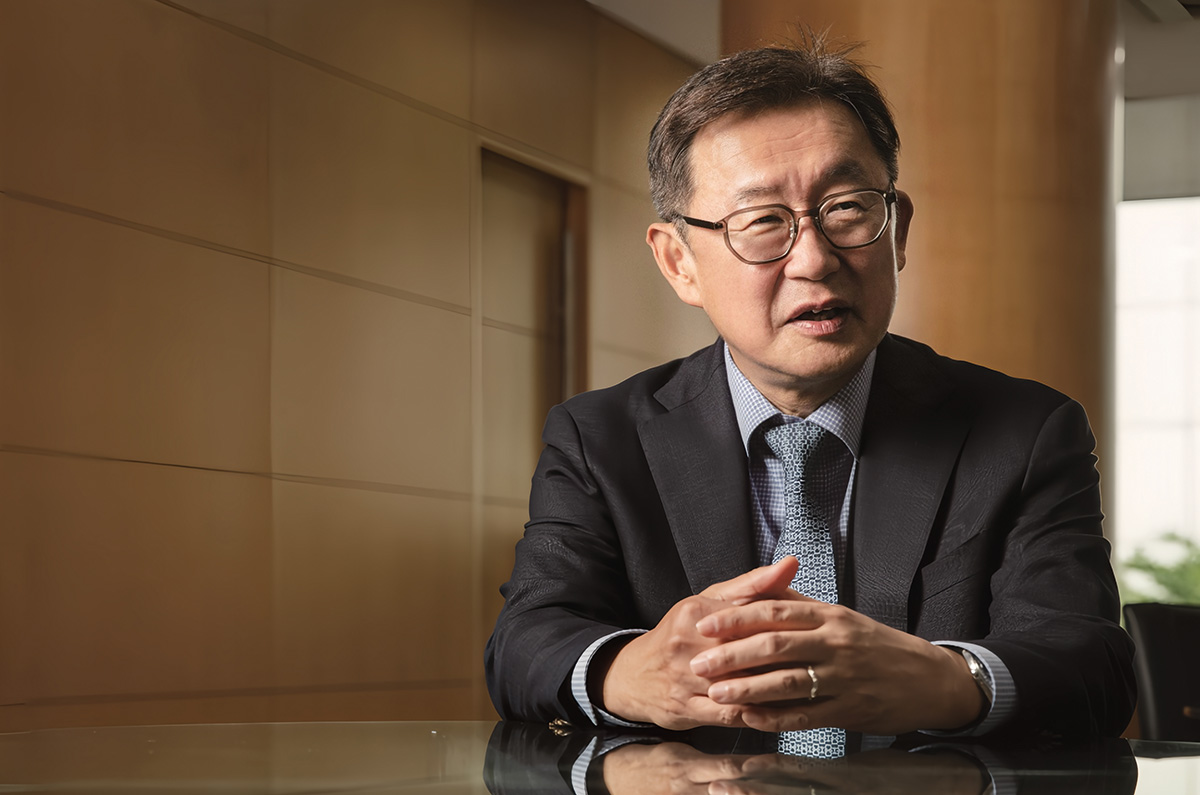
“Today, the industrial landscape itself is being reorganized around electricity. Ultimately, national competitiveness will be determined by the speed and execution of building reliable power infrastructure.”
Q. Hyosung Heavy Industries has established a strong presence in the global ultra-high-voltage market, including the U.S. 765 kV segment. What is the key to your success, and what challenges must be overcome to sustain your leadership?
The era of competing primarily on price has already ended. Above all, customers today ask one question: Can you deliver on schedule? Even a one-month delay in a power grid project can trigger cascading cost increases.
Hyosung Heavy Industries’ core competitiveness lies in supply stability and delivery responsiveness. Amid severe global supply constraints, the ability to consistently deliver high-quality equipment on time has become a formidable barrier to entry.
Power infrastructure is expected to last for more than 30 to 40 years, and so, customers look for more than manufacturers that simply supply equipment; they seek strategic partners capable of supporting the entire lifecycle of the asset. That is why we are expanding beyond manufacturing into a global power solutions partner role.
Q. HVDC technology and the "energy highways" initiative have recently emerged as critical components of national energy security. What is the significance of Hyosung Heavy Industries becoming the first Korean company to develop its own HVDC technology, and what is your long-term vision?
Transitioning to renewables, especially through solar and wind power, entails a geographic mismatch between electricity generation and consumption. HVDC transmission provides the critical infrastructure needed to transport large volumes of electricity over long distances with minimal losses.
Today, HVDC has implications far beyond transmission technology. Particularly in Korea and Northeast Asia, where electricity demand is highly concentrated, “energy highways” connecting generation sites to areas of consumption can serve as a defining factor for a successful national-level energy strategy.
Beyond import substitution or product development, becoming the first Korean company to develop proprietary HVDC technology is significant because we can provide the means to secure technological sovereignty over one of the most critical components of national power infrastructure. In an era of global supply chain disruption, possessing core technologies allows a country to achieve technological sovereignty over its national power grid while also maintaining industrial competitiveness. Without those technologies, it would not be possible to be either operationally flexible or have long-term market leadership.
Our vision is straightforward. Building on our proprietary HVDC technology, we will continue to expand our portfolio of long-distance, high-capacity transmission solutions tailored to evolving global demand. We anticipated these structural changes early, and we will lead the global market for energy highway initiatives through speed and decisive execution.
Q. Having worked closely with leading companies around the world, where do you see the biggest differences in corporate energy strategies? What should Korean companies prioritize?
The differences among corporate energy strategies become most apparent when companies decide where to make their next major investment. Global technology companies and data center operators no longer view energy simply as an operating expense; rather they consider it one of their most important strategic assets. Before deciding to invest, a simple question is posed: Can we secure a source of long-term, reliable and clean electricity? Without a clear positive answer, the investment would not be made, regardless of the market opportunity.
Many Korean companies, however, still tend to approach energy primarily as an operating cost, something to be procured and dealt with after the investment has been made.
Therefore, the most urgent challenge is a paradigm shift in companies' approach toward energy. In the years ahead, competitive advantage will depend less on getting the cheapest electricity and more on securing a reliable supply when needed, ensuring consistent power quality, and demonstrating credible carbon management capabilities that satisfy increasingly stringent global regulations. Companies should recognize that even world-class manufacturing technologies may prove insufficient if they fail to secure the necessary power infrastructure. Delaying efforts to secure power infrastructure heightens the risk that one may be excluded from future global supply chains.
Q. Many companies have announced RE100 commitments and net-zero targets, yet they often encounter significant obstacles during implementation. From the perspective of power infrastructure, how should companies approach renewable energy procurement and develop a realistic pathway toward carbon neutrality?
Many RE100 commitments and net-zero pledges fail to move beyond declarations because they are treated as matters of obligation or corporate image. Leading companies take a very different approach. They do not view carbon neutrality as an ESG reporting exercise or merely a matter of regulatory compliance.
From a power infrastructure perspective, a company's transition must take the following three concrete steps:
The first step is a shift in mindset. Carbon neutrality must be redefined not as a cost, but as a source of core competitive advantage.
The second step is strategic alignment. A company's power procurement strategy, manufacturing strategy, and investment strategy must move like clockwork, as integrated components of a long-term business plan. Before expanding production capacity, companies should first determine whether sufficient power infrastructure and renewable energy resources can support the project.
The third step is building an integrated energy architecture. Rather than relying on temporary measures such as purchasing Renewable Energy Certificates (RECs), companies should develop long-term strategies that integrate energy efficiency improvements, ESS for peak demand management, and resilient on-site power grid systems capable of accommodating the intermittency of renewable energy.
Ultimately, the energy transition is no longer simply about environmental stewardship. It has become a prerequisite for business survival. Companies that can rapidly build and deploy integrated systems based on the above three steps will be best positioned to secure both real survival capacity and leadership in future markets.
Q. As countries pursue decarbonization and grid modernization, companies often encounter institutional and social barriers that extend far beyond technology and financing. What policy priorities should governments address to support private-sector execution?
Once the energy transition moves beyond ambitious announcements and into the actual construction of infrastructure, the greatest obstacles are no longer technology or financing. The power industry is not simply another manufacturing sector; it is an ecosystem built upon complex social infrastructure.
Even with world-class ultra-high-voltage technologies and sufficient capital, progress can stall because of lengthy permit procedures, public acceptance challenges associated with long-distance transmission lines, and shortages of highly skilled professionals capable of coordinating all these elements.
The greatest dilemma today is the widening gap in speed. The electricity infrastructure demand from AI is expanding at an exponential pace, yet transmission development and permit processes continue to operate on timelines designed for traditional long-term infrastructure projects. Individual companies cannot bridge this gap alone.
The government's most important role is therefore to create a predictable and rapid policy environment. It is necessary to develop a long-term national grid master plan, modernize permit procedures, and create effective mechanisms to address public acceptance issues. Going forward, a country's speed of expanding reliable power infrastructure will be a solid foundation for both economic competitiveness and national security.
Q. Finally, what is Hyosung Heavy Industries' vision for the future energy ecosystem? And what advice would you offer to the next generation of business leaders and young engineers who will shape this transformation?
The future power industry will become the powerful behind-the-scenes engine that sustains the global industrial ecosystem. Every breakthrough that defines the future, from AI and semiconductors to hyperscale data centers, ultimately depends on reliable power infrastructure. Although power industry operations may go unseen by the wider public, those working on power grids should be proud that they are supporting the very foundation of national industries and national security.
My advice to future business leaders and young engineers is simple: the answers are always found in the field.
Technical specifications and engineering drawings alone are not enough to succeed in the global marketplace. A strong engineering foundation must be complemented by a broader perspective: the ability to recognize structural shifts in global markets and to understand the operational challenges of customers' power systems. It will be field-oriented engineers, with a holistic view of technology, markets, and operations - as well as the ability to execute - who will reshape the energy market of the future. I hope the next generation will build on the foundation that has been established, and expand the frontiers of the future energy market with even greater boldness and speed.