The Reemerging Importance of Energy Security: New Imperatives for Energy, Supply Chains, and Industrial Strategy
Middle East Risks, Surging AI Power
Demand, and Corporate Energy Strategy:
Placing Electric Power at the Center of a New Strategy
The energy supply chain disruptions triggered by the Strait of Hormuz crisis, combined with soaring electricity demand driven by artificial intelligence, have exposed businesses worldwide to energy risks unlike anything seen before. Electricity is no longer merely an operating cost to manage. It has become a strategic asset that determines production, investment, and sustainability. Reliable power supplies have become a prerequisite for competing in the AI era, and companies must look beyond short-term cost reduction and develop practical strategies for securing power-including long-term power procurement, diversification of generation sources, and linking PPAs, SMRs and ESS.
By Soon-han Bae, Director, Deloitte Insights
Structural Vulnerabilities in Power Procurement
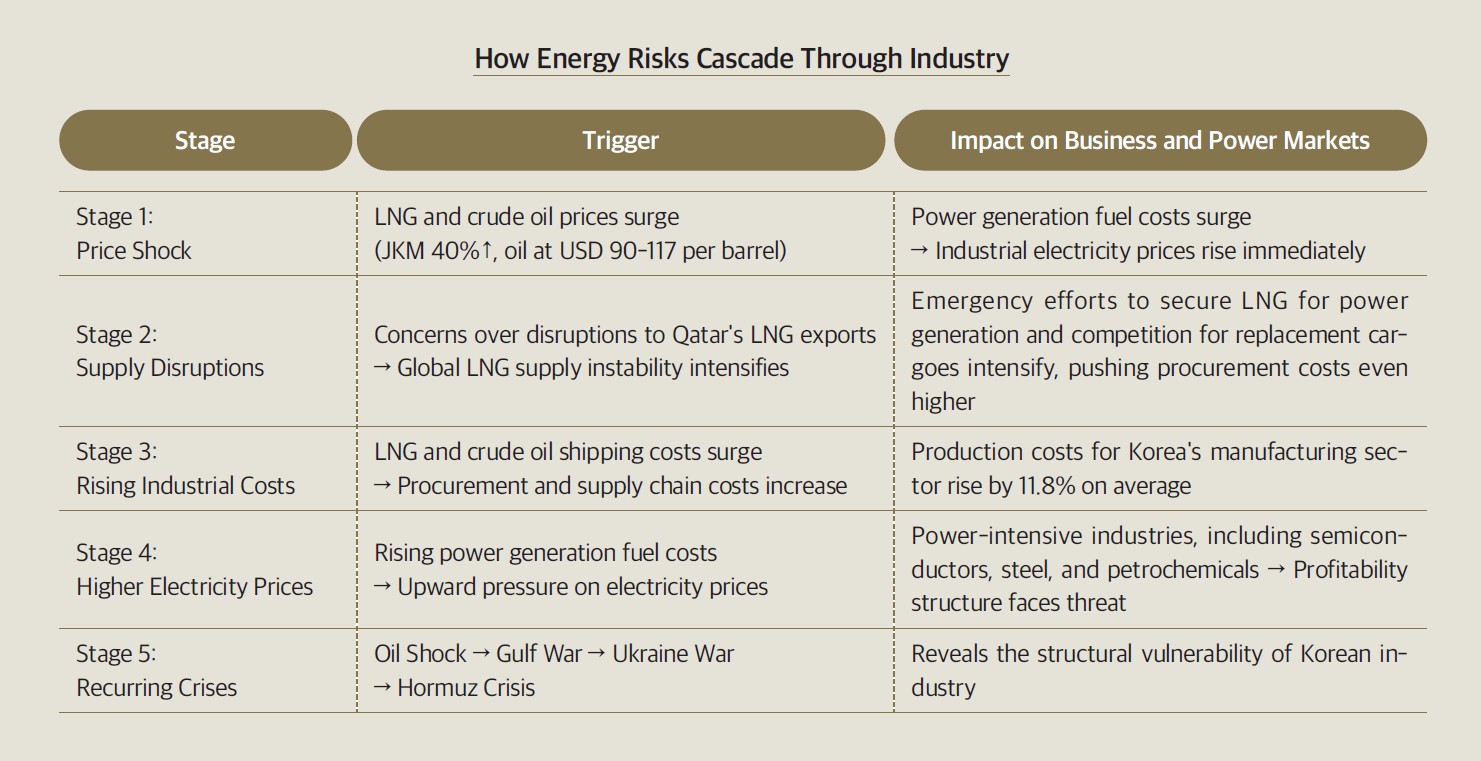
On February 28, 2026, the United States and Israel launched military strikes against Iran. Iran responded immediately by moving to close the Strait of Hormuz. One of the world's most critical maritime corridors, through which approximately 20–25% of global LNG shipments pass, faced severe disruption, and Qatar, the world's largest LNG exporter, declared force majeure on portions of its LNG contracts. Meanwhile, Iran attacked Israeli and U.S. military bases in Bahrain, the UAE, and Kuwait. Volatility in global LNG markets surged immediately after the outbreak of hostilities. European natural gas prices jumped by as much as 35% in a single day following attacks on Middle Eastern energy facilities, while LNG shipping rates rose sharply. The closure of the Strait of Hormuz and the resulting disruption to maritime transportation sent shockwaves through the global energy supply chain.
Korea is particularly vulnerable to such disruptions with roughly 70% of its crude oil imports and 15% of its LNG imports passing through the Strait of Hormuz. With Korean crude oil imports amounting to approximately 1.77 million barrels per day, any disruptions to shipping through the strait would immediately expose Korea's power plants and industrial sites to unstable fuel supplies and rising cost pressures simultaneously. The underlying challenge for Korea is its heavy dependence on LNG for electricity generation. Higher LNG prices translate directly into higher fuel costs for generation, putting upward pressure on industrial electricity prices. Energy-intensive industries such as semiconductors, steel, and petrochemicals are especially vulnerable to risks associated with rising electricity prices and an uncertain supply of electricity. This could erode profitability and export competitiveness across the manufacturing sector in general. According to a March estimate by the Korea Institute for Industrial Economics & Trade, a Hormuz blockade lasting longer than three months would raise average production costs by 11.8% in the manufacturing sector and 9.4% across the broader economy. This supports the International Energy Agency's (IEA) description of the crisis as one of the largest oil supply shocks in modern history.
Explosive Growth in AI Power Demand
While geopolitical tensions threaten power supply, AI data centers are driving electricity demand to unprecedented levels. According to the IEA, global electricity consumption by data centers is projected to rise from approximately 415 TWh in 2024 to 945 TWh by 2030, more than doubling in just six years. AI data centers also differ fundamentally from conventional facilities in their electricity requirements. Whereas traditional data centers typically consume between 10 MW and 25 MW, hyperscale AI data centers require more than 100 MW. Moreover, GPU-based AI training and inference operate around the clock at near-maximum utilization and so, demand for electricity at hyperscale AI data centers has almost no flexibility. AI training cannot be paused when electricity prices peak mid-day, nor can data centers shut down when there is a decline in solar generation.
Google, which is committed to operating on 100% renewable energy, acknowledged in its 2025 Environmental Report that achieving its climate goals has become more complex and challenging at every level, effectively recognizing that rapidly growing AI electricity demand is unlikely to be met by renewable energy alone. Within PJM Interconnection, the largest wholesale electricity market in the United States, soaring demand from data centers is already leading to upward pressure on electricity prices. Capacity prices increased significantly, from approximately USD 29 per MW-day1 in 2024 to roughly USD 329 per MW-day in 2026. PJM2and market analysts attribute much of this increase to the rapid expansion of AI-driven electricity demand. The current pace of growing demand for electricity is pushing existing power systems beyond what they were originally designed to accommodate.
- 1.MW-day: The price of securing 1 MW of electricity generation capacity for one day.
- 2.PJM: The world's largest wholesale electricity market and regional transmission organization that serves the eastern United States. It provides one of the clearest examples of how AI-driven electricity demand is translating into market prices.
Power as a Strategic Asset: Global Leaders' Four Response Strategies
Korea faces an especially difficult challenge because its electricity grid is effectively isolated from external power grid interconnections. As a result, geopolitical supply disruptions and surging AI-driven electricity demand pose an even greater risk for Korea. Changing energy procurement sources would not be enough; a fundamental solution would involve redesigning Korea's procurement structure by reducing dependence on imported fuels and directly securing stable, long-term sources of power generation.
Recognizing electricity as a strategic asset rather than a simple expense, leading global companies are pursuing four key strategies to strengthen their power self-reliance.
First, global leaders are shifting from conventional grid purchases to long-term direct power procurement, securing stable electricity supplies for the next 10 to 20 years. Companies such as Meta, Microsoft, and Google are signing long-term PPAs with power producers, enabling large-scale investments in renewable energy projects and ESS, and are helping move them into construction.
Second, leading businesses are expanding investments in nuclear power and SMRs to meet AI-driven demand for electricity that renewable energy and existing grids alone cannot support. Microsoft’s Three Mile Island3 -based power procurement strategy and Google's partnership in the Duane Arnold Nuclear Plant Restart Project illustrate why major tech companies are increasingly viewing nuclear power and SMRs as essential sources of reliable baseload electricity, capable of providing large-scale, round-the-clock power.
Third, leaders focus not only on securing more electricity but also on using available power more efficiently. Alibaba and Tencent, for example, are expanding AI-based energy management systems and cooling technologies such as immersion cooling4, to improve energy efficiency. They aim to build operational buffers that allow computing capacity to be maintained even when electricity prices fluctuate or supply becomes constrained.
Fourth, global leaders are diversifying their overall power portfolios to reduce exposure to external shocks associated with dependence on a single fuel source or electricity grid. Chevron's efforts to develop an integrated power ecosystem in Texas by combining gas-fired generation, long-term PPAs, and ESS illustrate this approach. By integrating multiple sources of electricity, companies can strengthen both supply security and resilience against price volatility.
- 3.Three Mile Island: A nuclear power station in Pennsylvania, United States. It has become a prominent example of how major technology companies are exploring long-term PPAs to secure reliable baseload electricity for the AI era.
- 4.Immersion cooling: A cooling technology that removes heat by submerging servers in electrically non-conductive cooling fluid.
Opportunities and Challenges for Korean Businesses
The growing instability of electricity supply presents both a challenge and a significant opportunity for Korean businesses. Meanwhile, the gap is widening rapidly between companies that have already seized this opportunity and those that still lack a response strategy.
First, the power equipment industry is entering a supercycle driven by global supply shortages. Demand for transformers, circuit breakers, and other grid equipment is surging as AI data centers proliferate, but supply is struggling to keep pace due to lengthy design, testing, certification, and specialized transportation constraints. Lead times for large power transformers are stretched to as long as 210 weeks. Korean companies such as Hyosung Heavy Industries, LS ELECTRIC, and HD Hyundai Electric, which offer both competitive pricing and reliable delivery, are expanding exports to North America and the Middle East and are well positioned to benefit from this trend.
Second, intensifying global competition to secure nuclear power and SMRs is drawing renewed attention to Korea's nuclear industry. The IEA projects growing demand for next-generation nuclear energy - and Korea is well-positioned to capitalize on this, drawing on more than 40 years of accumulated experience and project execution capabilities. Korea's global competitiveness in nuclear energy has been reaffirmed through recent successes such as the winning of a Czech nuclear power project. As nuclear power and SMRs gain recognition as strategic sources of baseload electricity, this trend is likely to create new growth opportunities across Korea's nuclear ecosystem, which includes companies such as Korea Hydro & Nuclear Power (KHNP) and Doosan Enerbility.
Third, energy-intensive manufacturers, including semiconductor, steel, and petrochemical producers, face a growing dilemma. Electricity costs continue to rise, yet on-site power generation is often constrained by scale and location. Accelerating the transition to renewable energy can significantly increase costs, but delaying action exposes companies to mounting ESG requirements. These industries need diversified power portfolios that combine PPAs, renewable energy, ESS, nuclear power, and SMRs. At the same time, they need to integrate power procurement with production site planning and develop strategies to secure power. In the long run, competitiveness will be measured by how reliably and efficiently companies can manage limited power supplies.
Securing Power as a Core Business Strategy
Both issues—the heightened risk from closures of the Strait of Hormuz and the explosive growth of AI-driven electricity demand—originate from different forces, but they ultimately pose the same question to businesses: Will you still have enough electricity to power your factories and data centers tomorrow? The OECD's projection that Korea's economic growth will experience the sharpest slowdown among major economies due to the closure of the Strait of Hormuz serves as a stark reminder of the country's structural dependence on imported energy. Energy is no longer a matter of cost management for procurement departments—it is now a core business variable that shapes manufacturing, investment, data center deployment, and supply chain resilience.
Global leaders are responding by securing long-term electricity supplies through PPAs, strengthening reliable baseload generation with nuclear power and SMRs, and improving AI computing performance through cooling technology and power efficiency innovations. At the same time, they are building diversified power portfolios that combine renewable energy, ESS, gas-fired generation, and nuclear power to withstand external disruptions. Their objective is not to eliminate risk entirely, but to build a shock-absorbing structure through a diversified mix of power sources.
Ultimately, success in the AI era is unlikely to be determined by technological capabilities or manufacturing capacity alone. The companies that secure reliable long-term electricity supplies and use them most efficiently will gain the strongest competitive advantage. Power is no longer merely an operating expense. It is becoming a core strategic asset that will determine corporate competitiveness.