Special Interview
Leading the Future
of Global Power Infrastructure
Ja Eun Koo, Chairman, LS Group
Leading the Future
of Global Power Infrastructure
Ja Eun Koo, Chairman, LS Group
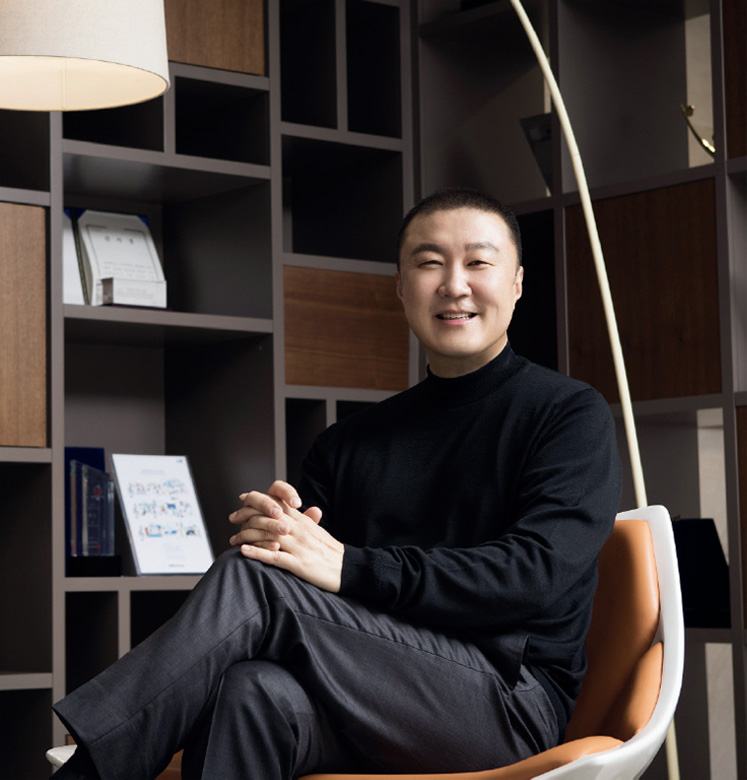
As the rapid expansion of AI and data centers drives unprecedented demand for power infrastructure, electrification has become a priority industrial issue. We sat down with Ja Eun Koo, Chairman of LS Group. A leading player in ushering in the era of electrification, LS Group has built a comprehensive value chain spanning copper, transmission, substations and power distribution. In the context of a global race for power grid leadership, Chairman Koo underscores the need for a blueprint to achieve energy security and argues that navigating this era of transformation requires practical leadership.
By Na-yeon Kim
Photo Credit LS Group
Q. Thank you for joining us today. You have long personally championed hands-on leadership from the front lines. Which areas are you focusing your attention on in this period of grand transformation?
A. I place great importance on management from the front lines because of my hands-on approach on future growth drivers. Every year, I visit major venues for cutting-edge technology such as CES in the United States and Hannover Messe in Germany to gain firsthand experience of the latest technological developments. This enables me to gain insights for the future of LS Group. I have also joined presidential business delegations to major economies, including the United States and China, and closely observed global business trends. Today, LS Group operates nearly 100 overseas sites across 25 countries, including ASEAN and Europe, and I visit these operations regularly to assess market sentiment on power infrastructure, the energy transition and the global power supercycle.
At the same time, I make it a priority to visit LS Group's key domestic and overseas facilities, including operations for battery materials, eco-friendly copper materials and submarine cables. I place heavy emphasis on these new projects, as they are drivers of LS Group's future growth. These visits also help assess LS Group's manufacturing competitiveness and provide opportunities to boost the morale of on-site employees who are working tirelessly.
Q. As electricity becomes foundational to advanced industries such as AI data centers, semiconductors and batteries, the issue of energy security also seems to be evolving. Traditional energy security emphasized securing oil and gas resources, but today, energy security encompasses infrastructure sovereignty, which includes power grids and critical minerals. How do you define this fundamental shift in the global industrial order?
A.
We are now entering a true era of electrification, in which all traditional energy sources, including coal, oil and natural gas, ultimately converge into electricity. In the past, industries such as semiconductors and electronics shaped the global industrial landscape. Going forward, however, the foundational industries supporting those advanced technologies will assume a far more central role, fundamentally reshaping the global industrial paradigm. In short, the defining question in this new era of energy security is this: which countries and companies can secure and efficiently transmit, store, and manage stable supplies of large-scale, high-voltage electricity?
For Korea, a country with limited natural resources, this presents both a challenge and an opportunity. While we lack abundant resources, we can leverage technology and investment to build power infrastructure and value chains. LS Group's portfolio of copper, the essential material for transmitting electricity, has expanded significantly. We have established an integrated value chain spanning transmission, substations and distribution, which we hope will help Korea's industries become leaders in the age of electrification.
“For Korea, a country with limited natural resources, this presents both a challenge and an opportunity.
While we lack abundant resources, we can leverage technology and investment to build power infrastructure and value chains.”
Q.What is your assessment of the global power infrastructure market, and what are the opportunities and risks for Korean industry?
A.
The global power equipment market has entered a full-fledged power supercycle, driven by generative AI infrastructure and data center expansions occurring simultaneously with the United States’ replacement of aging power grids. Industrial demand is at extraordinary levels. Reflecting this, the lead time for ultra-high-voltage transformers has been extended to more than two to three years.
More importantly, this is not simply a short-term boom. The power industry has exceptionally high barriers to entry, requiring advanced technological capabilities, rigorous quality certification and a highly skilled workforce. Only a limited number of companies worldwide possess the capacity to meet current demand, and it is likely that the supply bottleneck will persist over the long term. Korean companies that can deliver both superior quality and reliable lead times will thus be well positioned to expand their market share in sectors that have traditionally been dominated by European and American firms. That said, this window of opportunity will not remain open indefinitely. Success will depend on how quickly companies can expand their production capacity and respond proactively to growing market demand.
Q.North America's power grid modernization and Europe's offshore wind expansion have implications beyond capturing market share—these efforts reflect a struggle for geopolitical leadership in power infrastructure. Which regions do you view as the most important strategic hubs, and why?
A. North America is unquestionably the most important market for power infrastructure today. It is a place where a rapid expansion of AI data centers is occurring alongside a large-scale replacement of aging power grids. That is why we are concentrating our capabilities across the entire North American power infrastructure value chain, from transmission and substations to distribution, with a planned investment amount of approximately USD 3 billion in the U.S. market by 2030. The significance of this decision goes beyond a corporate investment decision—it is our response to a new era in which industrial sovereignty will be shaped by power grids.
Beyond today's high-growth markets, we are also closely watching future opportunities in Europe and the Middle East, where large-scale reconstruction projects are expected once geopolitical conflicts subside. Companies that prepare in advance for the rebuilding of damaged power infrastructure will have a decisive advantage when those markets eventually open.
Q.With supply chains for critical raw materials such as copper and rare earth elements becoming increasingly concentrated in a handful of countries, there is growing risk for power infrastructure and advanced industries. How is LS Group managing these geopolitical uncertainties, and what direction should be taken by the Korean industry?
A.
The localization of critical materials and diversification of supply chains have become national priorities, with much broader implications than the survival of individual companies. These efforts are essential if Korea is to maintain its leadership in global battery and power infrastructure markets. LS Group is driving forward next-generation businesses, including nickel sulfate for batteries, rare earth elements, permanent magnets and eco-friendly copper materials, with these efforts supporting the establishment of a stable supply base for critical materials. Our affiliates are accelerating the construction of precursor manufacturing facilities and nickel sulfate plants, putting in place a fully localized battery value chain spanning nickel sulfate, precursors and cathode materials. Additionally, our efforts provide a useful roadmap for the localization of critical materials in Korea.
To overcome supply chain risks, Korea must reduce excessive dependence on any single country for raw materials while enhancing technological self-reliance across the entire value chain through "localized value chains". Although concerns remain over the current chasm1 in the electric vehicle market, the ongoing global shift toward supply chain diversification and reduced dependence on China may result in new opportunities for Korean companies. Korea can significantly strengthen its national supply chain resilience against external disruptions by building an independent critical minerals value chain encompassing oxide production, metal refining and magnet manufacturing, particularly in rare earth elements with a 90% or greater dependency on China.
- 1.Chasm: A temporary but significant slowdown or decline in demand for advanced technologies or new products, which occurs prior to mass adoption but after early market entry.
Q.Major economies are offering unprecedented fiscal and tax incentives to strengthen domestic manufacturing and localize supply chains. What government policy support is urgently required by Korean businesses to navigate the restructuring of global supply chains?
A. With converging protectionism, economic nationalism and geopolitical tensions, corporate survival is directly influenced by energy and supply chain security issues. As the world moves toward electrification, ensuring a stable electricity supply and strengthening energy security have become top national priorities. Consideration should be given to advancing various industrial cooperation projects among countries and trusted partners, including the Korean government's proposed nationwide Energy Highway power transmission and distribution network project, and large-scale energy network strategies like the Trans-European Networks for Energy (TEN-E).
This is not a task for a single company alone. Rather, it requires a long-term national master plan, bringing together government, businesses and research institutions to look beyond short-term interests and collaborate around a shared vision for the country's future.
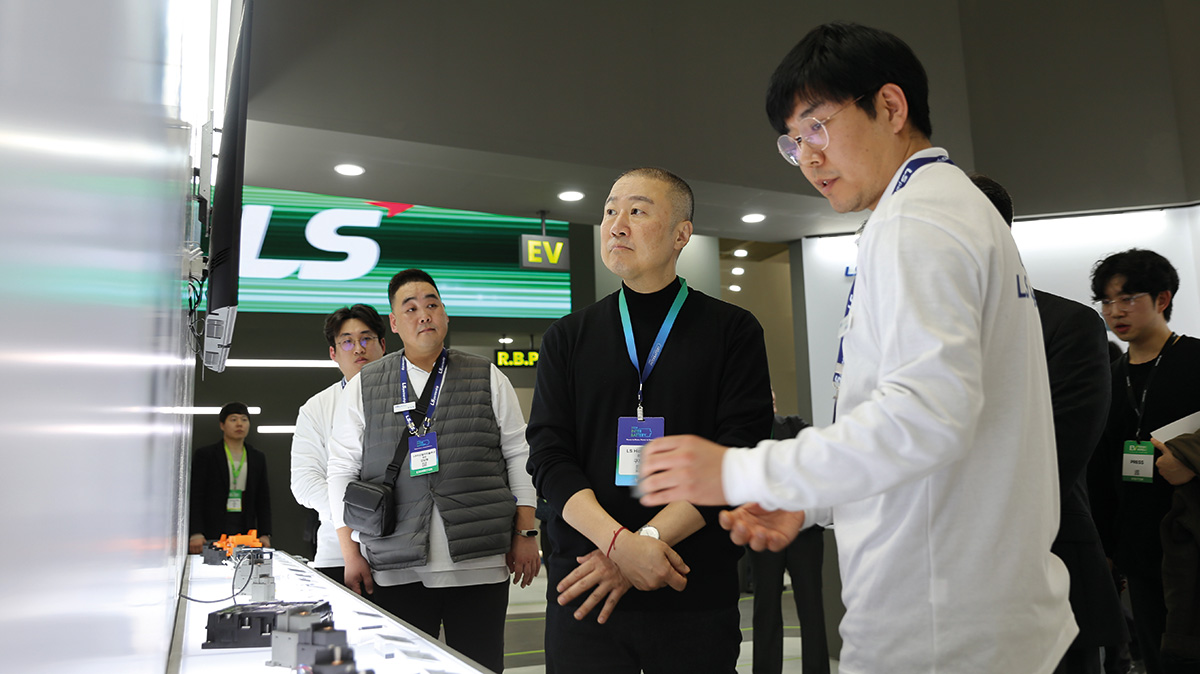 Chairman Ja Eun Koo receives a briefing at the LS exhibition booth at
InterBattery 2024, held at the COEX Convention Center in Seoul.
Q.I understand that LS Group is driving internal digital transformation through building a global cloud infrastructure and adopting generative AI. To successfully transition from a traditional manufacturer to a digital enterprise, which area must be innovated first?
A. To fundamentally reshape traditional manufacturers into digital enterprises, the first changes must address the work methods and mindsets of employees and executives. This should take priority over the adoption of new technology. My New Year's address this year utilized AI agentic technology, deviating from the customary format. More than a demonstration of new technology, my message was that repetitive, standardized tasks should be entrusted to AI to maximize efficiency. Work method innovations can bring a new focus on higher-value priorities, which will eventually generate greater impact.
To support this shift, we have developed our own enterprise-wide generative AI platforms, including LS GPT, LS Biz Intelligence, and an HR AI Agent. These platforms enable individual employees to develop AI-powered tools and prototypes, enabling better focus on core tasks.
At the same time, we are accelerating innovation across our manufacturing operations. Some key examples include LS Cable & System's AI-based cable monitoring system, i-Check; the continued advancement of LS ELECTRIC's Cheongju Smart Factory, recognized as a World Lighthouse Factory; and LS MnM's Onsan Digital Smelter (ODS) smart factory project. These initiatives not only maximize manufacturing efficiency but also strengthen safety management across industrial sites.
Q.In 2026, LS Group reaches the halfway milestone toward the company's Vision 2030 goals. How would you assess the implementation to date?
A. It is encouraging to see that the initiatives mentioned previously are now producing concrete results. Supported by the global power supercycle, our major affiliates delivered improved performance, enabling the group to achieve more than KRW 45.7 trillion in revenue and approximately KRW 1.5 trillion in operating profit in 2025. We achieved both quantitative growth and qualitative improvement. The combined market capitalization of our listed affiliates surpassed KRW 60 trillion, a more than two-fold increase over year-end 2023.
I believe these results demonstrate the effectiveness of our ambidextrous management strategy. On one hand, we continue to strengthen our established businesses in electricity, power and materials. On the other, we are actively investing in future growth sectors, such as batteries, electric vehicles and semiconductors. One hand strengthens what we already do well, while the other boldly develops new opportunities. In times of uncertainty, maintaining this balance becomes even more important.
Q.Leading a company through rapid industrial change requires constant strategic decision-making. How do you spend your personal time?
A. Every morning, I begin the day by soaking in a warm bath and quietly organizing my thoughts. On weekends, I prefer reflective hobbies, such as pottery, caring for trees, beekeeping, gardening and drinking tea, rather than physically demanding activities. I can feel my creative reserves being renewed during slower and more deliberate moments, and through that I can achieve insights that may not be apparent when engaged in the daily grind of business management. I believe it is important to consciously carve out moments of stillness amid a rapidly changing world.
Q.You often describe young talent as "futurists." What qualities or mindset do you believe the next generation will need to lead this era of industrial transformation?
A. No matter how rapidly AI advances or how dramatically the industrial landscape changes, individuals will always be the driving force behind every transformation. At LS Group, the ideal talents we seek are futurists. They are not people who simply make predictions of the future from behind a desk. Rather, futurists proactively address changes and take bold action to create new opportunities.
With my younger colleagues, I often share a quote by CNN founder Ted Turner: "Lead, follow, or get out of the way." Once committed, one should fully embrace a leadership role, or fully support the direction set forth by the leader. Bold execution is key to navigating periods of profound transformation, as it can consolidate society or an organization into a mutually supportive, goal-oriented organism.
Q.Finally, what message would you like to share with Korean businesses and the next generation of business leaders as they navigate this era of industrial transformation?
A. Realpolitik is reshaping the global economic order, and this is reflected in the recent growth of deglobalization and economic nationalism. History shows that there are windows of opportunity before major events such as the Plaza Accord and the Asian financial crisis. How we address these moments and opportunities will determine the next 30 years' industrial success or failure.
More than ever, companies must develop an agile management mindset. This will enable business to ride the wave of change rather than being overwhelmed by it. Since becoming Chairman, I have worked to transform LS Group into an organization that prioritizes strategy and execution - while remaining flexible - to be able to pivot quickly based on insights gathered from the front lines. I urge the next generation of business leaders to cultivate a keen eye for recognizing new and hidden opportunities amid a shifting global landscape. I sincerely look forward to working with agile and bold leaders in the years ahead, so that Korean industry may lead the way into the future.