in Issue & Trend
The Most Genuine Hospitality
for Valued Guests
Hyo-nam Park, Chef
The popular recent Netflix series Culinary Class Wars 2 drew attention not only for technical mastery, but also for the narratives shaped by relationships among chefs. One moment that resonated with viewers came when Hyo-nam Park, one of the show’s “white spoon” chefs, told a younger competitor who had chosen him as an opponent, “I hope you use me as a stepping stone and go even higher.”
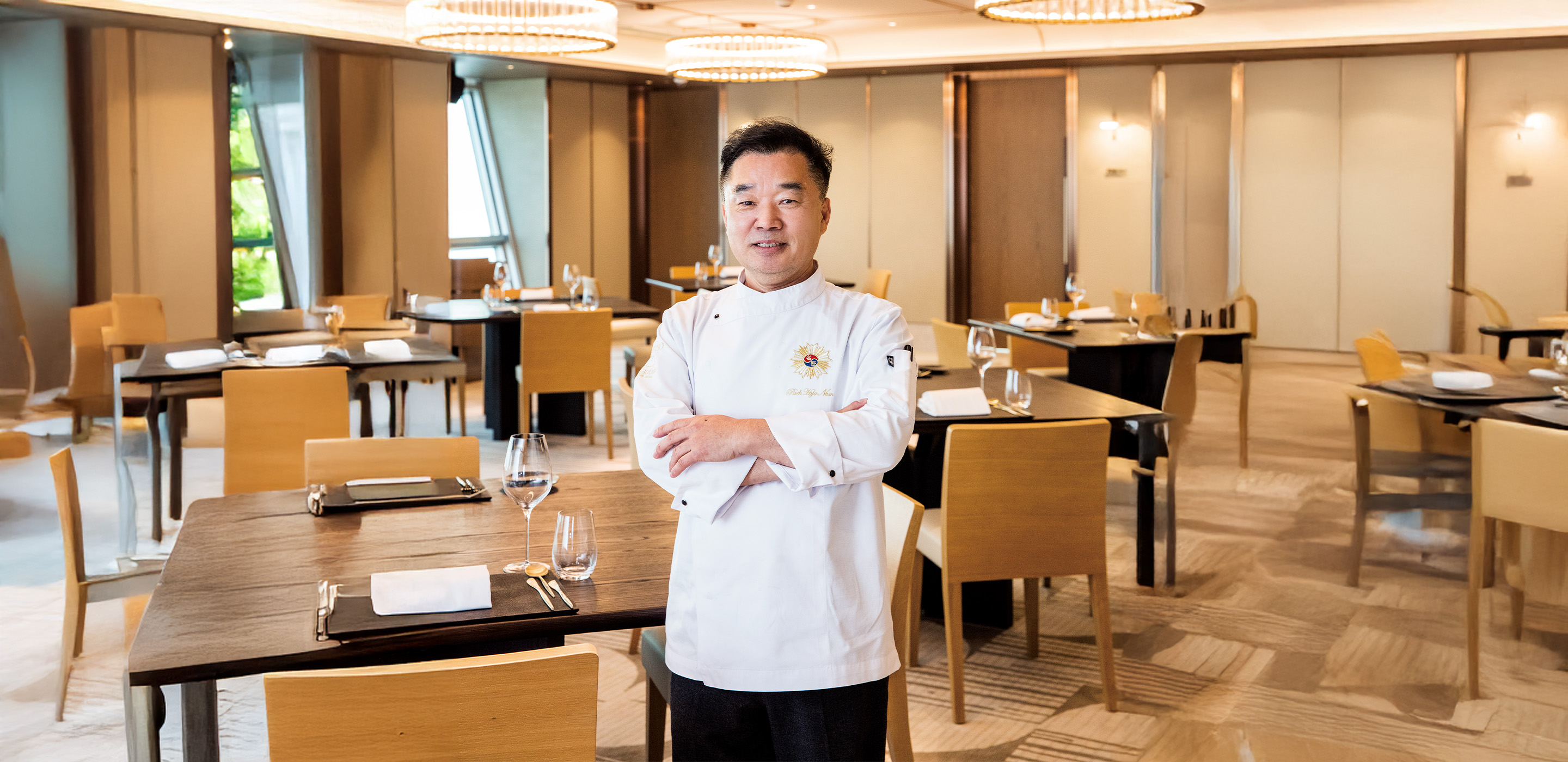
A master who, after reaching the pinnacle of his career, chose to return to his beginnings, Chef Park now leads ORBIT 50, a premium dining venue newly opened on the 50th floor of the FKI Tower in Yeouido.
By Na-yeon Kim
Photographer Kyu-chul Shin
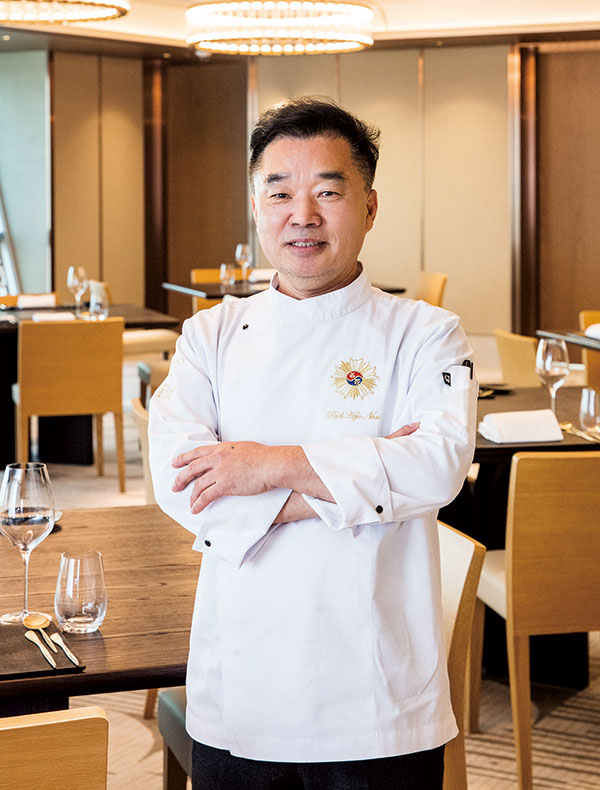
Your recent appearance in Culinary Class Wars 2 has drawn significant attention. What motivated you to take on a survival competition after already achieving master status?
I suggested to the producers that I appear as a “black spoon” rather than a “white spoon,” because I, too, began my career under difficult circumstances. However, I have never considered that period a hardship. I simply enjoyed cooking.
During the competition, a chef known as “French Papa” selected me as his opponent. I later learned that he had dreamed of becoming a chef after watching a program I appeared in during the 1990s. Seeing him give his best despite personal challenges, I approached the match not with a focus on winning, but with the hope that he would surpass me and shine. As a master chef in Korea, if I can be a source of encouragement to others, that in itself is meaningful.
Was there a defining moment that led you to pursue a career as a chef?
I moved to Seoul in my first year of middle school with my father, who had come down alone from the North and served as a career soldier for over 20 years. He opened a coal briquette shop in Seoul solely to support his children’s education. Watching the black sweat run down his forehead under the summer sun made me grow up quickly. I decided that I needed to learn a skill as soon as possible to ease his burden. I even hid my high school acceptance letter from my parents and enrolled in a culinary academy instead.
Although I lost part of a finger in a childhood accident, I never considered it a disability. Rather, it became a driving force that pushed me to practice knife skills with greater precision than others. I began cooking because I enjoyed it, and I was happy simply being able to create something worth eating. For me, the kitchen has been like a playground for the past 47 years.
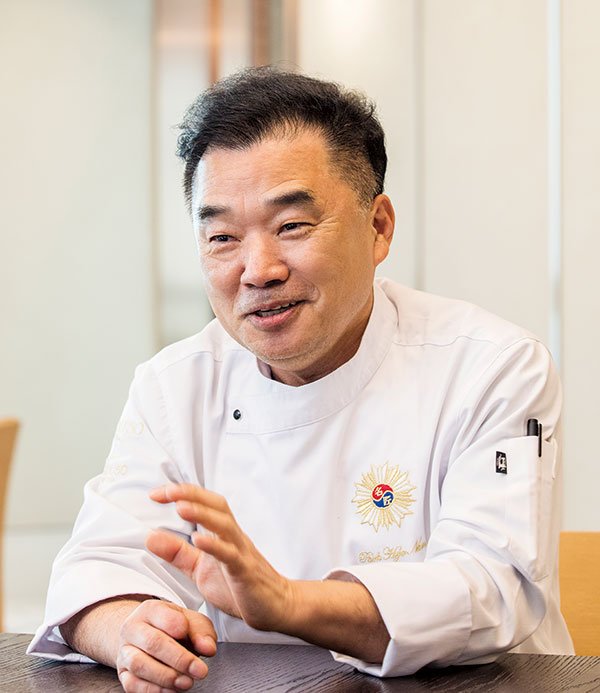
You received a decoration from the French government as a Korean chef in a field where French cuisine once had little presence in Korea. What do you consider your key competitive strength?
While French cuisine is my field, the flavors of Korean fermented sauces are deeply ingrained in me. I was greatly inspired when the renowned chef Paul Bocuse purchased Korean soy sauce. Korea’s ingredients are treasures grown from what I would call a “golden land.”
I incorporated fermented Korean foods such as doenjang and gochujang into French cuisine. I believe the French government recognized them not as a replication of traditional French dishes, but as an effort to reinterpret them using Korea’s unique ingredients and fermentation techniques. Cuisine gains strength when a nation itself is strong. The globalization of Korean cuisine ultimately depends on how effectively we integrate our distinctive identity, particularly the flavors of fermentation, into global culinary systems.
During the team competition on Culinary Class Wars 2, you stood out for coordinating the team with a calm and balanced approach rather than leading forcefully. What kind of leader are you in the kitchen?
Everyone there was highly skilled, each with strong individual expertise. In that kind of environment, I believe it is more important to act as a connector, bringing people together effectively, rather than trying to lead by force.
In my kitchen, I try to put into practice a “mother’s mindset”— ie. that of one who would prepare the best food for her children and manage the household ledger with care. I have gone so far as to check the kitchen waste bins. Throwing away usable ingredients is no different from throwing away money. I have told my team, “If it were your own money, would you discard it so easily?”
I believe that the fundamental responsibility of a head chef is to have a mother’s mindset, preparing meals for guests in a sincere manner. For that reason, the principles and discipline in my kitchen have never been compromised. This level of rigor is not driven by personal emotion, but by a shared commitment to achieving the highest standard of cuisine.
Looking back on your more than 50-year culinary career, is there one dish that best represents you?
I would choose fish. It is both the most challenging and the most intriguing category of dishes. With meat, there are clear levels of doneness, but fish is far more delicate. Slightly undercooked, it becomes unpleasant; slightly overcooked, it turns dry. When preparing fish, I focus on what I call “just cook,” capturing the exact moment of perfect doneness, which requires a higher level of concentration than other dishes.
A fish-based dish, bouillabaisse, a traditional seafood stew from southern France, marked a turning point in my career. When I was working at the Hilton Hotel in the 1990s, a guest sent the dish back twice. Although it was a blow to my pride, I sought feedback directly and was told that the seasoning was not right. That experience made me realize that I had been cooking to suit my own taste rather than the guest’s. From that point on, I recorded individual guest preference and started putting into practice what it truly means to be a chef.
As the executive chef of ORBIT 50 at the FKI Tower in Yeouido, what kind of experience do you hope to offer business leaders?
Food can serve as an important bridge in business settings. I hope that guests at ORBIT 50 will use the stories behind each dish as a starting point for conversation, leading to meaningful and successful business outcomes.
For that reason, I intend to use only the finest ingredients available in Korea. I personally select fresh seafood each day and source premium ingredients from across the country. I want business leaders to find both comfort and inspiration here. With the same care as a mother preparing a meal, I aim to create a dining experience that offers both restoration and new perspective.
You have declined many advertising offers, saying you wish to remain a master rather than a commercial figure. What does being a “true master” mean to you?
In my view, a true master is someone who gives back to society. Recently, I have received more recognition than I deserve, and I do not want that attention to end with personal benefit. Even if I do participate in advertising, I would prefer to donate the proceeds to those in need. Using my craft to contribute to society, even in a small way, is the legacy I hope to leave behind.
What advice would you offer to young people who are just beginning to pursue their dreams or preparing for new challenges?
First, I would tell them, “Be confident.” Young people today are highly capable, but they often compare themselves to others and become discouraged. Remember that everyone has unique strengths.
Second, “Do not seek out hardship unnecessarily.” Some believe that hardship is essential for growth, but I do not think young people should force themselves into suffering. If you pursue what you genuinely enjoy and find meaning in the process, perseverance will follow naturally. It is not about enduring difficulty for its own sake, but about finding enjoyment that allows you to continue on your path.