
Upgrading the Regulatory System for Emerging Industries
Regulatory Wisdom Driving
Innovation in Emerging Industries
How the World Designs the Future
By examining the success stories of companies that have leaped forward based on the regulatory innovation environments of four nations—the United States, the United Kingdom, Singapore, and the United Arab Emirates—this report explores how these economies are proactively designing future industrial ecosystems.
By Tae-eon Ku, Lead Partner of the AI, Platform & Technology Practice Group at Lin Law Firm
In 2026, AI is transcending the digital realm and entering physical reality. We have entered an era where autonomous vehicles traverse city streets, robots work alongside humans in factories and hospitals, and AI systems manage public infrastructure. This is the era of Physical AI. In this context, governments are now focusing on sources of competitiveness that go beyond technological prowess. The ability to design institutional frameworks swiftly and wisely—what may be called regulatory wisdom—is emerging as a core variable in national competitiveness. Leading nations are no longer leaving outdated regulations as obstacles to innovation; instead, they are redesigning legal systems to allow experimentation while demanding accountability. Regulatory emphasis is shifting away from prohibition and moving toward responsibility—from ex-ante permission to ex-post management.
U.S. NHTSA’s Regulatory Innovation and Waymo’s Commercialization
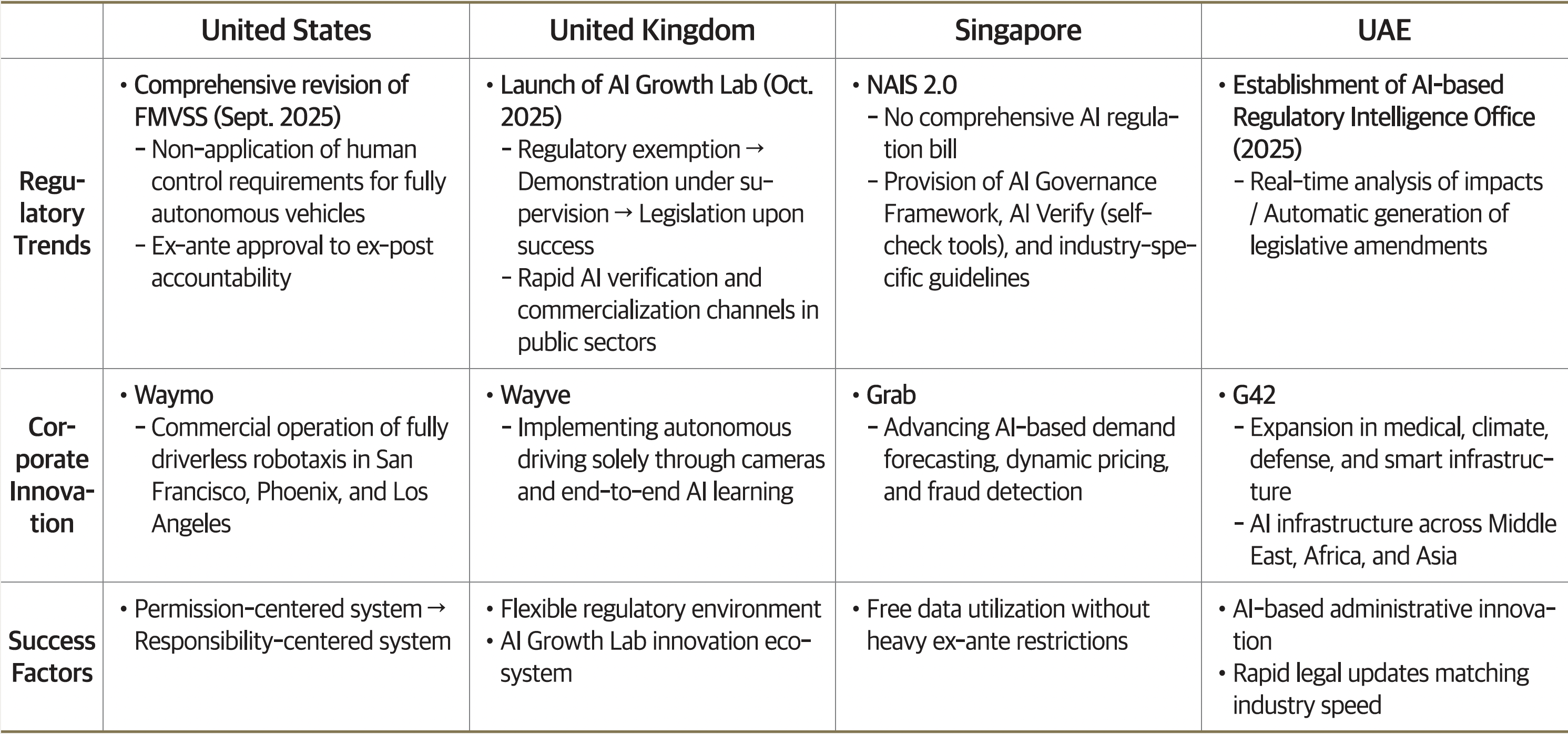
The U.S. National Highway Traffic Safety Administration (NHTSA) completely overhauled the Federal Motor Vehicle Safety Standards (FMVSS) in September 2025 for the first time in fifty years. The core of this revision was the removal of the requirement for a human driver, which had been the premise of previous safety standards. Requirements for devices intended for human operation, such as steering wheels, pedals, and side mirrors, were no longer applied to fully autonomous vehicles.
Along with this, the principle of ex-post responsibility was introduced in place of ex-ante permission. This allowed companies to launch technologies in the market first and then update safety standards based on actual driving data.
This change has produced concrete results. Waymo, a subsidiary of Google’s parent company Alphabet, is currently operating fully driverless robotaxis commercially in San Francisco, Phoenix, and Los Angeles, recording more than 100,000 paid rides per day. Waymo holds safety data from a cumulative driving distance of over 50 million kilometers and has a public record showing that its accident rate is significantly lower than that of human drivers. A virtuous cycle is thus in operation, in which regulators and industry accumulate data together and refine standards on that basis.
The success factor lies in a shift in regulatory philosophy. Instead of forcing new technologies into existing regulatory frameworks, the framework itself has been redesigned to fit technological reality. In this case, the United States’ federal government has assigned clear risk management responsibilities to companies—meanwhile, the government took on the roles of monitor and data collector. The message for Korean companies and policymakers is clear: there is an urgent need to shift from a permission-centered system to a responsibility-centered one so that companies with advanced technologies do not lose commercialization opportunities due to regulatory delays.
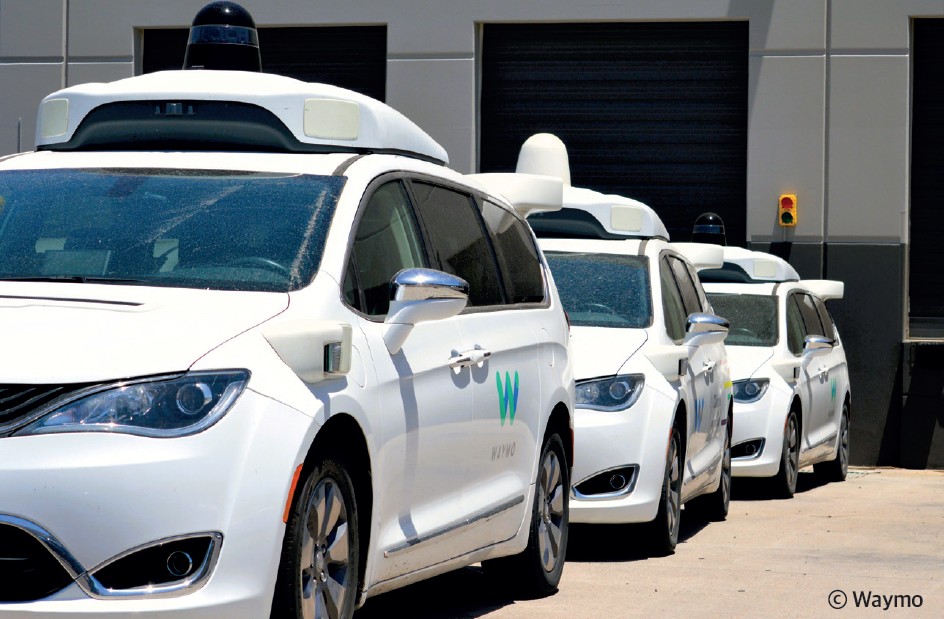 A fully driverless robotaxi in operation by Waymo
The U.K.’s AI Growth Lab and Wayve’s Leap Forward
The United Kingdom’s Financial Conduct Authority (FCA) introduced the world’s first regulatory sandbox in the fintech sector in 2016. A regulatory sandbox refers to a system that allows new technology startups to receive exemptions from existing regulations and experiment within a limited scope. The fintech sandbox shortened the time to market by an average of 40 percent and significantly increased the success rate of participating companies in attracting investment. The U.K. has expanded this experience to AI more broadly. The Department for Science, Innovation and Technology (DSIT) launched the AI Growth Lab in October 2025, which is structured to grant time-limited regulatory exemptions to individual companies. Regulatory agencies closely supervise the entire pilot process, and a successful pilot is immediately converted into permanent legislation. This created a channel for rapid verification and commercialization of AI in public sectors such as healthcare, housing, and transportation. According to OECD estimates, AI could add between 5.5 billion and 14 billion GBP annually to the U.K.’s GDP by 2030.
Wayve is a representative company that has flourished in the U.K.s broader pro innovation regulatory environment, which the AI Growth Lab aims to further strengthen. The company developed a unique approach that implements autonomous driving using only cameras and end-to-end AI learning. Throughout 2025, Wayve conducted autonomous driving tests in more than 500 cities across Europe, Asia, and the United States, attracting investments from Microsoft, NVIDIA, and Uber. In February 2026, it raised an additional 1.5 billion dollars, earning itself a valuation of 8.6 billion dollars and establishing itself as one of Europe’s most valuable AI startups. The flexible regulatory environment and the innovation ecosystem created by the AI Growth Lab supported this achievement.
 An autonomous vehicle by Wayve
Singapore’s NAIS 2.0 and Grab’s AI Innovation
Singapore is a small nation that does not lead in foundational AI technologies. Nevertheless, in the 2025 global AI readiness assessment, the country was ranked as having the best regulatory environment and number two in terms of its investment environment. Leading global tech companies such as Google, Microsoft, and NVIDIA have selected Singapore as their Asian AI hub and are establishing large-scale data centers and research labs. The Singaporean government announced that it would invest more than SGD1 billion in the national AI research and development plan from 2025 to 2030. Singapore’s strategy is centered on the National AI Strategy (NAIS) 2.0, which does not introduce comprehensive AI legislation. Instead, the Infocomm Media Development Authority (IMDA) provides a non-binding AI governance framework, a corporate self-assessment tool called AI Verify, as well as tailored guidelines for each industry, such as finance, healthcare, and education. This is referred to as a “soft regulation” strategy. Companies voluntarily use these tools to verify AI reliability without legal obligations, and the government draws on those results to facilitate global partnerships.
A notable beneficiary of this regulatory initiative is Grab, Southeast Asia’s largest super-app. Grab leveraged Singapore’s flexible AI regulatory environment to rapidly advance its AI-based demand forecasting, dynamic pricing, and fraud detection systems. In February 2026, Grab announced a plan to increase its EBITDA to SGD1.5 billion dollars—triple the current level—by 2028 through expanded AI investment, and set an annual revenue growth goal of more than 20 percent. Such growth is underpinned by an environment where data can be used freely, without strict ex-ante regulations.
UAE’s AI-Based Regulatory Administration and G42’s Growth
In 2025, the UAE established the world’s first AI-based Regulatory Intelligence Office. This agency is equipped with AI capabilities aimed at assessing the impact of regulations on new industries in real-time and automatically generating legislative amendment proposals.
The UAE has innovated regulatory administration itself using AI. Dubai is applying AI across its entire urban infrastructure, including traffic optimization, crime prediction, and energy management, and has maintained a top global position in the 2025 Smart City Index. Moreover, the UAE government is moving forward with the UAE Stargate AI infrastructure project, which has an estimated cost of 150 trillion won, and has a target of fostering 10,000 AI companies by 2030.
G42 is a notable beneficiary of this strategic environment. The company is based in Abu Dhabi, and under the full support of the UAE government, it is expanding its business in various fields such as medical AI, climate analysis, defense, and smart infrastructure. Microsoft invested 1.5 billion dollars in G42, and the firm is deploying this capital to establish AI infrastructure across the Middle East, Africa, and Asia. Furthermore, the UAE government established the Mohamed bin Zayed University of Artificial Intelligence (MBZUAI), the world’s first AI-specialized graduate school, which recruited a record 400 new students in the fall of 2025. Flexibility in the UAE’s AI regulatory environment is simultaneously driving both corporate growth and the ecosystem for nurturing talent. The key lesson from the UAE case is the transition of regulatory administration to AI. Innovating how regulations are created makes it possible to update legal systems at a speed that matches the pace of industry. Korea, too, should consider measures to improve agility in regulatory administration by incorporating AI into legislative impact assessments, regulatory sunset reviews, and regulatory sandbox operations.
Major Economies' New Industrial Regulatory Trends and Corporate Innovation Cases
Implications for Korea
The four countries’ success cases have common factors. First, there was a shift in regulatory objective from prohibition to responsibility. Instead of blocking new technologies, experimentation was permitted, and there was enhanced clarification on responsibilities regarding outcomes. Second, the principle of ex-post management was applied, rather than ex-ante permission. This created a cycle where companies could conduct real-world trials and regulatory standards could be updated based on accumulated data. Third, the regulatory sandbox served not only as a pilot project, but it was designed to inform legislative reform, so that a successful pilot would directly trigger the process for permanent legislation. Finally, agility in the legal system was enhanced by introducing AI into regulatory administration in general. It is also important to note that in all these cases, regulatory innovation led not only to institutional changes, but also to tangible successes and concrete growth in specific companies, such as Waymo, Wayve, Grab, and G42.
In Korea, the AI Basic Act is set to take effect in 2026, and legislative frameworks related to autonomous driving and data-driven economies are being established. Korea possesses strengths in both technological capabilities and institutional foundations. The remaining task is to implement a shift in regulatory philosophy. This would require the acceptance of real-world technological trials first, followed by regulation; a design that lays out clear responsibilities but does not block innovation or market entry; and a collaborative ecosystem between regulatory agencies and industry for the sharing of data, in order to co-create standards. In the coming era of Physical AI, legislation and technology must evolve together. Leading nations already recognize that regulatory wisdom is a core element of national competitiveness. Korea has an opportunity to establish itself as a country with one of the most innovation-friendly regulatory environments in Asia by joining this trend. The mission of regulatory policy in this era is to create the conditions in which Korean companies can become the next Waymo, the next Wayve, the next Grab, and the next G42.