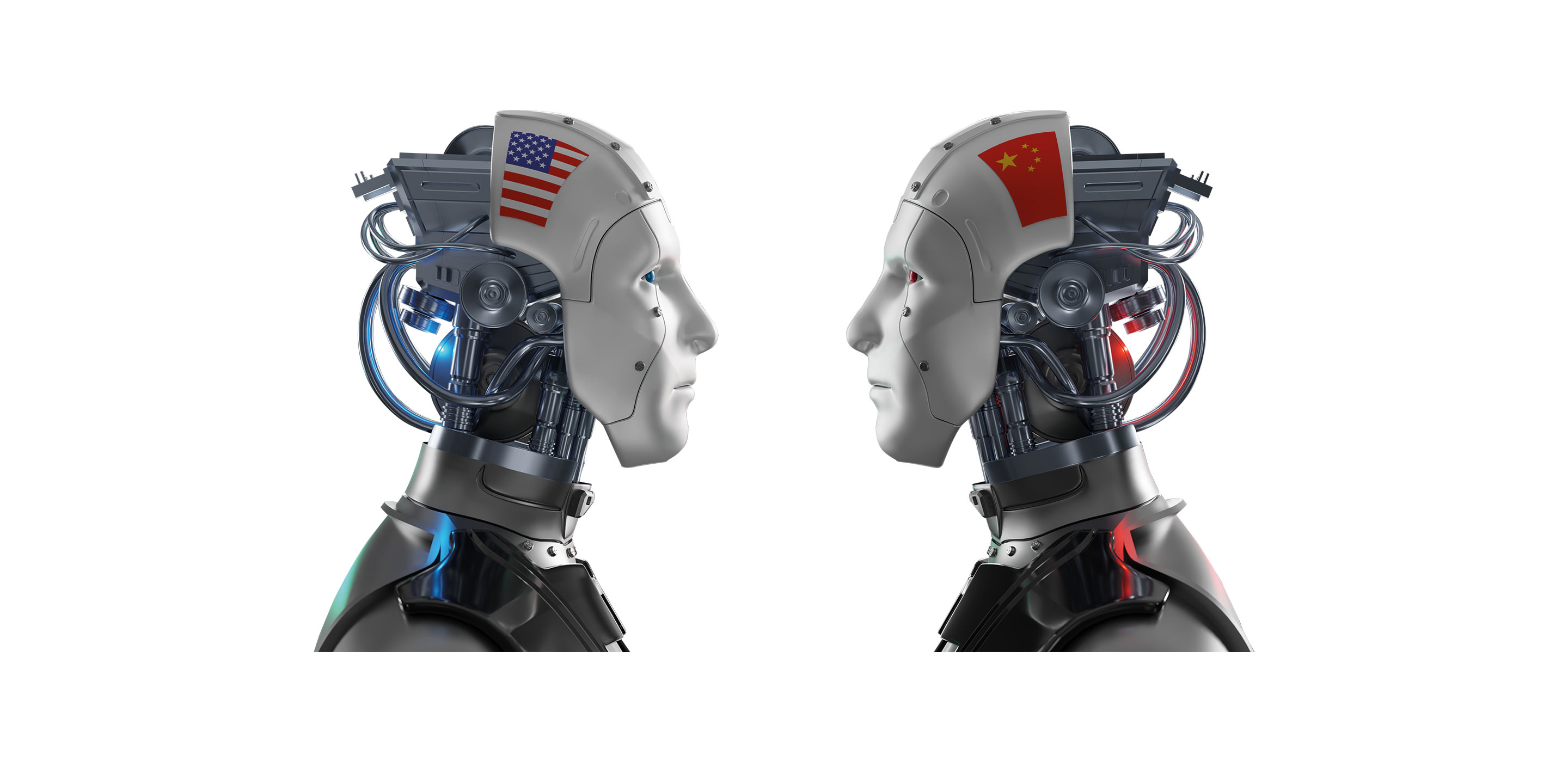
The Advent of the Physical AI Era
The U.S.-China Physical AI Hegemony War
Toward Technological Independence:
The Pathway Ahead for Korea
The global race for technological hegemony is rapidly shifting toward “Physical AI,” which operates in the real world. While the United States leads innovation with its massive capital base and Artificial General Intelligence (AGI), China is in fierce pursuit, leveraging its state-led capacity for massive data collection. This article analyzes the diverging hegemonic strategies of these two nations and explores survival strategies for Korea—which currently faces a crisis characterized by a focus on hardware but a lack of an “AI Brain”—to break free from technological dependence and leap forward as a truly independent technological power.
By Jong-sung Park, Lead of AI & Optimization Consulting at LG CNS, author of The Physical AI Hegemony War and Why Innovation Fails
The New Battlefield of Technological Hegemony: Physical AI
Human history has unfolded alongside the evolution of tools, and we are now confronting the culmination of that evolution: “Physical AI.” If ChatGPT reorganized information on the screen, AI is now stepping out into the real world, in the bodies of robots and drones. As Jensen Huang asserted, the battlefield of technological hegemony has moved from the world of bits (data) to the world of atoms (reality). AI is now evolving beyond mere information processing into “Embodied Intelligence” that makes judgments, moves, and creates tangible value on its own. This signals a major shift that will upend both industrial ecosystems and the geopolitical order.
U.S. vs. China Physical AI Strategies: Market-Led vs. State-Led
The competition for hegemony between the United States and China over Physical AI has emerged as the core arena of a 21st-century “Cold War,” with implications beyond that of a mere technical capability gap. To understand the essence of this competition, one must first examine how Physical AI differs from traditional automation and why it has become a “strategic asset” that will determine the fate of nations. In the past, industrial robots stopped short at being “diligent machines,” with limited performance to a closed loop consisting of thousands of rules predefined by humans. In contrast, Physical AI engages in repeated cycles of “sensing, perception, and action” at hundreds of iterations per second, allowing it to adapt autonomously to unpredictable real-world environments and find optimal movements.
Behind this remarkable adaptability lie three innovation engines: the “Digital Twin,” which replicates the real world in a virtual space; the “World Model,” which captures the physical laws of the world; and “Reinforcement Learning,” which builds proficiency through endless trial and error. Within the safe virtual laboratory of the Digital Twin, AI encounters various scenarios presented by the World Model and finds optimal solutions after hundreds of millions of failures. The way it closes the “Sim-to-Real Gap” through this process is essentially similar to how a baby learns to walk after falling hundreds of times.
The United States and China have chosen different philosophies and strategies to seize the initiative in this new frontier. First, the United States takes a “market-led” approach, driven by Silicon Valley’s powerful private innovation ecosystem and immense capital. As demonstrated by Tesla’s humanoid robot “Optimus,” the U.S. pursues Artificial General Intelligence (AGI) that can judge and move autonomously in any environment. Its aim is to reach the pinnacle of technology through disruptive innovation that breaks existing frameworks.
Conversely, the Chinese government is actively intervening in the market as both a chief executive and a strategic investor. China’s strategy follows a narrative structure similar to a three-act play meticulously prepared over the past decade. The first initiative, which began in 2015, aimed to deploy “steel bodies” (robot platforms) through the “Made in China 2025” across factories worldwide. The second initiative, starting in 2017 following the AlphaGo shock, focused on designing an AI “brain” through the “Next Generation Artificial Intelligence Development Plan.” The third initiative, currently underway, aims to merge the body and brain under the name “具身智能”1 to shift the center of the AI revolution from Silicon Valley to the Pearl River Delta, which encompasses major economic hubs like Guangzhou, Shenzhen, Dongguan, and Foshan.
The United States currently exerts tight control over the supply of GPUs, the core engine for AI development. The semiconductor export controls that intensified in October 2022 demonstrate a resolve to shake the very foundations of China’s ability to develop AI effectively. However, China has not remained passive; it is attempting to counter by leveraging its unique strengths to overcome its technical inferiority. Its strategy is to independently build a “B+ grade technology ecosystem” that, while slightly lacking in performance, would be under direct Chinese control and to overcome hardware limitations by using the overwhelming amount of “data fuel” generated by its 1.4 billion citizens under a powerful central governance system.
Notably, the Chinese government has transformed the entire nation into a “massive living laboratory” for Physical AI learning. The data accumulated by Baidu’s autonomous taxi service, “Apollo Go,” serves as evidence of this, with over 17 million trips and 240 million kilometers of driving records that are overwhelming in scale. More important, however, is the quality of that data. While the total volume may be less than what Tesla has secured, the consensus among experts is that Baidu holds an advantage in terms of density. This is because Baidu has accumulated “practical” and “concentrated” experience on the complex, unpredictable, and difficult-to-control urban roads of China. Ultimately, Chinese AI is evolving at a frightening speed and is being fueled by “Embodied Data”—data harvested from the real world, amid harsh and complex conditions. The momentum of Chinese AI, which uses real-world uncertainty as a driver for learning, is now creating a technological gap that no one can easily overlook.
- 1.具身智能 : A Chinese term meaning “intelligence with a body,” which shares the same conceptual meaning as Physical AI. (Source: The Physical AI Hegemony War , Jong-sung Park)
China’s Strategy for a Quantum Jump: Data Flywheels and Cultivating National Champions
The most precious resource in the era of Physical AI is not abstract information from the internet, but “Embodied Data” that contains real-world movement and context. While ChatGPT may be able to collect theoretical knowledge about cats, Physical AI collects practical experience, such as how to pet a cat. China is securing high-quality data by utilizing the world’s largest manufacturing base as a massive sensor network. Millions of robots, robotaxis, and drones have evolved into data collection terminals that absorb real-world variables in real time.
This “Data Flywheel”2 strategy is the core driver of China’s technological advancement. As more robots are deployed in the field, higher-quality data is accumulated, which in turn becomes the basis for creating smarter AI models, increasing the speed of evolution exponentially. China’s rise is becoming a reality through a powerful group of “National Champion” companies. DJI, which controls 70% of the global commercial drone market, has become a platform company collecting global topographical data as “winged CCTVs.” Baidu, shielded by full government support, is honing its autonomous driving intelligence by conducting training in the complex environment of the large Chinese city, a setting that is rare for Western companies. Furthermore, Ubtech has signaled an era of “autonomous labor” without human intervention by deploying its humanoid robot “Walker S2” into electric vehicle factories, while Huawei is acting as a logistical base for all these companies by building its own chip and software ecosystem despite export controls.
However, behind this quantitative expansion lies a fatal Achilles’ heel: the “Reliability Dilemma.” China has hit a technical limit where the reliability of the entire system falls short. In addition, China has yet to overcome the technological barriers of Japan and Germany in high-end core components such as reducers and servo motors. Meanwhile, the U.S. has also fundamentally revised its strategic stance against China’s fierce challenge. For economic reasons, the U.S. previously tolerated interdependence with China. Now, however, the U.S. is imposing restrictions on China to prevent further growth of Chinese technological capabilities, tightening controls on components, such as HBM, as well as state-of-the-art processing equipment.
- 2.Data Flywheel: Like a flywheel that, once set in motion with an initial input of force, reaches a point at which it spins faster while requiring only a small amount of additional energy, this refers to the accelerating cycle in which AI model deployment in real-world settings → data accumulation → AI model improvement → broader AI model deployment → further data accumulation reinforces itself. It is also referred to as the “data compounding effect.”
Korea’s Current Standing and the Path Forward
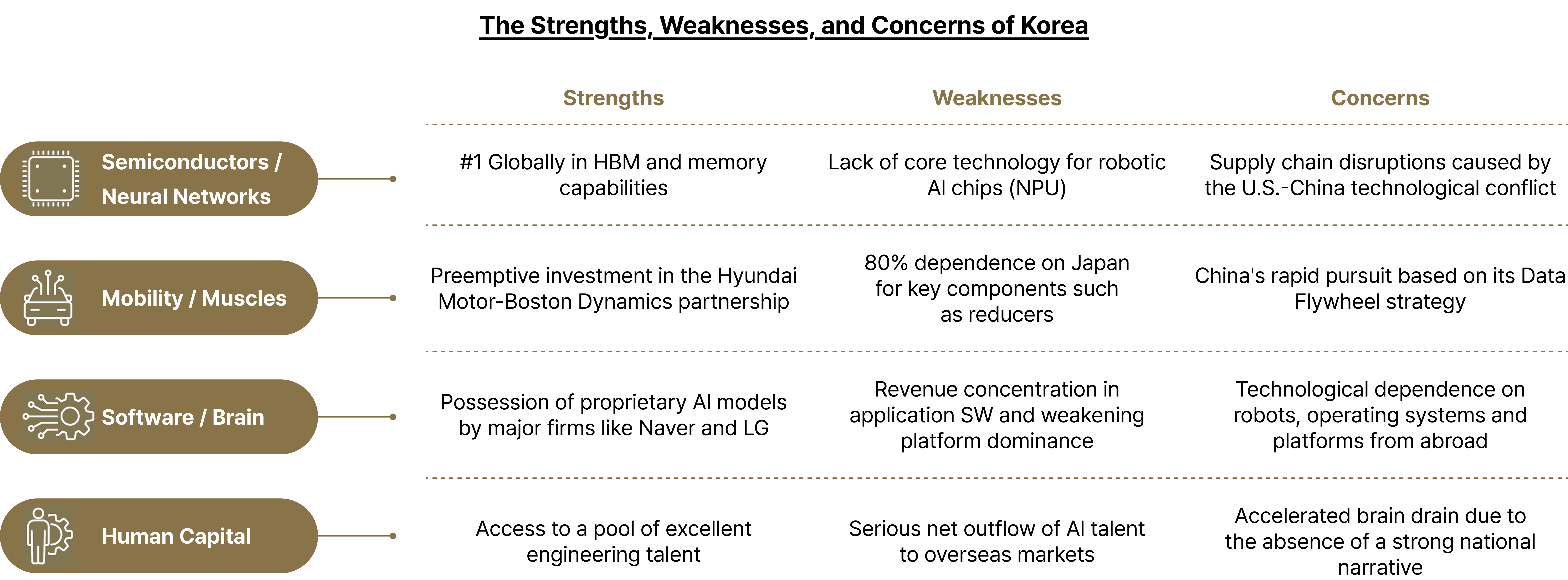
The paradigm shift in manufacturing triggered by Physical AI is a serious challenge that shakes the foundations of the Korean economy. The first shock is the end of the era of “labor-cost arbitrage,” where factories were moved in search of lower wages. We are entering an era of the “Automation Imperative,” where cost competitiveness is determined not by who has the cheapest labor, but by whose robots are more efficient. China is already artificially raising the barrier to entry in manufacturing by deploying robots whose cost is twelve times domestic wage levels. Existing manufacturing powers, whether they wish to or not, have been caught in a “robot arms race” that requires massive capital investment. Furthermore, the “Second China Shock,” characterized by an overflow of Chinese overproduction into the global market, is threatening the market dominance of our companies. Moreover, the fragmented ecosystem caused by the formation of technological blocs forces Korea to consider harsh geopolitical choices.
Korea has the highest robot density in the world, with 1,012 robots per 10,000 workers. Statistically, it appears to be the best-prepared logistical base for the Physical AI era. The prestige of a manufacturing power equipped with the “Hardware Trinity” of semiconductors, automobiles, and batteries remains intact. However, behind these impressive indicators are vulnerabilities that cannot be taken lightly. Korea’s high robot density is less a result of preemptive investment for the future and more a legacy of “20th-century-style automation” accumulated over decades to withstand rising labor costs and labor shortages. However, this legacy of the past risks becoming a heavy “sunk cost” that hinders upgrading to new intelligence as we transition into the era of highly intelligent Physical AI.
Most troubling is that Korea lacks a globally influential “AI Brain.” As of 2024, the revenue of the domestic AI industry is mostly concentrated in applied services such as chatbots or video analysis. The proportion of computing components and devices—the heart of Physical AI—is less than 5%. This means that no matter how well Korea builds the world’s best robot “bodies,” the “soul” that gives commands to those bodies must rely on U.S. platforms like NVIDIA and Google, or Chinese ones. If this imbalance continues, Korean manufacturing could be reduced to an “externally dependent manufacturing hub” that creates only sophisticated outer shells. The fact that Japan dominates the market for core components, such as reducers and servo motors, is another key challenge Korea must urgently address for technological self-reliance.
Even more serious is the “Brain Drain.” Korea is currently losing AI talent to overseas markets at one of the worst levels among OECD nations. This is not simply due to salary differences. While China rallies talent with the powerful goal of “National Rejuvenation” and Silicon Valley presents a grand vision of “changing the world,” Korea is failing to tell a compelling story to attract talent. Rigid corporate cultures, evaluation systems preoccupied with short-term results, and regulations that stifle research autonomy are fueling the talent outflow. If Korea cannot break this vicious cycle—where a lack of core technologies leads to a preoccupation with applied technology, which in turn creates an unattractive environment for talent—Korea’s future will inevitably be bleak.
For the past half-century, Korea has been among the most diligent climbers of ladders built by others. However, it is now time for Korea to design and build its own ladders. Launching this initiative requires clearly recognizing one’s strengths and making the decision to bind fragmented capabilities into a single national will. Whether Korea will emerge as a proud “Technologically Sovereign State” or is reduced to a “Technologically Dependent State” amid the turbulent 21st-century technological struggle for hegemony will be shaped by the choices and actions taken today.