The Advent of the Physical AI Era
The Changing Industrial Landscape
in the Era of Physical AI:
Global Trends and Policy Implications
Currently, the most prominent topic in the global industrial arena is undoubtedly the rise of “Physical AI.” Moving beyond mere operational efficiency, this new wave is fundamentally disrupting the hardware-centric industrial landscape, presenting Korean companies with a critical choice. This article examines the structural paradigm shift triggered by Physical AI, analyzes global trends, and explores the policy tasks and future landscape through which a leadership position can be secured for the Korean manufacturing industry.
By Young-jae Jang, Professor of Industrial & Systems Engineering, KAIST
Why Physical AI Now?
“Physical AI” goes beyond software that calculates data and generates responses. It refers to AI that perceives its physical surroundings, makes autonomous decisions, and moves in and changes physical environments such as factories, cities, and warehouses. Unlike LLM-based AI confined to massive server rooms, Physical AI begins operating from a different starting point—it integrates with sensors, robots, and equipment to directly impact the physical world. This shift presents two fundamental questions to industry. First, how is this distinct from “Smart Factories,” which are already familiar? Second, who will emerge as the true beneficiaries in this new era? Physical AI will serve to answer both questions simultaneously and is a new benchmark that will determine the success or failure of Korea’s manufacturing and service industries over the next decade.
Structural Changes Within the Factory
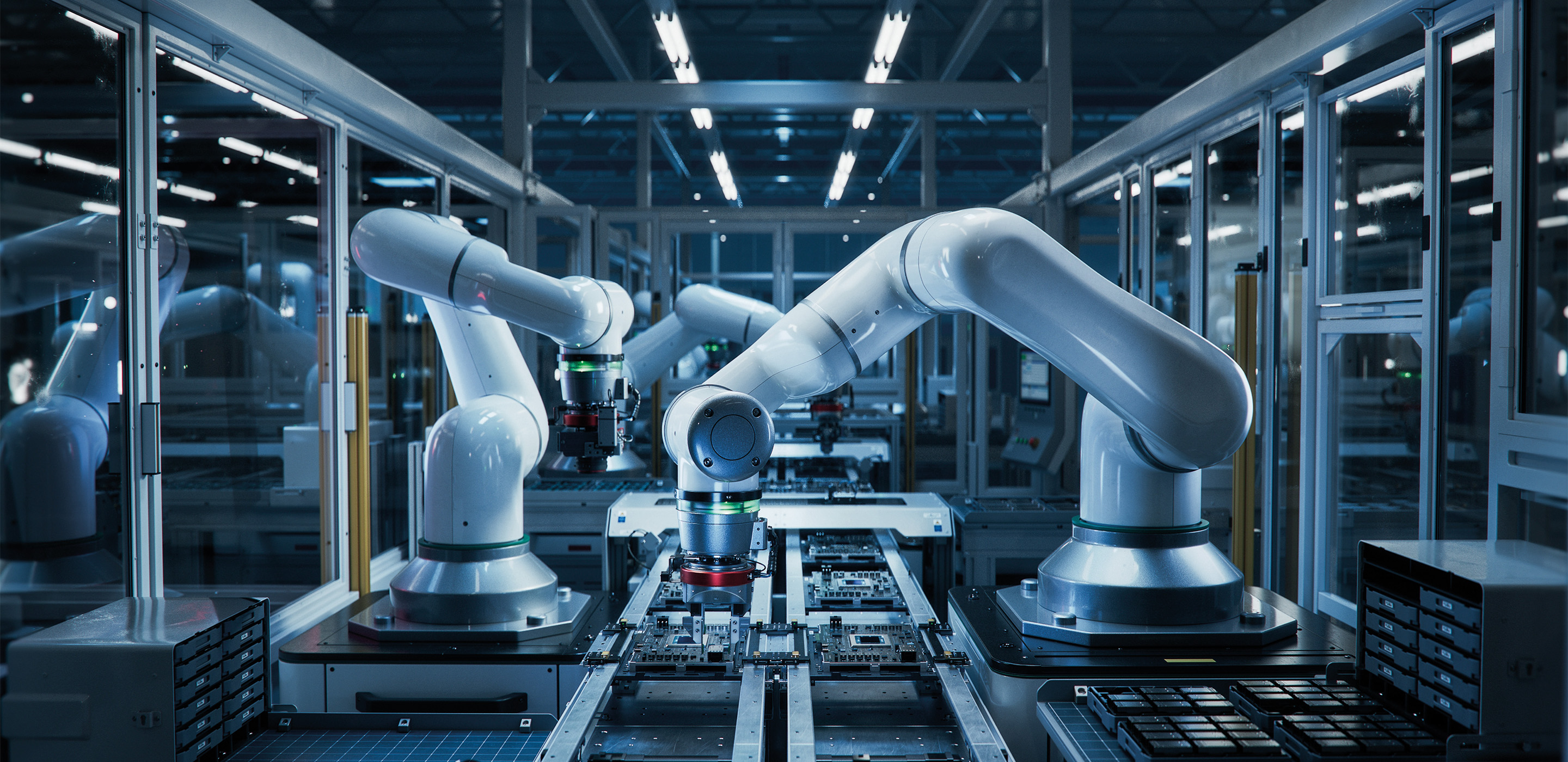
Physical AI is impacting how factories are structured. Traditional, linear production lines, which are centered on conveyor systems, are being reorganized into flexible, networked structures. The new manufacturing system focuses on cell manufacturing and autonomous robots, and future-oriented pilot plants, such as Hyundai Motor Group’s Innovation Center Singapore (HMGICS), minimize conveyor systems in favor of Autonomous Mobile Robots (AMRs) that can independently transport materials and product to each processing cell. The implication of such processes is that Digital Twin technology plays an increasing role—it enables replication of the movement patterns of logistics robots and factory equipment in virtual spaces, where Physical AI models can be trained and validated. Initiatives such as NVIDIA’s Omniverse-based Digital Twin designs or AI-automated factory layouts signal a paradigm shift from “replicating reality to create a virtual replica” to “replicating virtual designs to create real factories.” Ultimately, Physical AI aims to create fully automated facilities that operate 24/7 with minimal human intervention—called “Dark Factories.” In such a setting, less priority is given to the performance of individual robots; instead, there is emphasis on system intelligence that can operate the entire factory as a single organism.
The “Profit-Making Factory” and Logistics-Centered Physical AI
While manufacturing AI has traditionally focused on process- and equipment-level applications such as quality control and predictive maintenance, the clearest view of a factory’s cash flow and profitability lies not in the production process itself, but in logistics and inventory flows. Physical AI focuses on precisely this area. For many mid-sized and smaller manufacturers, however, investment in factory logistics and warehouse automation has often been treated as a lower priority. Yet no factory can operate efficiently without more sophisticated warehouse management. In this respect, making raw material and finished goods warehouses more transparent through AI and robotics is the starting point for building a profitable factory. When Physical AI-based robots and systems optimize logistics flows in real time—from raw material receipt to process input and final shipment—they improve not only productivity, but also inventory and cash flow management.
Amazon’s transition from automation in the 2010s— the AGV-based warehouse1 system—to full picking automation2 in 2025 illustrates a roadmap for transitioning to Physical AI. Automation requires long-term investment, but logistics automation can yield results in a relatively short period. Cases from German factories also demonstrate that there is a strategic preference for prioritizing investment in logistics robots over task-oriented ones. This means delegating intricate tasks to humans while assigning transport and movement to robots, enabling more effective management of overall cash flow. Korean manufacturers who continue to maintain the practice of investing in task-oriented robots first, while delaying logistics robots, will inevitably fall behind in the Physical AI era. Rather than adopting an approach of automating processes one at a time, there needs to be a strategic shift. Higher priority should be given to logistics and warehouse intelligence, with a core focus on overall factory operations and cash flow.
- 1.AGV (Automated Guided Vehicle)-based warehouse: A logistics warehouse equipped with autonomous mobile robots (AGVs) that follow fixed paths (marked with magnetic tape, QR codes, wires, etc) to transport materials or goods.
- 2.Picking Automation: A technology in which robotic arms or intelligent automation systems, not human workers, perform the task of accurately locating and retrieving specific items from inventory.
Domestic and Global Trends: From Hardware to Platforms
Globally, there is heightened competition in shifting toward integrated platforms, which combine hardware, software, and Digital Twin technologies. The goal is to establish a single operational system with integrated data and control—equipped with interoperating sensors, communications, industrial networks, robots, automation equipment, and factory control systems. This transition has two core features. First, Physical AI can only be realized when the entire hardware ecosystem grows together, unlike in the case of cloud-based LLM models. Structurally, this means that specific software platform companies are not the sole beneficiaries of excess profits; instead, investment and jobs can be distributed across components, equipment, manufacturing, and services. At the level of national industrial policy, this is a rare opportunity to drive simultaneous upgrades across the supply chain.
Second, Physical AI is entering various physical spaces beyond the factory environment. Autonomous robots in every distinct physical setting can serve as potential demand sources, including in warehouses, while it is also possible to employ surgical, rehabilitation, and nursing support robots in hospitals, caregiving robots aimed at an aging society, and other robots in smart buildings, smart cities, defense and disaster response settings. Physical AI in manufacturing and automotive sectors are just the beginning; its impact will eventually reach various services, healthcare, and urban environments. Korea is uniquely positioned for a successful, widespread transition, as the country has a robust manufacturing base in semiconductors, display, secondary batteries, precision machinery, shipbuilding and plant engineering, and automobiles and auto parts. It is worth noting that the autonomous vehicle is an all-encompassing Physical AI platform, since it integrates sensors, automotive chips, communications, and urban infrastructure. It is one of the most promising fields where Korea can claim a strategic leadership position.
Policy Tasks: From Regulator to “Platform-Building Investor”
The challenge lies in execution, rather than direction. Unlike single-product projects led by individual companies, Physical AI requires a platform-level approach encompassing everything from sensors, communications, and robots to digital twins, cloud computing, security, and standardization. The role of the government must also undergo a fundamental transformation. First, testbeds must be established. Pilot plants and pilot cities for Physical AI must be designated for key industries such as manufacturing, automotive, and robotics. This will enable staged implementation of digital twins, physical AI, and autonomous operations. There must be bold relaxation of regulations at these sites, and an institutional safety net should be extended to allow for rapid trials and adaptations under conditions that permit failure.
Second, open platforms and common standards must be established. By defining common interfaces, data models, and security standards that link sensors, components, robots, and control systems companies, Korea must foster a domestic ecosystem that is not dependent on specific overseas platforms. A starting point for this domestic ecosystem could be a Software-Defined (SD-X) architecture for integrated manufacturing logistics. Third, there needs to be a comprehensive talent nurturing strategy. Without multidisciplinary talent who can understand both code and the physical work site, it will be impossible to understand both the language of computer code and the realities of the factory and the city. We must cultivate field-ready AI talent who can also understand the industrial field. This will require practical training programs involving universities, research institutions, and companies.
Future Landscape: Can Korea Rewrite the Rules?
While leading global tech companies may dominate LLM platforms, the competition around Physical AI takes place on a different dimension. Korea’s traditional strengths lie in the physical world—factories, equipment, cars, ships, and infrastructure. Integrating Physical AI into these areas does not mean that we are belatedly joining a software competition against early movers. Rather, it represents an opportunity to rewrite the rules of a game in which Korea already excels. In the era of Physical AI, it is less likely that companies fail due to major missteps—it is more likely that they struggle to understand the fundamental shifts in business in a timely manner. Accordingly, today’s major agenda should not consist of technical debate. Instead, the discourse should focus on placing Physical AI at the forefront of national industrial strategy, which should be backed by strong commitment and effective execution.
Industrial sites are already populated with numerous robots, but many remain siloed, low-intelligence machines that stop short at performing repetitive tasks. It is the goal of Physical AI to elevate these robots into collaborative intelligence, thus, redefining the productivity of factories, cities, and society as a whole. Korea’s manufacturing sector and industrial policy have now reached a critical juncture.