
in Story & News
Beethoven,
the Pride of a Freelance Musician
Anecdotes about Ludwig van Beethoven(1770–1827) meticulously counting exactly 60 coffee beans each morning may sound like a harmless personal quirk.
In reality, this habit reflected a carefully designed daily system that structured his life and sustained his creative rhythm. It reveals an almost managerial mindset, treating artistic creation as an operating system in itself. Beethoven did not rely on institutional patronage. Instead, he built his own name into a brand, emerging as one of the first truly independent artists.
By Joon-hee Kim, Pianist and Adjunct Professor at University College, Korea University
Building an Independent Brand in a Changing Market
In Vienna during the late 18th and early 19th centuries, the music market was rapidly reshaped by the Industrial Revolution and urban expansion. Advances in orchestral and piano technology broadened expressive possibilities, while audiences expanded from aristocrats to urban citizens. Beethoven recognized these shifts earlier than most. Rather than depending on a patron-centered system, he concluded that creators now had to articulate their own value propositions and build their own audiences in a newly evolving market.
Even when composing commissioned works, Beethoven refused to compromise artistic integrity. He always envisioned his music as enduring works of art rather than disposable entertainment. His handwritten scores reveal constant revisions and intense deliberation. He often continued to revise manuscripts until the final stages of printing, even visiting publishers repeatedly to make last-minute changes. This approach stood in sharp contrast to earlier composers who produced music quickly to serve aristocratic leisure and diversion.
The high level of artistic completion in Beethoven’s music naturally resonated with a broader public. As his influence expanded, so too did the way aristocrats and the rising bourgeoisie perceived him. He was no longer treated as a hired performer, but as an artist with independent brand value, capable of enhancing the cultural prestige of those who supported him.
Passion, Technological Change, and Creative Strategy
The Piano Sonata in F minor, Op. 57, Appassionata, exemplifies Beethoven’s artistic philosophy and creative strategy. Pushing the technical capabilities of the piano to their limits, he designed sounds that moved beyond aristocratic tastes and spoke to a wider civic audience. The work’s violent contrasts and extreme dynamics represent an intense exploration of the physical limits of the instrument at the time.
The sonata demands exceptional physical endurance, technique, and interpretive depth. It is often said that only a virtuoso1 such as Franz Liszt could fully master it. By refusing to confine piano music to the realm of elegant salon pieces, Beethoven fundamentally redefined both the instrument’s potential and the scope of artistic expression. Alongside Pathétique and Moonlight, Appassionata remains a beloved part of the modern repertoire, reinforcing Beethoven’s identity and brand value as an independent artist who absorbed technological change and a new audience environment into his own musical language.
- 1.Virtuoso: An adjective of Italian origin meaning “possessing excellence or virtue,” commonly used to describe a master musician renowned for exceptional technical skill.

Listen to Appassionata on YouTube

Listen to Choral Fantasy on YouTube
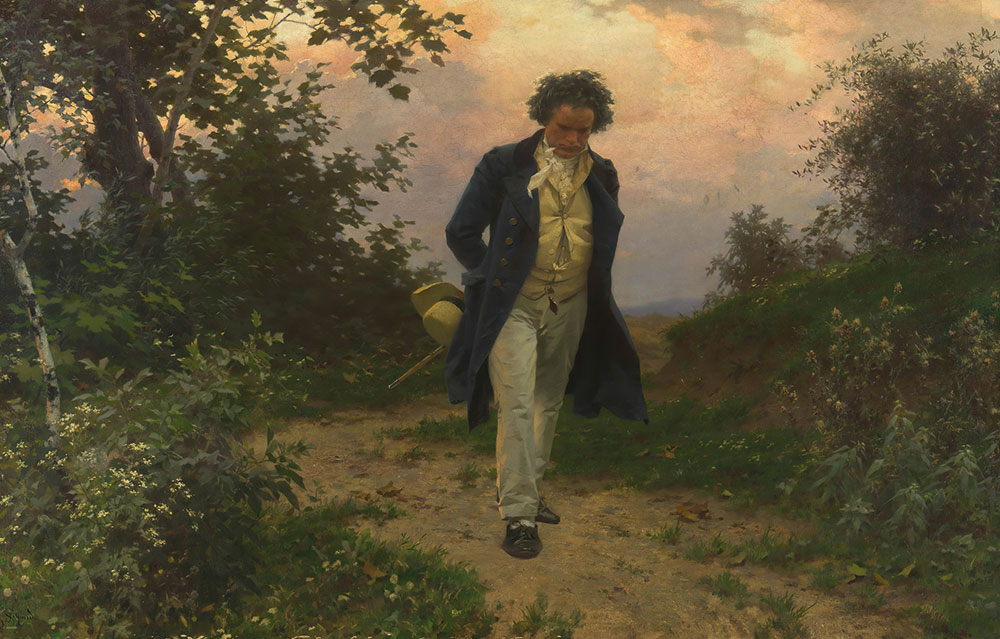 Beethoven’s Walk in Nature (1901), oil painting by Julius Schmidt © Artvee
Freelance Acumen and the Expansion of Inner Expression
Beethoven’s career trajectory closely resembles the realities faced by freelance musicians today. He demonstrated notable business acumen in publishing contracts, often offering the same work to multiple publishers in competitive fashion to secure better terms. In some cases, following strategies also used by Joseph Haydn, he divided publishing rights by country and contracted with different publishers to maximize revenue. At a time when such practices were rare, Beethoven established strong negotiating power and systematically built up his artistic assets. He secured a position as a modern, autonomous artist who could control ownership, contracts, and conditions independently.
He directly managed the form, scale, and aesthetic direction of his works, positioning himself not as a supplier responding to market demands, but as a creator who generated value on his own terms. This was the first clear example of musical pride reframed as a strategic choice. Beethoven demonstrated, through practice, how essential it is for creators to shape their own brand positioning and control both the quality and direction of their content.
Another major innovation lay in his integration of personal emotion and lived experience into his music, redefining the meaning of art itself. He embedded a worldview into his compositions, articulated his identity as an artist, and conveyed messages through sound. In doing so, he opened a new expressive domain centered on the inner self. This approach directly parallels contemporary creative strategies in which artists build narrative-driven brand identities rooted in personal experience.
Creative Autonomy and the Intellectual History of the 19th Century
As 20th-century musicologist Carl Dahlhaus observed, “Beethoven’s history is the intellectual history of the 19th century.” Beethoven was not only a central figure in music but also a formative force in shaping the cultural and intellectual currents of his time. With exceptional insight into emerging change, he combined artistic vision, technological innovation, and business sense into a coherent strategy of creative autonomy. The freelance model he established became a benchmark for later generations and remains, even today, a foundational reference point for creators seeking direction as independent artists.