
in Story & News
The Sustainable Growth Mechanism Through the Lens of Sports Medicine
Quality of Recovery Dictates Performance
Organizational growth is not achieved by running harder or faster. Just as muscles improve during the recovery process, the key driver of sustainable organizational growth also lies in the quality of recovery. Ultimately, growth begins with well managed recovery.
By Suk-yool Jung, Professor, Department of Sports Medicine, CHA University
Redesign After Injury
Reading Pain as a Signal
In November 2022, Heung-min Son suffered a serious injury during a match against Marseille, sustaining multiple fractures to the orbital bone after a collision with an opposing player. Surgery was unavoidable, making his participation in the World Cup uncertain, with the competition dates approaching fast. In most cases, athletes would prioritize recovery and wait for the next opportunity. Son, however, began rehabilitation immediately after surgery and joined the national team under the condition of wearing a protective facial mask.
What truly distinguished his competitiveness was not sheer grit or playing through pain, but his decision to redefine his post-injury condition as his baseline. Rather than forcing himself to perform at pre-injury levels, he adjusted his patterns of movement and redesigned his match rhythm. Even as he faced a series of setbacks, including hamstring injuries, Son interpreted pain as a clear signal to reassess his limits. Son actively recorded and analyzed these signals, a choice that ultimately enabled an early return to play.
Corporate challenges such as declining performance, burnout, and strategic failure are no different. They signal that an organization can no longer grow through past methods. When risks are recognized and workloads, staffing structures, and decision-making processes are reconfigured, a crisis becomes a turning point for the next stage. Leaders need the ability to read crises not as an end, but as the beginning of a new design.
The Formula of Super Compensation
How Recovery Drives Upward Change
High-intensity exercise or unfamiliar movements cause microscopic damage to muscle fibers, tendons, and fascia. This damage triggers an inflammatory response, drawing white blood cells to the affected area. These cells send regeneration signals, initiating the recovery process.
During this phase, muscle fibers are not only repaired, but protein synthesis is accelerated to rebuild the muscles to become thicker and stronger. This goes beyond a simple return to the original state, rather, it upgrades the structure to better withstand the next stimulus. In sports medicine, this process is known as supercompensation.
While the quality and speed of recovery vary depending on rest, nutrition, sleep, and stress management, muscle growth is ultimately determined not by the sheer volume of training, but by optimized post-training recovery regimes. In other words, performance is shaped by the quality of recovery. This principle extends beyond athletes, offering a framework for designing sustainable performance systems within organizations as well.
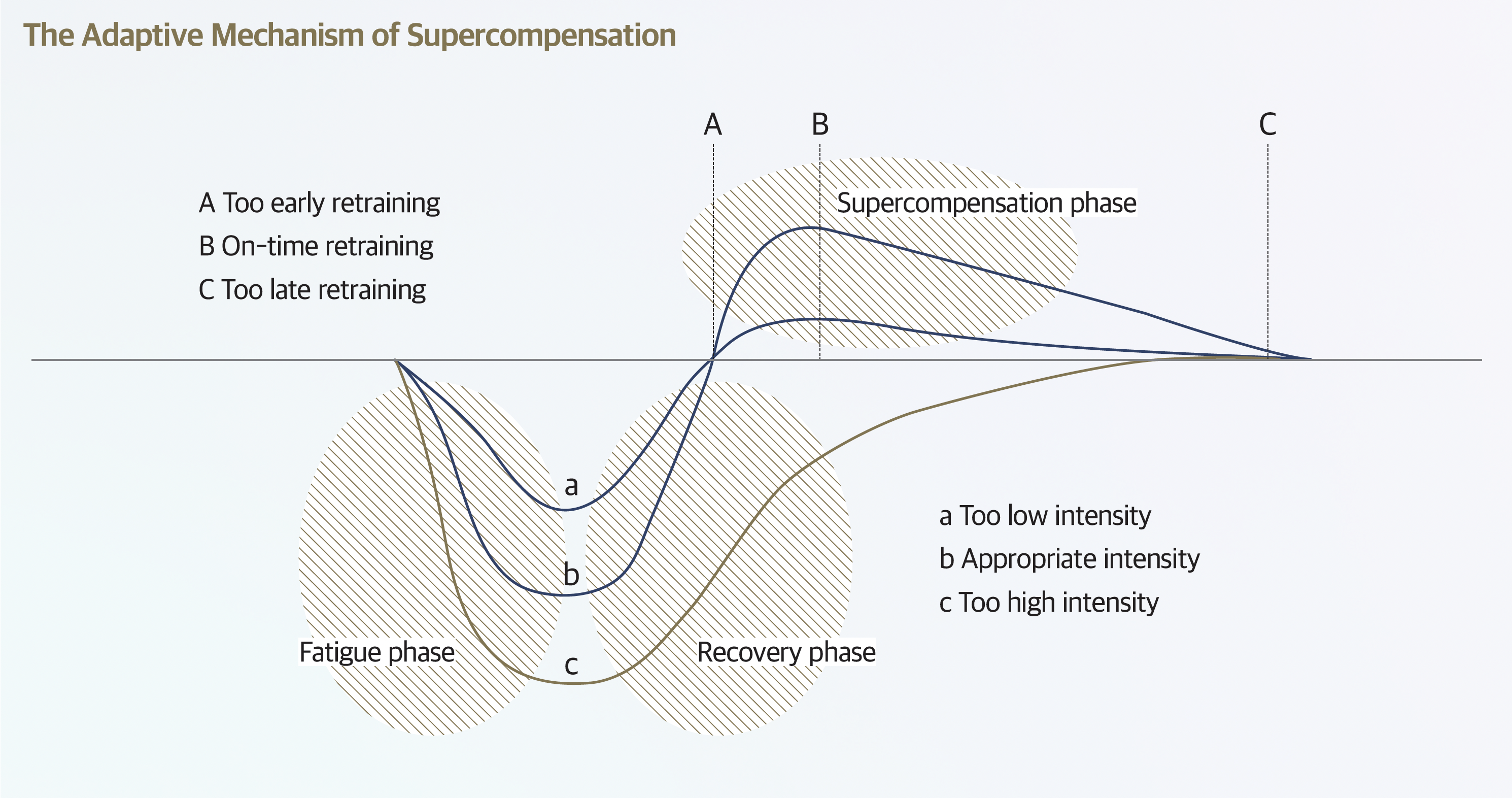
Balancing the Overload–Recovery Cycle
Leadership That Designs Recovery Systems
The key to making the body stronger lies in design. An athlete’s career is shaped by combining and timing elements such as training, nutrition, sleep, mental conditioning, movement analysis, injury prevention, and performance enhancement. High-intensity training alone has its limitations. Sustaining high performance over the long term requires a simultaneous improvement in the quality of recovery. Integrating all of these elements into a coherent whole constitutes a system.
Recovery is already embedded as a core component of the EXOS training program, which has supported the German national football team and Olympic medalists.
The program emphasizes that peak performance can only be sustained when appropriate recovery accompanies training.
Global companies are likewise designing rhythms of focus and recovery by incorporating lounges, fitness areas, and rest facilities into office spaces. Project cycles, meeting schedules, and evaluation systems can also be redesigned from a recovery perspective. After a period of high-intensity projects, organizations can intentionally create phases dedicated to recalibration, training, and feedback, allowing teams to regain balance before the next push.
Ultimately, leadership is not about pressing for results. It is the ability to design conditions in which people and organizations can recover and rise again.
The Threshold Principle
The Line Between Growth and Breakdown
Is muscle soreness the day after exercise always a negative signal? More often than not, it is not. Pain that appears and fades within a predictable range is evidence of growth, a natural outcome of muscle fiber reconstruction following microscopic damage.
However, if pain persists despite rest or is accompanied by functional decline, it should be interpreted as a warning sign of injury. In sports medicine, this distinction is defined by the concept of a threshold. Once the threshold is exceeded, recovery becomes difficult and damage accumulates. Athletes and coaching staff often push limits in pursuit of better records, but because thresholds vary by individual, careful and continuous monitoring is essential.
Organizational growth follows the same principle. Ambitious goals and new roles can feel burdensome at times, but when teams collaborate to find solutions and accumulate experiences of achievement, the resulting healthy tension functions as a ‘growth pain’ that raises collective capability.
By contrast, prolonged tension without recovery resembles the kind of pain that goes with collapse. As organizations drive toward goals near their limits, invisible fatigue and damage can quietly accumulate.
Leaders must be able to distinguish sensitively between growth and the onset of breakdown. Only leaders with a clear sense of thresholds can sustain a long and stable growth curve for their organizations.
Recovery as a Competitive Advantage
The Decisive Factor in Sustainable Performance
We often describe a strong team as one that endures to the end. From a sports medicine perspective, however, true strength lies not in a team that never breaks down, but in one that recovers more quickly after breaking down.
The same applies to organizations. Crises, failures, and burnout are not exceptions. They are inevitable forms of micro-damage encountered along the path of growth. What sets organizations apart is how quickly and how healthily these disruptions are converted into recovery processes. Over time, the performance gap between organizations that leave recovery to chance and those that deliberately design it becomes unmistakable.
The question to ask is not how hard we have worked, but how well we are recovering. The sustainability of performance depends on how effectively recovery systems function. Recovery is no longer optional; it is a core strategy.