
2026 Economic and Business Environment Outlook
Korea's Opportunities and Strategies
Amid Trade Paradigm Shifts
Hosuk Lee,
Director of the European Centre for International Political Economy (ECIPE)
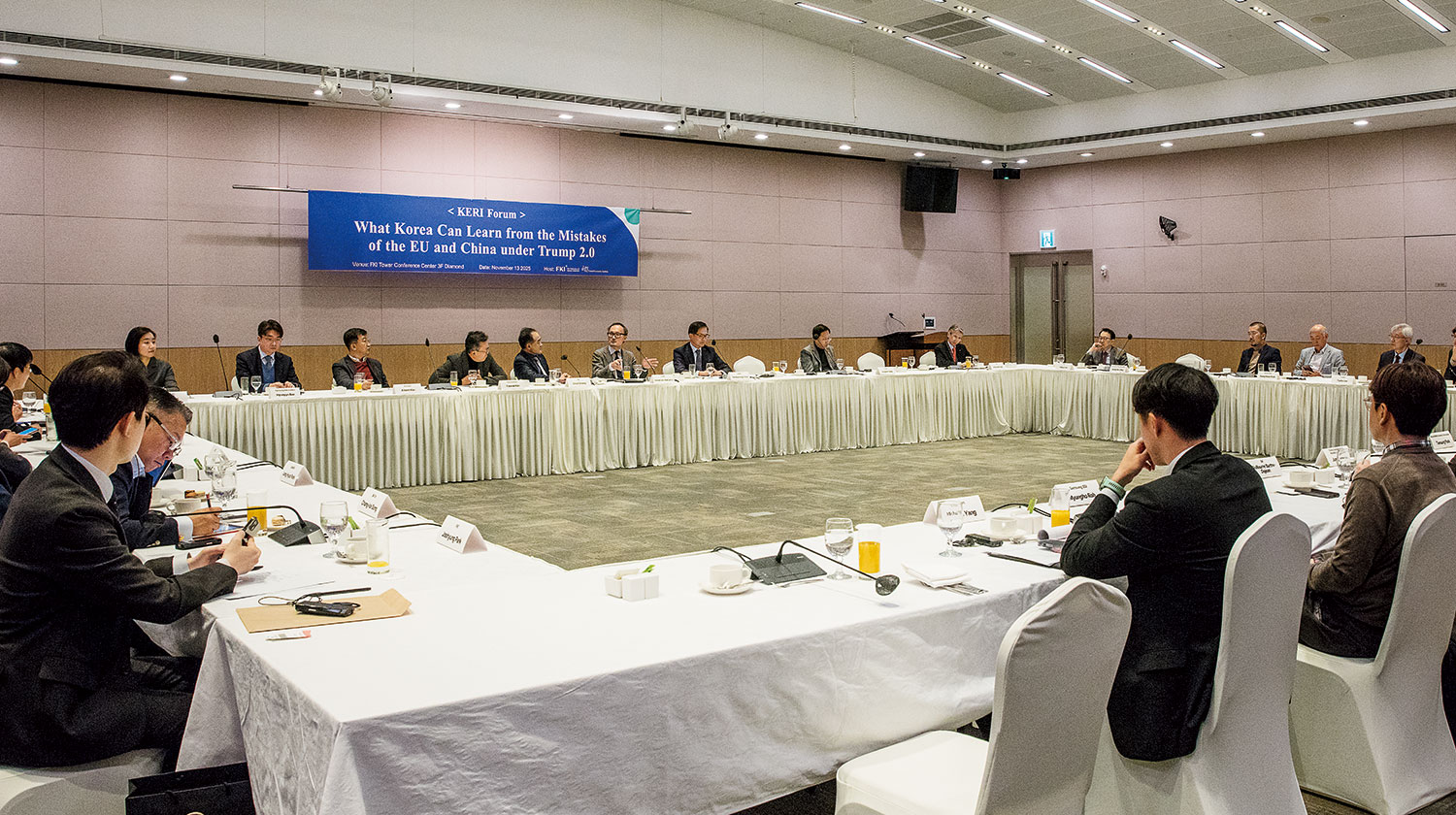
Countries are exploring new trade system strategies as we look ahead to structural transformations in the global trade landscape in 2026. The main session of the KERI Forum included discussions on strategic response measures by Europe and China amid shifts toward a U.S.-centered global trade system, and on lessons for Korea. In the ensuing interview, Director of European Centre for International Political Economy (ECIPE) Hosuk Lee shared detailed insights on risk and opportunities for Korean corporations amid systemic realignments driven by the U.S. and China.
By Na-yeon Kim
Photo Credit Kyu-chul Shin
Q.During the forum’s main session, you covered the newly emerging U.S.-centered trade order and the E.U.’s and Chinese response measures to these developments. Could you give us an overview of the current international landscape, from your perspective as a trade expert?
The Trump administration is not just blindly imposing tariffs on the world; it is doing so to correct its unsustainable macroeconomic imbalances—even if it must destroy the rule-based system in the process. Meanwhile, China is seeking alternative markets to address overcapacity while enhancing its capabilities, as it is no longer possible to isolate the country the way Russia was economically. In short, the rules-based order has been replaced by coercion driven by hard economic nationalism.
Europe and Korea are both at the losing end of this new trade order. Some voices in the E.U. argued for strong retaliation or offered a reciprocal FTA with the U.S. to avoid the Liberation Day tariffs. However, such ideas have backfired, as the U.S. only threatened to withdraw from NATO, and an FTA with Europe would further worsen America’s trade balance.
Instead, Europe had no choice but to accept U.S tariffs and pledged to invest in the U.S. and raise defense spending, which is an implicit promise to purchase more U.S. weaponry. The outcome was acceptable, as the E.U. would have done both anyway, given the current returns in the U.S. market and the threat from Russia.
Despite claims to the contrary, Europe is actually increasing its dependence on China. If the U.S. market is not opening up there is only one market large enough to absorb E.U. exports—and other countries seem to think alike. European auto and high-end industries are rapidly transitioning to the outsourcing model of the likes of Apple, where products are designed in the West and manufactured in China, and its member states are competing with each other for inward Chinese investments in electric vehicles and battery technology.
This crisis is not lost on European leaders. Any change to the status quo furthers Europe’s decline. They have no choice but to erect import barriers by weaponizing their security and sustainability rules, not least to offset their limited geopolitical leverage. China, of course, is sensing the E.U.’s decline and seeking to divide the G7. Beijing also accuses Europe of overproduction and protectionism, demanding reciprocity in areas such as export controls, investments, and market access.
Q.Thank you for describing the E.U.’s course of action. Meanwhile, Korea still needs to identify opportunities. In your opinion, what are the realities that Korean companies are facing at the moment?
My headline message is to “beware of unfounded optimism.” There will be no return to the past. The shifts are not a product of the Trump presidency but long-overdue changes driven by irreversible shifts in the economic balance of power.
Compared to the first Trump administration, there will also be fewer Korean opportunities, from trade diversion replacing Chinese exports in the U.S., India, or Europe. These markets are already saturated by local conglomerates that are well-protected by their regulatory systems. Nearly half of global growth is generated by two markets—China and the U.S.—and direct investments, rather than exporting, into these economies will be inevitable.
As for trade policy, many countries are desperately negotiating bilateral FTAs to ‘legalize’ their relationships with third countries. However, the new trade barriers are justified by national security exceptions, which FTAs cannot address. Many of these negotiations are about optics, and one should be wary of overpaying for them.
Q.The E.U. also cites ‘security’ as a reason for raising barriers, and ‘De-risking’ and ‘Toolbox’ are often referred to in this context. Could you describe for us what these refer to in detail?
‘De-risking’ is distinct from the concept of ‘decoupling,’ and severing ties with China. Instead, de-risking means mitigating only those risks that are unacceptable, as complete bifurcation is not only unrealistic due to its high cost, but also unnecessary. A cynic might say de-risking simply means whatever we are already doing.
De-risking—with strategic autonomy—has become a central tenet of the E.U.’s economic security doctrine. But the subject is particularly sensitive for the E.U., as the union is not supposed to have a role in security. Nonetheless, the member countries have agreed to update foreign investment screening and export controls. It has also developed ‘toolboxes’, which are joint risk assessments and guidelines on risks from Chinese and other foreign participation in 5G networks and EVs, and which are now being expanded to all ICT supply chains.
Our cloud regulations are currently undergoing reforms to reduce U.S. dependency, similar to existing regulations such as the Digital Services Act (DSA), the Digital Markets Act, and the AI Act, which were enacted for that purpose. But in fact, these regulations are as much retaliatory leverage in negotiations with the U.S. as they are tools for strategic autonomy.
Q.Regarding China’s overproduction and the responses from the U.S. and Europe, what risk and opportunities exist for Korean companies?
China’s overproduction issue is particularly pronounced in steel and autos. In just 15 years, China has doubled global production in these sectors, on top of existing, unreduced worldwide capacity, resulting in a structural excess of supply relative to demand. Ceasing to trade with China is inadequate—the problems permeate through distorted global prices, and the only choice is to delink local prices from international markets. Whether it is U.S. tariffs, the recent E.U. carbon taxes, or tariff-rate quotas, they all share that purpose.
Third countries like Korea face a two-fold challenge: artificially depressed prices from Chinese state-owned mills on the one hand, and rising import tariffs and regulatory compliance costs from the U.S. and the E.U. on the other. On these occasions, Korea inevitably becomes collateral damage.
In contrast, the 5G restrictions that gradually halved Huawei’s market share in Europe paved the way for Korea’s entry into that market. Similarly, Europe’s anti-subsidy tariffs on Chinese-made EVs help sustain Korea’s position in lower-market segments.
Q.Let’s move on to the steel industry. Subsequent to the U.S., the E.U. is moving toward strengthening safeguards (emergency import safeguard measures). Do you think that Korea will be able to gain an exception, given the Korea-E.U. FTA?
To be candid, there will be no exceptions for Korea or any FTA partner. Unlike the U.S, which has no qualms about naming specific countries in its laws, such a drafting technique would be unnatural for E.U. treaties.
We must understand why the E.U. must transition to quota restrictions rather than imposing simple tariffs. Chinese state-owned enterprises are incentivized to maximize output or employment rather than profits, and are willing to sell at a loss if necessary. This means duties are not an effective deterrent.
However, Korea’s counterargument is not without merit. Korea and other FTA signatories have already paid for their market access—and if the E.U. fails to adequately compensate Korea for losing its quota-free preferential treatment, the credibility and value of E.U. FTAs are undermined before the eyes of all its current negotiation counterparts, including some important partners like Mercosur, India, and Indonesia.
Korea is also well-placed to coordinate its compensation negotiations with other signatories, including Japan, Canada, New Zealand, Chile, and Vietnam. Many of them also have similar concerns about their privileges under E.U. FTAs being nullified by deforestation rules. Not even the E.U. can control the narrative against such a group of like-minded partners.
Q. There are stronger regulations in new & emerging industries, such as the data and cloud industries. What are some viable response measures?
The upcoming package on telecom and network regulations is likely to achieve several political objectives. First, E.U. regulations are evolving toward a level playing field between cloud and traditional telecommunication networks, which, for all intents and purposes, are converging as technologies, yet are regulated differently.
Second, reform of the Cybersecurity Act aims to strengthen data sovereignty requirements and reinforce the use of European cloud services and hardware. National regulatory agencies will also be supplanted by centralized E.U. powers to harmonize these requirements to ensure uniform outcomes across the union.
Third, the renewed role of governments is also a factor for consideration. For example, Nokia, a private Finnish company, sold its submarine cable business unit to the Government of France, which operates a formidable nuclear-capable navy that can protect subsea cables that it makes against threats from Russian or Chinese military vessels. The nationality of a company and the deterrence capabilities of its government have become a source of competitiveness.
Q.As we look ahead to 2026, what message would you like to share with Korean leaders?
In this era of economic security, governments and corporations no longer operate in silos. Geopolitical risk imposes costs or uncertainties that individual corporations cannot shoulder—and a government’s ability to mitigate or underwrite those risks has come to determine investment decisions.
Businesses and governments are also developing joint capabilities—not just in R&D and financing, but also in unconventional domains such as coalition-building, supply-chain security, or intelligence gathering to predict the behavior of foreign powers. The experiences of the U.S., France, Germany, or Japan show how consultative bodies, such as FKI, play a pivotal role in coordinating these horizontal efforts in countries where agile economic statecraft has become essential.