Special Interview
Never Standing Still,
NAVER on the Move
Soo-yeon Choi, CEO of NAVER
Never Standing Still,
NAVER on the Move
Soo-yeon Choi, CEO of NAVER

Starting as a search engine service, NAVER continues to evolve by expanding its businesses into commerce, content, fintech, cloud services, and robotics. Although the company’s business scope has widened steadily, its direction has always been clear: using technology to serve as a bridge, connecting infinite possibilities in the world.
As AI reshuffles the industrial landscape NAVER is charting a new course, evolving from a technology company into a platform ecosystem leader. At the beginning of 2026, a year of new challenges and opportunities, we spoke with CEO Soo-yeon Choi about NAVER’s spirit of taking on challenges, the company’s strategy for navigating the AI- and data-driven era, and the significance of “Tech for People”.
By Na-yeon Kim
Photo Credit NAVER
Q. The industrial and technological landscape is changing rapidly. You have shaped NAVER’s key business areas, including search, content, commerce, fintech, and AI. What is your mindset as we enter into 2026?
A. It is a time when key industrial buzzwords change every quarter. Even so, AI will remain the central industrial theme this year, continuing on from last year. Alongside AI, stablecoins and other digital assets as well as Web 3.0 and other new web operating models are expected to emerge as key technologies. AI is already beginning to reshape businesses, and the convergence of digital assets and Web 3.0 will create new synergies and accelerate change. So, 2026 is, for NAVER, both a year of taking on challenges and clearly outlining our distinct competitive edge.
No matter what changes may arise, NAVER endeavors to remain true to the company’s core essence-connecting people and society through technology. Rather than being swept along by market trends, we are entering 2026 with a reflective mindset on the values we seek to create.
Q. From a small startup to a global platform, what would you identify as the most significant turning point in the history of NAVER?
A. Various words can describe NAVER, but a keyword that is central to NAVER’s identity is “global”. From the very beginning, NAVER aimed its sights beyond the local market and built technologies and services fit for the global stage.
Given this mission to go global, NAVER focused intensely on services, which entailed paying close attention to users. This approach enabled NAVER to develop unique solutions during the transition from PC to mobile, keeping NAVER competing with global tech leaders while continuing to grow. Through this journey, we recognized that being a global player involves more than simply expanding overseas; rather, it is a process of understanding and redefining technology applications in various local user, cultural, and market contexts.
These accumulated experiences and insights led to the success of LINE and later to the expansion of global services such as WEBTOON, SNOW, BAND, ZEPETO, and LINE WORKS. The addition of overseas companies such as Poshmark and Wallapop was also meaningful milestones that broadened NAVER’s playing field. NAVER’s growth was enabled by taking on challenges that were oriented toward the global stage.
Q. Which business areas and strategies are you currently focusing on to advance as a global company?
A. I believe that the aggregation of the local forms the global. There are areas where standardized global models are effective, but there are also domains that require services tailored to local conditions. NAVER does not subscribe to a single standard, but rather adopts the latter, locally-focused strategy.
For example, in the field of content, NAVER owns WEBTOON intellectual property across North America, Japan, and Europe. Japan is our main focus for deploying workplace collaboration tools, while we focus on AI and digital twin1 technologies primarily in Middle Eastern markets. By respecting the diversity of each market and connecting them through technology, NAVER continues to grow as a global company.
- 1.Digital twin: A technology that reproduces real world objects or systems in a virtual space, enabling real time monitoring as well as simulation, prediction, and optimization
Q. Since assuming the CEO role, what change do you consider most meaningful from a management perspective?
A. A leader’s role extends beyond managing short term performance, including building the foundation for future growth. As CEO, I have focused on building organizational structure and working methods fit for the AI-driven era.
During the mobile era, NAVER’s growth stemmed from a Company-in-Company (CIC) organizational structure that enabled independent operations and rapid decision making. However, organizational changes and a new type of leadership have become essential for sustainable growth with the paradigm shift driven by AI.
To use limited resources more efficiently than global Big Tech leaders, we built an organizational system that focuses on specialization by separating business and product functions and developing shared platforms. We also introduced AI across all technology fields and created an environment that enables collaboration without physical constraints through connected work systems. As a result, the quality of our core services such as search, commerce, content, and advertising improved, while new service experiments like CHZZK, Open Talk, and Clip could move forward quickly.
Revenue grew from KRW 8.22 trillion in 2022 to KRW 10.7 trillion in 2024, and operating profit increased from approximately KRW 1.3 trillion to KRW 1.97 trillion. However, I believe the most significant change was the organizational redesign centered around AI.
 CEO Soo-yeon Choi introducing “Agent N” at the DAN25 Conference
“Above all, people matter most for future growth.
In an internet-based industry without production facilities, competitiveness ultimately lies in talent.”
Q. Which emerging industry is NAVER paying close attention to, and are there additional plans for future growth?
A. Without question, AI is the most prominent theme across industries today. Most companies are pursuing innovation by leveraging AI to develop new services. NAVER is no exception. We place AI at the center of our strategy, strengthening the competitiveness of our proprietary models while advancing AI agents2 as a core initiative.
Given the speed of change in the industrial environment, new keywords may emerge. However, the core focus is always technological, regardless of the shifting environment. So, NAVER continues to invest in and internalize technology, rather than focus on specific industries.
We are consistently expanding R&D spending to enhance AI model competitiveness and move quickly in near future technologies such as digital twins and robotics. These technological capabilities will form the foundation for NAVER’s next wave of innovation.
NAVER also aims to support the next stage of growth for Korea’s key manufacturing industries, including semiconductors, automobiles, shipbuilding, and defense, through AI-driven innovation. By leading the AI transition across Korean industries, NAVER seeks to contribute to Korea’s advancement as one of the world’s top three AI nations.
Above all, people matter most for future growth. In an internet-based industry without production facilities, competitiveness ultimately lies in talent. Through D2SF/NAVER Ventures3, we identify promising startups and build an ecosystem for mutual growth. These efforts will drive new growth, connecting technology, companies, and people at NAVER.
- 2.AI agent: An AI based software system that understands user goals or commands and independently makes decisions and takes actions to perform tasks.
- 3.D2SF/NAVER Ventures: NAVER's technology startup accelerator and corporate venture capital organization that identifies, invests in, and supports early-stage startups across AI, robotics, mobility, spatial computing, healthcare, and other technology driven fields.
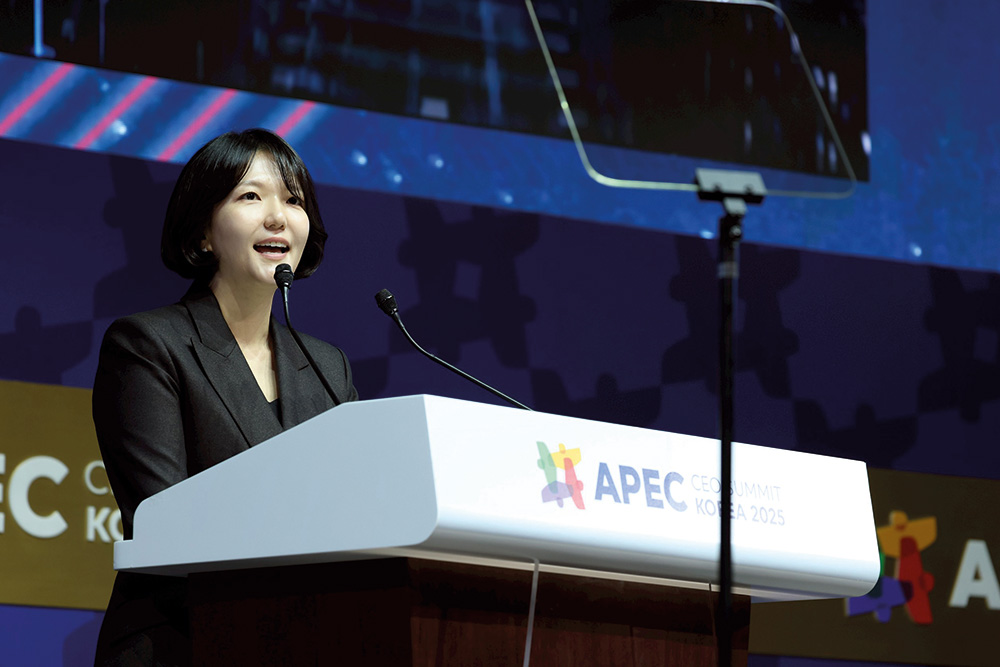 CEO Soo-yeon Choi delivering a keynote speech at the 2025 APEC CEO Summit
Q. At the center of NAVER’s AI strategy is HyperCLOVA X. What does this model represent for NAVER’s future?
A. NAVER aims to apply generative AI across all services over the long term, building an integrated agent that can better connect users, creators, and sellers within the digital ecosystem. The most critical factor in this process is technological internalization.
NAVER has consistently developed essential technologies through internal research rather than relying on external sources. HyperCLOVA X is the embodiment of that philosophy. The same applies to other core technologies such as NAVER’s proprietary search engine and NAVER Labs’ spatial intelligence.
Built on the Korean language and cultural context, HyperCLOVA X aligns with the concept of sovereign AI.4 I believe that technology confined to a single language or culture cannot achieve sustainable growth. Therefore, we are expanding our accrued experiences in development to Southeast Asia, the Middle East, and Japan, to cooperate in building local AI ecosystems.
- 4.Sovereign AI: A technological self-reliance in which a country independently develops, manages, and operates AI technologies.
Q. What impact do you expect from the open-source model HyperCLOVA X SEED?
A. Many domestic open-source models have previously been limited to research use. HyperCLOVA X SEED was designed to allow commercial applications as well. AI develops far more rapidly when shared than when monopolized. Small and medium-sized enterprises (SMEs) that hesitate to adopt AI due to licensing or cost concerns may freely experiment with HyperCLOVA X SEED and create new services. We hope this will further energize Korea’s AI ecosystem and expand the influence of Korean AI technology within the global open-source community.
Q. How does On-Service AI differ from the conventional platform plus AI approach?
A. NAVER has an inclusive AI philosophy, which enables all participants-including users, sellers, advertizers, and partners-in the platform ecosystem to benefit from AI. NAVER plans to embed AI across all services, although many companies approach AI as an additional feature. NAVER instead views AI as a foundational structure of services, functioning as a medium that connects every participant in the platform ecosystem.
For example, AI Briefing presents concise key information for search queries while clearly identifying content creators and sources. This approach goes beyond summarization by protecting the creative ecosystem and enhancing information trustworthiness.
In NAVER Plus Store, AI analyzes user preferences and purchase history to deliver highly personalized shopping experiences. In NAVER Map, spatial intelligence technology connects physical and digital with precision.
Q. NAVER has supported creators and SMEs through Project Flower. Recently, the Impact Committee was launched, signalling a social contribution strategy shift. What prompted this change?
A. NAVER’s ecosystem is built together with countless creators, SMEs, and partners. The philosophy that their growth is directly connected with NAVER’s growth remains unchanged.
In an era driven by technology, we must place more emphasis on inclusiveness. As the AI transition accelerates, creators and SMEs must be supported so they can adopt new technologies without excessive burden. This is why we shifted away from one-time donations or sponsorships and toward an impact-centered strategy that aims to create a virtual cycle of sustainable growth. We established a KRW 1 trillion impact fund to invest in creator education, AI literacy expansion, and improved access to technology in local communities, thereby broadening and deepening social impact.
At NAVER, fulfilling social responsibility through technology is the impact we strive to achieve.
Q. How have your diverse academic and professional experiences, including engineering at Seoul National University, marketing at NHN, and an LLM at Harvard Law School, influenced your management approach?
A. My marketing experience taught me how to listen to users and the market. Working as a lawyer helped me understand corporate structures, risk, and regulation. At Harvard Law School, I gained first-hand exposure to diverse overseas markets and legal systems, and it contributes greatly to global management strategy.
These experiences guide my decision making, helping me prioritize. I favor long term trust over short term gains, and always consider the social impact of technology whilst striving to integrate a wide variety of perspectives across the organization. I believe my diverse set of experiences helped form a solid foundation for putting NAVER’s user-centered philosophy into practice.
Q. What aspect of entrepreneurial spirit has been most critical to NAVER’s growth, and what core value would you like to leave behind?
A. I would say the spirit of taking on challenges. NAVER’s history is a continuous story of meeting and overcoming challenges. When we first entered the search market, a powerful global competitor, Yahoo was already the dominant player in Korea. We chose to compete head-on by introducing innovative, user-centered search services, and ultimately changed the paradigm of Korea’s internet market.
At every technological transition, NAVER has sought its own solutions. The shift to mobile, global expansion, and the current AI transition were all challenges that fueled NAVER’s growth.
Never giving up, and continuously finding one’s own solutions to move forward. That is the role that has been upheld by NAVER and its leadership. I hope to follow suit, embedding the spirit of taking on challenges even more deeply within NAVER.